

Back in 2010, a chorus of government officials and industry voices assured the world that the Keystone XL pipeline was on the verge of being built. Then Secretary of State Hilary Clinton called the project a “done deal.” Now, nearly five years later, stacks of pipeline along the route are gathering dust and costing TransCanada millions of dollars.
In a stroke of deja vu TransCanada is making similar claims with their new Energy East proposal to ship 1.1 million barrels per day of tar sands from Alberta to the Atlantic Ocean. Almost a direct re-enactment of their Keystone bluster, a TransCanada executive was recently cited as calling Energy East, “virtually a done deal.”
The problem with their posturing is that Energy East is far from a done deal. In fact, the project has yet to be formally applied for and is already facing rising opposition. Just this month, TransCanada have received an injunction to build a necessary port facility in Cacouna, QC, and is facing almost nightly protests at it’s Open House events.
Proponents of Energy East, from Stephen Harper to the Irving family in New Brunswick have called the Energy East project a “nation builder.” The truth is, they may be right, but not in the way they’re hoping. This proposed pipeline follows close to the TransCanada highway, cutting across both some of the most populated areas in the country and some of the most pristine wilderness. It cuts across hundreds of waterways, would impact over 150 First Nations communities, would impact hundreds more cities and towns and would have the same climate impact as adding over 7 million cars to Canada’s roads. It’s no surprise then that this “nation builder” is in fact waking people up across Canada to resist this project.
A community by community insurrection
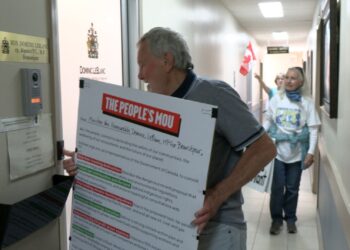
Earlier this summer, TransCanada rolled into the Ontario town of Kenora for another Open House event. It was the start of their second round of these events, the first round harried by pranksters who flipped the open houses around by showing up in mock TransCanada outfits to deliver the truth about Energy East. The event was greeted by protests both outside and in, where community members and members of local First Nations raising concerns and pledging to oppose the project.
Since that Open House, TransCanada has faced demonstrations and disruption regularly at these events. This month in Quebec, they are facing frustrated community members mobilizing nearly every night, already having confronted the company in Lachute, Lanoraie, Saint-Sulpice, Sainte-Ann-des-Plaines, and more, with demonstrations expected at nearly every stop in the province.
These actions are only one outlet for the rising local resistance. A steady stream of community groups have been emerging all along the pipeline route; Alternatives to Energy East Kenora, Stop Energy East Halifax, the Coule Pas Chez Nous network in Quebec, No Energy East Aki in Winnipeg, the consistently building local organizing of Ecology Ottawa to keep tar sands out of the Rideau River, and many more.
On top of this, the mayors in Thunder Bay and North Bay have both voiced opposition to the project, along with twenty municipalities across Quebec that have passed resolutions against Energy East — something with serious power after a municipal ordinance in Portland, Maine closed one of the United States’ major ports to tar sands exports.
Speaking of ports, TransCanada is already facing construction delays with their new port facilities in Cacouna, Quebec. Local opposition and a global call to protect Beluga whale habitat in the Gulf of the Saint Lawrence have led to an injunction on undersea drilling to construct a tar sands export facility on the Energy East line. The injunction is in place until October 15th, but a major protest planned this weekend is expected to draw hundreds to echo concerns about the risk of Energy East in the region.
The climate problem
Of course, whales and spills are only a fraction of the threat posed by Energy East. Left out of TransCanada’s talking points for the project is the fact that this pipeline would facilitate a carbon footprint the same as adding over 7 million cars to Canada’s roads. With a bigger climate impact than the entire province of Nova Scotia, Energy East represents a greater climate threat than even the Keystone XL project, a project which US President Barak Obama has delayed largely because of the potential climate impacts of the pipeline.
Despite this massive climate threat, the Canadian government has excluded any consideration of climate change from the National Energy Board review of Energy East. In other words, at a time when the United States has created a “climate test” on Keystone XL, this pipeline will not receive a single consideration on it’s impact on climate change and tar sands expansion.
The good news is that already nearly 50,000 people all across Canada have submitted messages to the National Energy Board demanding that climate change be included in the review of the Energy East project. At the same time, the NEB review of the Kinder Morgan pipeline has been delayed in part because of a slew of lawsuits for the Board’s refusal to include climate change in the review of that pipeline — along with another list of lawsuits challenging their handling of consultation with First Nations communities. In fact, Liberal leader Justin Trudeau has already been challenged at fundraisers in Ontario and Nova Scotia for his support of Energy East being out of step with a strong climate plan.
While pipeline proponents may be applauding this project as nearing the finish line, the reality is that it has barely event started, and already is facing unprecedented opposition across Canada. From community opposition to climate change to Indigenous rights, TransCanada is facing a mounting wall of opposition along all 4,400 km of this pipeline route and we’re just getting started.
Cameron Fenton is a campaigner with 350.org.
First published by Huffington Post.





![Proposal for gas-fired power plant in Tantramar lacks transparency, says veteran journalist [video]](https://nbmediacoop.org/wp-content/uploads/2025/09/Screenshot-2025-09-04-at-17.47.39-120x86.jpg)
