What is the story or action needed to ignite the movement to turn our selves, our communities, our province and our country to using renewable energy in place of fossil fuels, including shale gas? Why is our province now funding a legal challenge fighting the federal carbon tax? When is our current dependent relationship going to end where our mother (the earth) becomes unable to feed us, provide clean drinking water, clean air, energy, and everything needed to survive? Or put another way, when is the earth going to rise up against the human race and tell us that enough is enough?
These questions along with many others were discussed at the information session about carbon pricing on Dec. 3 in the Charlotte Street Arts Centre in Fredericton. Speaker Dr. Louise Comeau reminded participants that the earth is already telling us it has had enough but we continue to struggle to listen to her: “When your house is destroyed by flooding or a tree is blown onto it, that is when some people begin to pay attention to what is happening.”
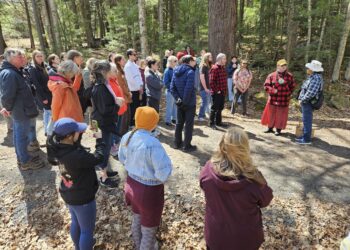
The Fredericton Green Party Association hosted the panel discussion to share important information with community members and provide an opportunity for community discussion. More than 100 people came to learn about carbon pricing, a difficult topic that will affect everyone in New Brunswick and across Canada in the near future. Some participants travelled from out-of-town to attend this event. Tamara White, Green Party candidate for Fredericton North in the recent election, chaired the session.
Comeau, Director of the Environment and Sustainable Development Research Centre at the University of New Brunswick (UNB), spoke first. Comeau’s research on climate change adaptation shows we need to speak about climate change to increase acceptance of carbon pricing and encourage behaviour change. The impacts of climate change on mental health is directly linked to catastrophic events such as floods, fires, earthquakes, etc. caused by human actions towards the earth.
Carbon pricing needs to be fair, honest and it needs to work. People do not want to pay for something that will not work. The recent “yellow vest” protests in France can be interpreted as a result of the imposition of another tax that many people feel is unfairly implemented.
Some of the main actions individuals can do to reduce their carbon footprint are to reduce flying, carefully consider their travel options, invest in renewables and talk about how our politicians and their decisions are impacting our communities and our future. For industry, the biggest emitter by far is the oil refinery in Saint John.
The focus now needs to be converting as much as possible to electricity. Talking about water and food security is one way to mobilize people to take climate action. Everyone cares about water quality and supplies are affected by corporate extraction industries and climate change in different ways.
Dr. Anthony Myatt, professor of economics at UNB and the author of several books including, The Economics Anit-Textbook: A Critical Thinker’s Guide to Microeconomics, was the second panel member to speak. Myatt said that if you believe in the efficiency of markets then carbon pricing is a good way to ration the scarce resource of carbon emissions (given the existence of a small ‘carbon budget’). But the proposed carbon taxes are very tiny and too small to make a real difference. The three options he challenged everyone to consider are (1) carbon taxes, (2) cap and trade, and (3) regulation. Myatt said that while the efficient market options are carbon taxes, and cap and trade, everyone wants regulations until these laws really affect them.
He explained that the major complication with any attempt to regulate carbon emissions is the fact that we trade with the rest of the world. We don’t want to make our industries uncompetitive, or have them relocate, or close down. It is this factor that complicates the approach to having big industry pay the lion’s share of pollution costs.
Myatt showed a chart with the different provincial contributions and rebates to households with the new federal government carbon tax. Most New Brunswick households will have a net gain and will be receiving a rebate in the short-term.
In response to a question from the audience, Myatt noted that the oil industry in Alberta really only makes up about three per cent of the national economy. So the narratives and marketing folks in the oil industry have done a great job of making everyone including the current provincial government believe their industry is essential for New Brunswick’s transfer payments. The myths created make leaders believe we need pipelines but in effect the lack of pipelines is now forcing the tar sands industry to slow down their destruction of the earth.
David Coon, Fredericton South MLA and leader of the provincial Green Party, was the last to speak. Coon reminded everyone of the campaign to end acid rain in the 1980s when the government put considerable effort into bringing people along and building support, as an example of what government can do now to encourage climate action. This type of effort requires a government and leadership to directly begin challenging and changing their own ways of speaking and making decisions that are harmful to the earth.
Coon has seen three phases of addressing climate change. First, the government trusted industry to act on a voluntary basis to introduce cleaner, more environmentally-friendly measures, and very little changed. Second, everyone got caught up discussing and agreeing on targets, and again we are still talking, debating about the best way to do something while very little is changing. Now we’re in a debate about carbon tax vs cap and trade vs regulation. By spending too much time talking about carbon pricing, we are simply avoiding carbon action while corporations continue to expand their destructive industry. We are told jobs will be lost in the transition away from carbon fuels, but it is well known that even a small shift in investment in homes and businesses to begin using renewables will create many new local and regional jobs.
“We own the power company – we can tell it what to do!” Coon stated. “We can regulate the oil refinery. The revenue from carbon pricing needs to be applied to reducing our carbon footprint. We need a broad campaign to move people along to take climate action.” These along with other great ideas were presented by New Brunswickers to Coon when he toured the province in 2016 with the NB Select Committee on Climate Change.
The session ran for nearly three hours. White ended the evening with a message of hope and the importance of looking after oneself and engaging with others in a positive way. The Fredericton Carbon Pricing session had some international competition for the same audience at the same time with Bernie Sanders’ LIVE Town Hall – Solving Our Climate Crisis that is now available online.
Brian Beaton is a contributor to the NB Media Co-op and a friend of the RAVEN project (Rural Action and Voices for the Environment). He lives in Fredericton.