Alma Brooks, a familiar face in the movement against shale gas, wants non-natives to join the Wabanaki Confederacy Conference at the riverfront at St. Mary’s First Nation on September 1st and 2nd.
Recognizing multiple threats to Wabanaki territory, members of the Maliseet Grand Council and St. Mary’s First Nation are for the first time inviting non-natives who wish to join them in struggle against destructive resource extraction and historical and ongoing colonization to sit in council with the Wabanaki people on the last two days of their conference. The conference organizers state, “Centuries-old unresolved issues create barriers among the different peoples. These issues must be addressed head-on before true reconciliation and sincere relationships can be formed.”
The Wabanaki Confederacy, including the Maliseet, Mi’kmaq, Passamaquoddy and Penobscot peoples, have been gathering in council in Wabanaki territory long before European settlers arrived. Wabanaki means people of the dawn or dawnland people. Wabanaki territory covers the Atlantic provinces, southern parts of Quebec and stretches down into the states of Maine, Massachusetts and New Hampshire.
Brooks, a member of the Maliseet Grand Council and St. Mary’s First Nation, says, “We will talk about the obligations found in our peace and friendship treaties. The land and water in New Brunswick has never been ceded by our people. The time has long passed for us, natives and non-natives, to get to know each other. It’s been over 600 years. We need to protect Aboriginal title to land and water. The process of decolonization needs to begin and it will be a long process. This is just the beginning.”
Brooks fondly recalls many special moments in shale gas resistance in the past year: the water ceremony on the Maliseet’s old burial grounds along the banks of the Wulustuk in July 2011, the blockade in Stanley that stopped the transport of seismic vibrators exploring for shale gas in August 2011, the numerous rallies and marches in Moncton and Fredericton and the erection of the teepee on the N.B. Legislature lawn last November.
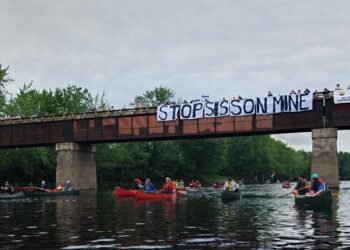
Shale gas, the Sisson tungsten and molybdenum mine near Stanley and the East-West Highway in the state of Maine are some of the concerns that Brooks wants discussed at the conference. She wants strong resolutions and plans of action coming out of the conference: “We need to take another look at our land and water and how they are the building blocks of life. We all depend on the land and water. Right now they’re at risk. The Sisson mine does not have the consent of the people just like SWN Resources does not have the consent of the people to frack. We demand free, prior, informed consent.”
Brooks’ story of fighting for the Wulustuk River, known as the Saint John River, features prominently in the soon-to-be-released film, Take Me to the River. The film explores the personal stories of people fighting to save seven endangered rivers across Canada. “My people used to drink from the river and now you can’t even swim in it. The river is poisoned and so is the fish,” says Brooks.
Upon returning from the UN Permanent Forum on Indigenous Issues in New York in May, Brooks is sharing what she learned at the forum. The theme of this year’s forum was the doctrine of discovery. “The doctrine of discovery has been recognized as the most discriminatory, genocidal document in the world. It is condemned around the world,” says Brooks. The doctrines of discovery, domination, conquest and terra nullius (land belonging to no one) were used by colonizers across the world to justify the theft of land, destruction of culture and the abrogation of the rights of indigenous peoples. The Permanent Forum called upon states to renounce the doctrines that deny the rights of indigenous peoples.
The theft of lands and destruction of the hunting territories of the Maliseet people is described by Andrea Bear-Nicholas, a St. Thomas University professor of native studies, in A Summary History of St. Mary’s to 1950: “These events have been characterized as the natural progress of civilization, but they were not natural, or even accidental. They were the direct consequences of greed and corruption on the part of wealthy colonial authorities who began by granting away huge tracts of Maliseet lands, often to themselves, and in direct violation of the Royal Proclamation of 1763. Next they designated all ungranted lands as Crown lands, overlooked or participated in massive and uncontrolled lumbering operations, profited from huge land settlement schemes, passed the offensive 1844 act legalizing the management and disposal of lands reserved for Indians, and became directly involved in massive fraud as railroad barons/legislators by granting more Crown lands to one another.”
Today, the endemic problems rooted in a social system based on production for profit continue to wreak havoc across Maliseet lands, Wabanaki territory and Turtle Island. Indigenous people are forced to assert their rights by various means necessary including suing the government over violating treaty rights and erecting blockades like those seen in Barriere Lake and Grassy Narrows to stop logging. The repressive apparatus of the capitalist Canadian state including the police, military and the courts have been used to crush movements across the country that attempt to assert indigenous sovereignty. Many indigenous leaders have gone to jail and faced fines for defending their territories from mining exploration like former Ardoch Algonquin Chief Robert Lovelace and Kitchenuhmaykoosib Inninuwug Chief Donny Morris.
According to Pat Paul, editor of Wulustuk Times from Tobique, “Supreme Court decisions rendered during the past few years state that full consultation and Aboriginal consent and agreement must be conducted and reached well before any resources can be harvested and removed from native territories.”
Treating the demand for cultural survival seriously is key to forging alliances with Aboriginal peoples according to David Bedford, a professor of political science at the University of New Brunswick, in his paper, Marxism and the Aboriginal Question: The Tragedy of Progress. He renounces the idea of progress as it is today understood. Bedford writes, “In New Brunswick, the Maliseet nation survived primarily on fishing salmon, on hunting deer and moose, on gathering berries, fiddleheads and so on, and on staple agriculture. A socialist society committed to the continued existence of Maliseet culture would have to make significant changes to the industrial development of the region. It is not enough simply to set aside some land and then pay out welfare. Cultural survival requires that the economic base of culture be preserved. This means saving old growth forests, stopping clearcutting close to stream beds and significantly reducing industrial activity on the major river arteries.”
For Alma Brooks, the survival of all of us depends on beginning the process of decolonization by stopping shale gas exploration and the Sisson tungsten and molybdenum mine on Wabanaki territory. She invites you to join her in these struggles.
![No timeline yet on pay equity bill promised during election campaign [video]](https://nbmediacoop.org/wp-content/uploads/2025/03/PayEquityMar112025-350x250.jpg)


![No timeline yet on pay equity bill promised during election campaign [video]](https://nbmediacoop.org/wp-content/uploads/2025/03/PayEquityMar112025-120x86.jpg)