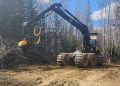
The head of an Indigenous-owned forestry company in New Brunswick says that provincial government statements about consultation with Indigenous communities over forestry policy are “hollow” without efforts to increase self-determination.
Annie Simoneau, owner of L’Puk’Tuwis Forestry — which is based in Natoaganeg, also called Eel Ground First Nation — says that most small Indigenous communities currently lack the capacity to cut and manage their own timber.

“Many are forced to rely on large forestry companies or urban-based contractors to do the harvesting for them. Those companies decide the methods — and too often that means clear-cutting, followed by herbicide spraying,” she told the NB Media Co-op.
“That’s not self-determination,” she continued. “That’s dependency created by decades of policy that withheld equipment, training, and access from First Nations, then turned around and said, ‘You were consulted.'”
She made the comments amid recent controversy over a land swap proposed by the billionaire-owned conglomerate J.D. Irving Ltd, which is based in Saint John. JDI has timber licences covering more than one million hectares of land, making it the largest licensee in the province, according to figures from the Department of Natural Resources.
Premier Susan Holt’s Liberal government ultimately rejected the company’s proposal, but the story shone light on dissatisfaction among First Nations more generally about how the provincial government is approaching forestry issues.
Land swap kiboshed but First Nations treated as ‘afterthought’
Under the proposed deal, JDI would have been allowed to harvest timber from protected woodlands in exchange for conserving certain areas near municipalities, in zones where JDI holds timber licence, as reported by the CBC.
Reports about the plan attracted a wave of criticism from First Nations and conservationists. The Green Party argued that JDI was trying to swap out land already “degraded” by industrial forest operations.
JDI was among four timber licence-holders that reportedly presented plans to the government in October about how to meet New Brunswick’s forest conservation goals under the so-called Shared Landscapes Initiative.
In its 2024 election platform, the provincial Liberal Party pledged to increase protected areas of forest from 10 to 15 per cent and to “work with communities, First Nations, and experts to develop a plan to reach 30 per cent.”
A number of municipalities threw their support behind JDI’s proposal after being approached by the company. However, organizations representing Mi’kmaq and Wolastoqey communities in New Brunswick only learned about the proposed deal through media reports and conservation groups.
The Mi’kmaq and Wolastoqey Nations have filed separate land title cases that together cover the entire province, arguing that none of the territory was ceded under the Peace and Friendship Treaties of the 1700s.
Mi’gmawe’l Tplu’taqnn Inc., a non-profit representing chiefs from the nine Mi’kmaq communities in New Brunswick, called the lack of consultation “unacceptable.”
“The Government of New Brunswick first wrote to the Chiefs about the Shared Landscapes Initiative in December 2025,” a statement from MTI said. “This despite the fact that work has clearly been ongoing on this initiative since at least the summer.”
“The Shared Landscape Initiative is clearly being planned and worked on in Mi’gmaq territory,” MTI noted.
“It is very concerning that the Government of New Brunswick has been working with stakeholders, soliciting their input on areas to protect,” the statement said, “and that Irving is engaging with other stakeholders, before and without involving First Nations leadership and MTI, especially considering the potential impact on Mi’gmaq Rights.”

The Wolastoqey Nation in New Brunswick, which represents the six Wolastoqey chiefs, issued a statement outlining similar concerns.
“Any transfer or exchange of ‘Crown land’ impacts Aboriginal Title and Treaty Rights and triggers the legal duty to consult,” the Wolastoqey chiefs said. “Forestry companies cannot determine which lands should be set aside for conservation or Aboriginal and Treaty Rights purposes.”
In January, a senior official with the Department of Natural Resources gave a presentation to Riverview town council about the Shared Landscapes Initiative.
The slide deck includes a timeline showing that “stakeholder engagement” was planned for Fall 2025, followed by “First Nation engagement” in Winter 2026.
In its statement, Wolastoqey Nation in New Brunswick called out the provincial government for sidelining First Nations in the development of the plan.
“In this situation, our Wolastoqey communities were treated as an afterthought,” the statement said. “No business organization, including J.D. Irving, should be engaged ahead of the First Nations whose lands and rights are unceded. No company stands above the law, and the Crown cannot sidestep its duty to consult.”
In response to queries from the NB Media Co-op, MTI spokesperson Jennifer Coleman said that consultation still hasn’t begun, but the Mi’kmaq chiefs have spoken to Natural Resources Minister John Herron, who confirmed that the land swap wouldn’t occur.
“Consultation has not started but a meeting between MTI and GNB officials will take place next month where we hope to learn more about the Shared Landscape Initiative,” Coleman said. Wolastoqey Nation in New Brunswick didn’t respond to a request for comment by the time of publication.
Self-determination necessary for ‘true consultation’
Minister Herron said in a recent statement that conservation efforts “will be informed by science, guided by Indigenous consultation, and advanced through early and respectful collaboration with communities and stakeholders.”

But, references to Indigenous guidance amount to empty rhetoric without “true consultation,” according to Simoneau of L’Puk’Tuwis Forestry.
“I worry about Indigenous communities being unfairly held accountable for forestry outcomes they don’t actually control,” she said. “When the system only offers one option — industrial clear-cut forestry — consent becomes hollow.”
She said true consultation would involve: “supporting Indigenous-led forestry capacity; funding equipment and training; respecting selective cutting, land-based knowledge, and long-term stewardship; and ending the practice of spraying poisons on unceded lands.”
Simoneau added: “And once forests are gone, once medicines are destroyed, once wildlife habitat is broken — we don’t get that back.”
As for JDI, the company was clearly unhappy with the provincial government’s decision to kibosh its plans following a week of controversy.
James Irving, co-CEO of the conglomerate, published a letter in Postmedia-owned newspapers across New Brunswick objecting to the provincial government’s response, alluding to the financial pressure caused by President Donald Trump’s trade war. The industry currently faces 45 per cent tariffs at the American border on softwood lumber products.
The Irving family scion called the provincial government’s decision “the worst kind of reactive policy that puts investment, jobs and our economy at risk.”
There appears to be a silver lining for the company: last week, Opportunities New Brunswick announced that Irving Paper Ltd. — a division of JDI — would receive subsidies worth “up to $15 million per year over three years… to support the global competitiveness of New Brunswick’s only remaining paper mill during a period of significant cost pressure and market volatility.”
(A company executive wrote in a letter to the Telegraph-Journal that it’s “not a subsidy” and that the funds “can only be accessed when the electricity costs in New Brunswick become uncompetitive and threaten operations.”)
Meanwhile, the federal government on Wednesday announced $2.8 million in funding for forestry projects in New Brunswick and Nova Scotia, including roughly $400,000 for Indigenous forestry initiatives.
Those initiatives included $200,000 for Wolastoqey Nation in New Brunswick to host a “series of knowledge-sharing and information sessions to support the development of land use and forestry management plans for their forested lands.”
The funds also include $50,000 to support an updated business plan for overhauls to a mill at Neqotkuk, also called Tobique First Nation, to supply kiln-dried lumber for housing.
David Gordon Koch is a journalist with the NB Media Co-op. This reporting has been made possible in part by the Government of Canada, via the Local Journalism Initiative.
![Acknowledge history of genocide and commit to reconciliation, says human rights advocate [video]](https://nbmediacoop.org/wp-content/uploads/2026/02/AlexNeveFeb172025-350x250.jpg)
![NB Update: What comes after the crisis in local journalism? [video]](https://nbmediacoop.org/wp-content/uploads/2025/06/LabourUpdateApr132025-350x250.jpg)
![Migrant workers’ labour conditions not on the table at Canada–U.S. lobster industry conference [video]](https://nbmediacoop.org/wp-content/uploads/2026/01/LobsterJan222026-5-350x250.jpg)