
With residential electricity bills quickly rising in New Brunswick, some advocates are calling for a relief program geared towards low- and moderate-income households, but one housing researcher warns that means-tested programs are likely to exclude some households that need support.
Unlike universal programs, income-tested or means-tested programs are available only to people whose financial circumstances make them eligible.
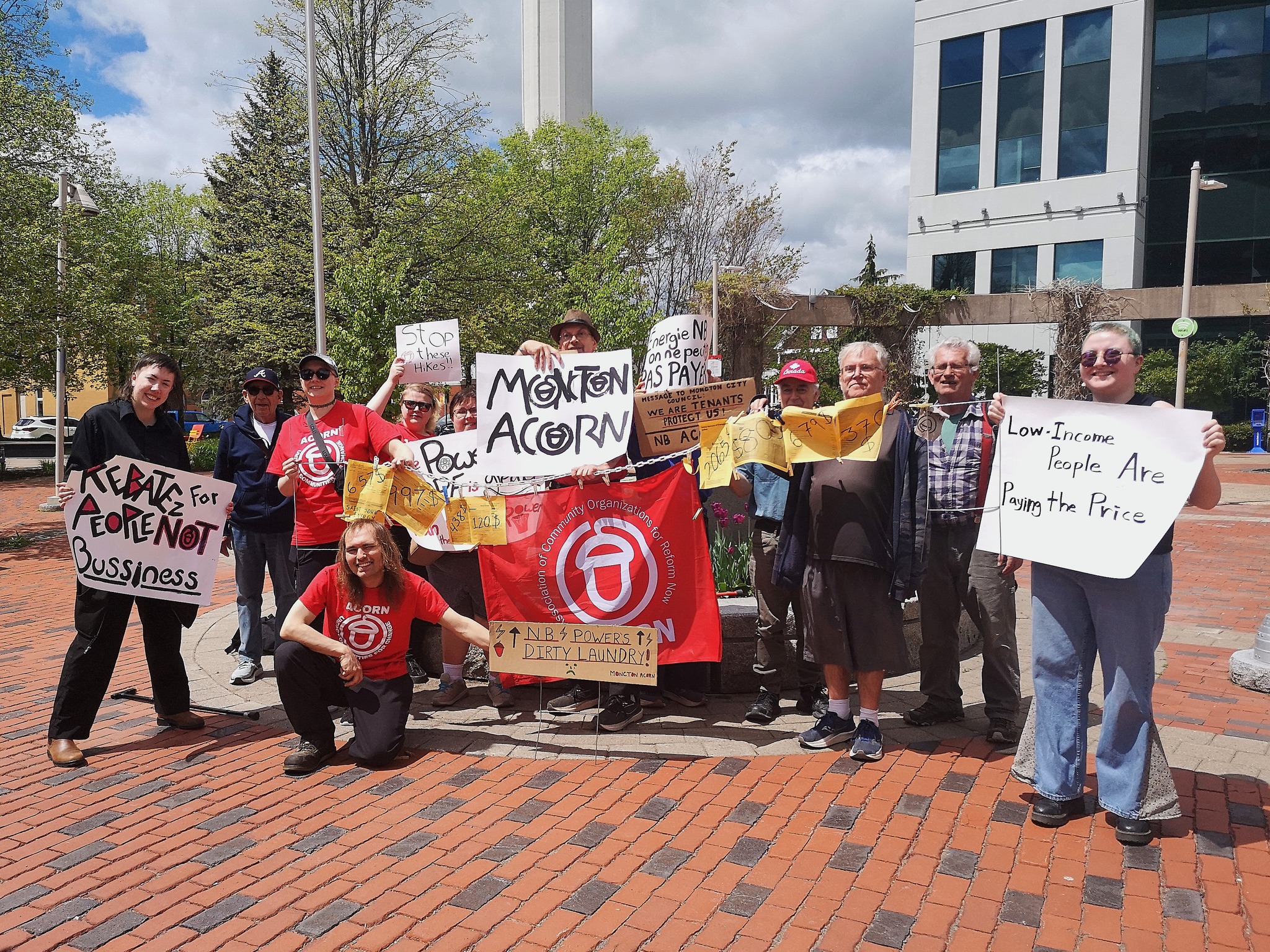
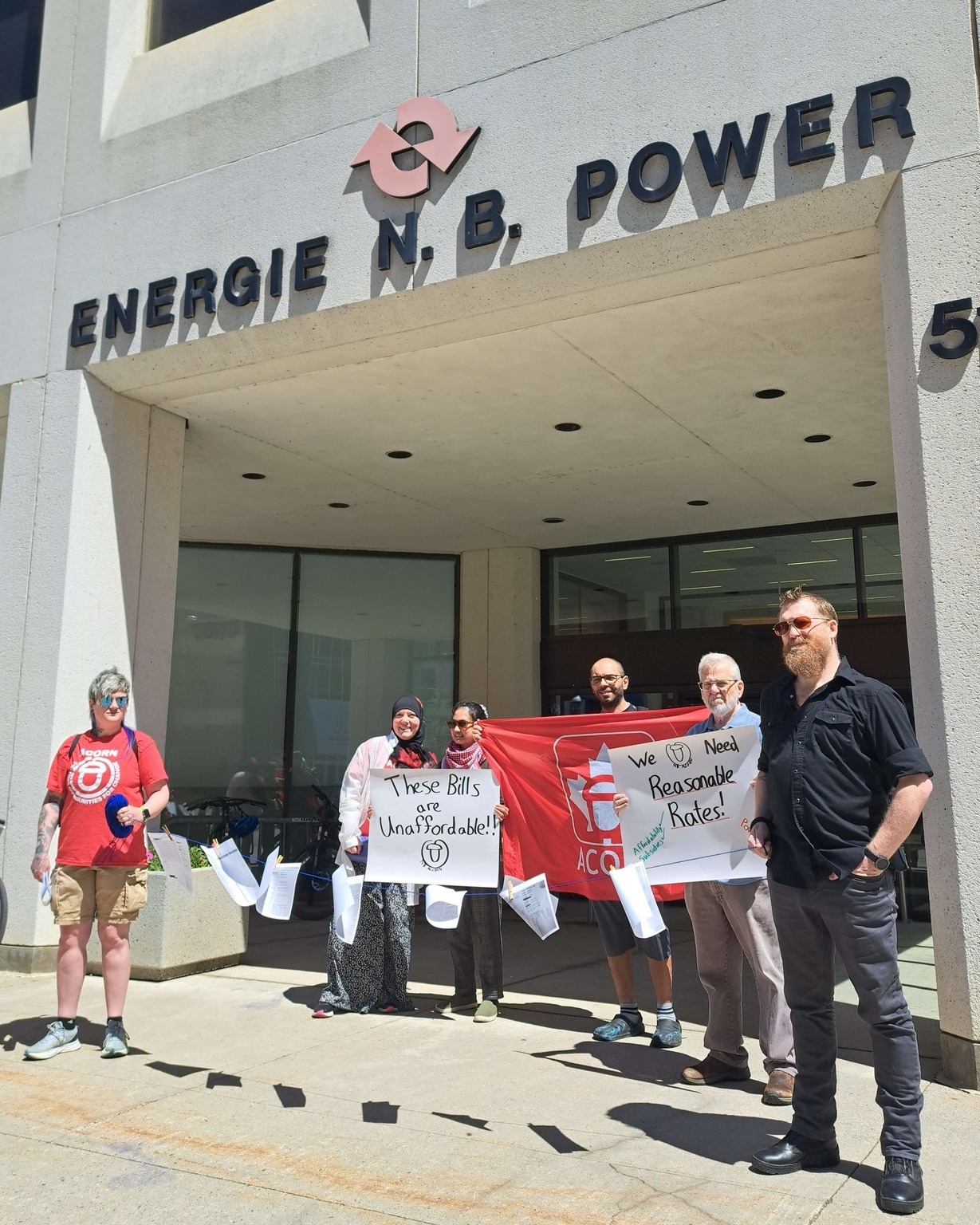
Anti-poverty campaigners held rallies in Moncton and Fredericton last week calling for an income-tested rebate, with members of New Brunswick ACORN displaying copies of steep NB Power bills, one of them exceeding $2,000 for a two-bedroom house in the Moncton area.
“How can you afford to pay for rent and these insanely high energy bills on minimum wage, and still have money to buy food?” asked Moncton ACORN chair Peter Jongeneelen in a statement. “Everyday people are making sacrifices they shouldn’t have to.”
In January 2025, the provincial government removed provincial sales tax from all residential power bills in the wake of provincial elections that saw Premier Susan Holt elected amid the ongoing cost-of-living crisis.
However, that 10 per cent rebate has come under scrutiny, with an analysis by CBC News indicating that the richest 70,000 New Brunswick homes have received twice as much financial benefit than the poorest 70,000 households.
Those wealthier residents consume twice as much energy as their low-income counterparts. The program has reportedly cost the provincial treasury an estimated $130 million in tax revenue.
Jongeneelen believes the Liberal government should scrap the program, restoring a source of public funds that could be used as targeted relief for poorer households.
“If the Liberals can remove the [provincial] HST, they can easily put it back in place to create a low-income energy assistance program and also help people at risk of disconnection due to overdue bills with some sort of debt forgiveness,” he said in a message to the NB Media Co-op.
The rallies in Moncton and Fredericton came one day after the provincial government issued its official response to a report on the future of NB Power published in March by a panel of experts.
The panel issued 50 recommendations, including a call for the government to review the utility’s various social and affordability programs to “identify the greatest value for money.” In response, the government committed to a review of those programs, but the timeline is long, extending from now until 2028.

Randy Hatfield, executive director of the Saint John-based Human Development Council, has pushed for a “comprehensive energy poverty strategy” that would include a low-income energy rebate program.
In an interview, he said that targeted relief would be a better way to reduce energy poverty than the current blanket tax rebate. “If your goal is to reduce energy poverty, then targeted relief… is more efficient or more effective than other forms,” he said.
Research by the Human Development Council shows that New Brunswick has one of the highest rates of “energy poverty” of any province or territory in Canada.
Roughly one quarter of households in New Brunswick spent more than six per cent of after-tax income on electricity in 2021, second only to Newfoundland.
Hatfield acknowledged that with income-tested programs, there’s a risk that people will fall through the cracks due to issues such as low literacy levels or lack of internet access that may prevent them from applying.
“I appreciate that there will be issues around program design,” he said. “That’s part of the challenge.”
However, he suggested that NB Power could automatically include some households, including social assistance recipients or low-income seniors who receive the Guaranteed Income Supplement.
Housing researcher Matthew Hayes, a sociology professor at St. Thomas University, cautioned that income testing often excludes people arbitrarily.

For example, low-income households may experience a temporary windfall, causing them to suddenly lose access to an income-tested program. “It doesn’t provide security,” Hayes said.
He argued that low-income ratepayers — who are also seeing average rents go up faster than elsewhere in Canada — are disproportionately shouldering NB Power’s debt burden and subsidizing industrial ratepayers.
Ultimately, the energy affordability issue results from successive Liberal and Conservative governments showing little interest in tackling the problem of lopsided wealth distribution in New Brunswick, Hayes said.
“In reality we live in a very wealthy province,” he said. “We produced two of the richest families in the country.”
After a period when rates were effectively frozen, power bills have surged in recent years, with 9.14 per cent increases in 2024 and 2025 and a 5.7 per cent rate increase in 2023. The Energy and Utilities Board (EUB) recently approved NB Power’s latest rate hike, causing energy bills to increase by 4.29 per cent.
All signs indicate that residential electricity rates will continue to rise. NB Power plans to request further rate increases of 6.5 per cent in 2027 and another 6.5 per cent the following year.
The heavily indebted utility — which declined to comment for this report, referring questions to the provincial government — has stated that it needs the money to deal with aging infrastructure, increased demand for electricity, and more intense weather systems linked to the climate crisis.

The EUB recently recommended in one of its decisions that the province should “consider offering targeted relief to New Brunswickers experiencing energy poverty.”
Finance and Energy Minister René Legacy has stated that the province is considering an income-tested relief plan, but it’s unclear when those measures might get rolled out. Legacy’s office issued a brief statement in response to queries from the NB Media Co-op.
“We understand that the cost of living can be a challenge,” said the statement, which was attributed to Legacy. “Providing a 10 per cent rebate on electricity bills is part of its [sic] ongoing commitment to make life more affordable for New Brunswickers.”
The statement added that the Department of Social Development “is leading work to examine the suite of programs currently available to determine the best approach going forward and ensure that at the end of the day the people who need help the most are getting it.”
Until then, protests are likely to continue, as long as electricity rates and the cost of living continue to rise.
David Gordon Koch is a journalist with the NB Media Co-op. This reporting has been made possible in part by the Government of Canada, via the Local Journalism Initiative.
![Health care privatization under scrutiny ahead of provincial elections [video]](https://nbmediacoop.org/wp-content/uploads/2024/03/MedavieBlueCross-350x250.jpg)
![Federal social media bill threatens to undermine privacy rights, alienate youth: critics [audio]](https://nbmediacoop.org/wp-content/uploads/2026/06/SocialMediaBanJun122026-350x250.jpg)

![Federal social media bill threatens to undermine privacy rights, alienate youth: critics [audio]](https://nbmediacoop.org/wp-content/uploads/2026/06/SocialMediaBanJun122026-120x86.jpg)

![Health care privatization under scrutiny ahead of provincial elections [video]](https://nbmediacoop.org/wp-content/uploads/2024/03/MedavieBlueCross-120x86.jpg)
