

The Mi’kmaq Warriors Society opposes plans for a fossil fuel-burning plant in Tantramar, says district war chief Jason Augustine of Elsipogtog.
If NB Power’s plans proceed, it could result a confrontation similar to the 2013 movement against shale gas exploration in New Brunswick, Augustine said in an interview with the NB Media Co-op.
“Anything that is there to destroy our land, warriors will always oppose it,” said Augustine, who stressed that the facility is slated for construction on unceded Mi’kmaq territory.
“All we want is to have our traditional medicine going — our traditional food, our traditional hunting, traditional fishing… our traditional rights.”
NB Power’s planned generating station, if it goes forward, will burn gas that originates from a controversial process known as fracking, supplied by the Maritimes & Northeast Pipeline.
The use of fracked gas raises the specter of past shale gas exploration by the company SWN Resources, an effort that was met by a Mi’kmaq-led resistance movement.
Tensions reached a climax on Oct. 17, 2013, when the RCMP raided an anti-fracking camp near Rexton to enforce an injunction halting the blockade of a company compound.
Premier Brian Gallant’s Liberal government implemented a moratorium on new shale gas development after defeating the incumbent Conservative Party the following year.
“All we were trying to do was protect our land,” Augustine recalled. “Our traditional medicine was one of the biggest things.” He was among several warriors who were arrested during the RCMP raid. He later told APTN that he suffered a concussion after being beaten and roughed up by police.
Augustine eventually pleaded guilty to charges that included assaulting a police officer, two counts of obstruction, and one count of mischief in relation to the events that unfolded on the day of the raid, according to the CBC.
Police shot him four times with rubber bullets during that raid, he told the NB Media Co-op. Despite those past experiences, Augustine said he’s committed to resisting the power plant that’s planned for construction north of Sackville. “I will gladly go to jail again,” he said. “I will gladly get shot again.”
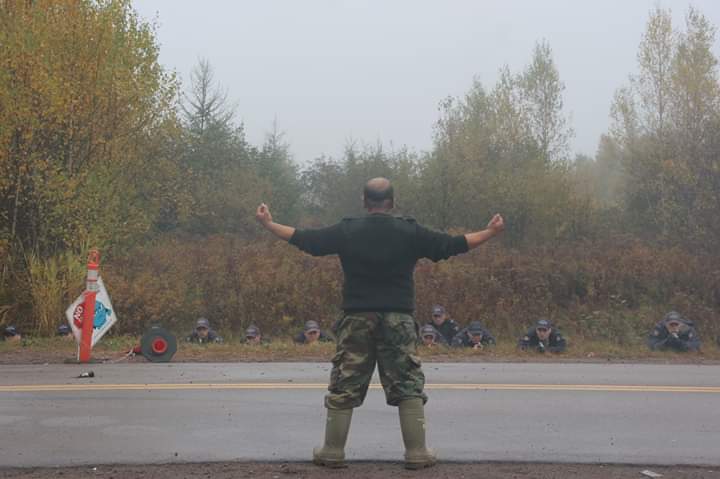
He believes that NB Power and the provincial government are “jumping the gun” on plans for the Tantramar facility and warned that it may “blow up again like SWN did.” He cautioned that the Warriors Society will attempt to block construction, but he called for talks to avoid a confrontation.
“We all don’t want to go to jail, but you know, we’re not going to stop,” he said. “If they’re not going to stop, we’re not going to stop.”
Augustine said the history of the Mi’kmaq Warriors Society dates back to the arrival of Europeans. “Warriors Society was formed to be protecting our land and our rights,” he said.
He said peace is the first priority and “fighting is always our last option,” adding that the role of warriors goes beyond the protection of rights.
“You’re also helping out with our community members, helping our Elders, our youths, our general public, standing up and teaching our youth how to hunt, how to fish.”
He stressed that Mi’kmaq warriors won’t back down. “We will never back down,” he said. “We never surrendered before, and we refuse to surrender, at any cost.”
NB Power has said the power plant is needed to stabilize New Brunswick’s electricity grid and serve as backup when renewable energy sources are unavailable.
The utility has stated that the power plant will be owned and operated by RIGS Energy Atlantic, a subsidiary of the U.S.-based company ProEnergy.
ProEnergy Canada has insisted that the power plant will have little negative environment impact and that it will contribute to an overall reduction of carbon emissions in New Brunswick.
The project was met with pushback from Elsipogtog residents in March, when NB Power and ProEnergy officials spoke at a public meeting in the community.
The First Nation issued a statement last summer warning that the project “risks igniting widespread Indigenous resistance” and that it “will be met with legal and direct action.”
Elsipogtog, also known as Big Cove, is located about 75 kilometres northwest from the site of the proposed power plant, which falls within a larger Mi’kma’ki district known as Sikniktuk.
In 2016, Elsipogtog launched a land title claim covering that region. Since then, eight other Mi’kmaq nations have also asserted title to a larger overlapping territory.
The NB Media Co-op requested interviews with the Minister of Indigenous Affairs and Minister of Energy for this story, but their offices were unable to provide comment by publication time. ProEnergy Canada didn’t respond to an interview request, while NB Power provided an emailed statement.
The utility stated that it “recognizes the importance of meaningful engagement with First Nations and respects the perspectives being shared regarding this project.”
It continued: “Consultation with Indigenous communities is a critical part of the Environmental Impact Assessment process. Proponent-led engagement is ongoing, and ProEnergy is actively working with established Indigenous consultative bodies, following all required regulatory processes.”
NB Power added that it is “committed to respectful dialogue and to ensuring Indigenous communities have opportunities to share their views and concerns. We understand the importance of continued discussion and are supportive of efforts to engage constructively as the project moves forward.”
David Gordon Koch is a journalist with the NB Media Co-op based in Moncton. Lisha Francis is a student at St. Thomas University who lives in Elsipogtog.
This reporting has been made possible in part by the Government of Canada, via the Local Journalism Initiative. We also acknowledge the support of the Canadian Race Relations Foundation with funding provided by the Government of Canada.

![Massive increase in military spending imposed by U.S. with little media pushback [video]](https://nbmediacoop.org/wp-content/uploads/2026/10/AlexCoshSept232026-350x250.jpg)
![Amid push for ‘nation-building projects,’ critics warn of ecological devastation [video]](https://nbmediacoop.org/wp-content/uploads/2026/10/MineBabyMineSept242026-2-350x250.jpg)





![Massive increase in military spending imposed by U.S. with little media pushback [video]](https://nbmediacoop.org/wp-content/uploads/2026/10/AlexCoshSept232026-120x86.jpg)
