
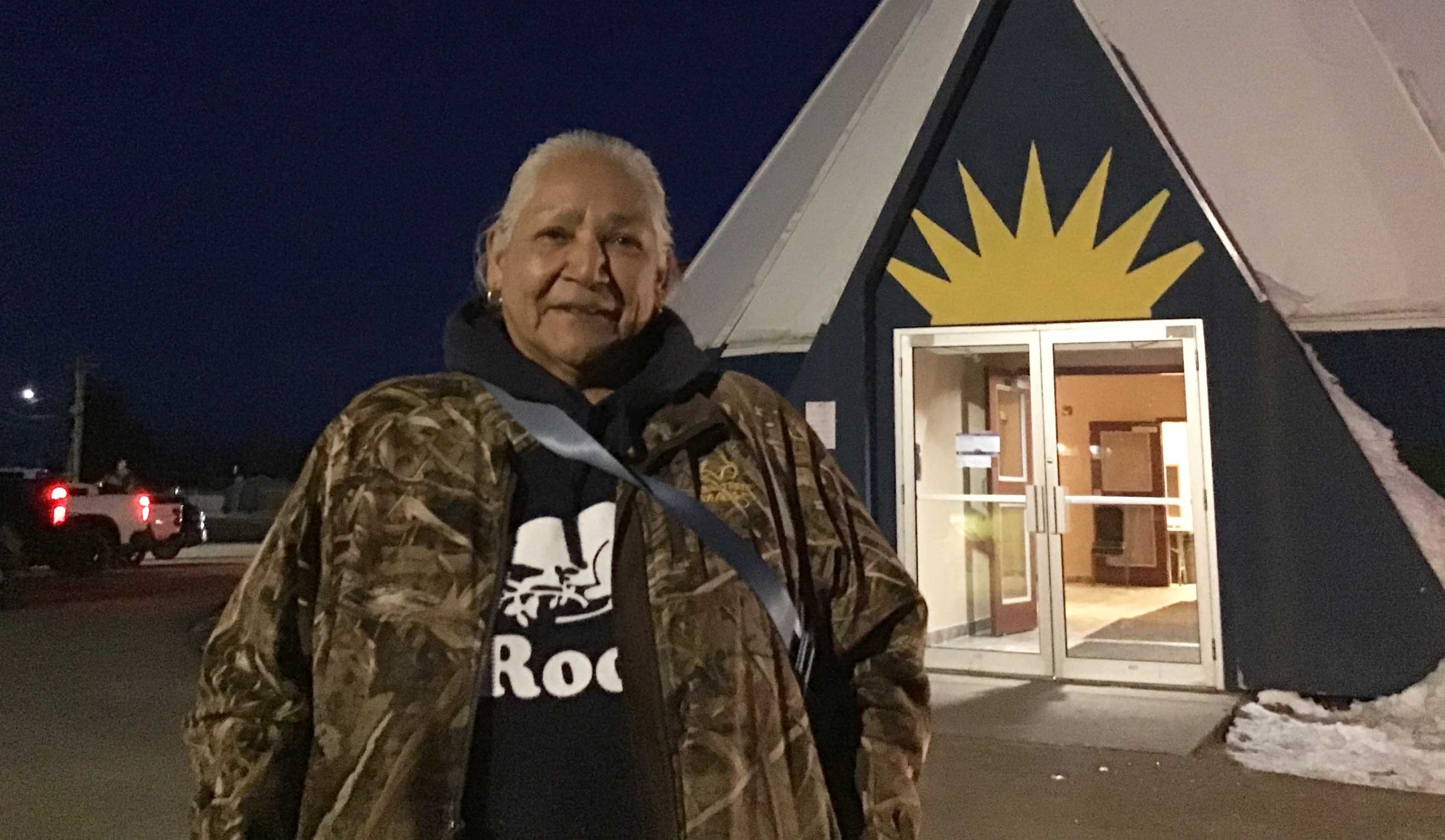
The company behind a proposed gas-burning power plant in southeast New Brunswick faced heavy scrutiny on Wednesday night in Elsipogtog First Nation.
Dozens of local residents attended the community meeting, many of them expressing strong opposition to ProEnergy’s proposed facility.
ProEnergy Canada president John MacIsaac struggled to get through his presentation as community members peppered him with questions following a community dinner.
His presentation quickly turned into an impromptu question-and-answer session, with the company executive on the defensive.
At one point, a community member asked what would happen if the Mi’kmaq people rejected the company’s proposal. MacIsaac responded that the company would engage in “active listening” and find a way to work together.
That answer didn’t satisfy at least some members of the crowd, who demanded to know what would happen if Mi’kmaq nations nonetheless refused to give their consent.
When the topic of conversation shifted, someone interrupted, telling MacIsaac that he hadn’t answered the question.
The company official eventually stated that he didn’t think the project could go forward without Indigenous support, prompting some applause.
Company officials were accompanied by an environmental consultant from Stantec Consulting and representatives from NB Power.
The meeting was hosted by Kopit Lodge, an organization representing Elsipogtog on resource development issues.

Company pitches project
NB Power has said the project will stabilize New Brunswick’s electricity grid and serve as backup when renewable energy sources are unavailable.
However, the proposal has met with considerable pushback.
It has attracted controversy, in part, because of the company’s earlier claims that North Shore Mi’kmaq Tribal Council was a “minority equity holder” in the project.
It later emerged that the tribal council only had an option to invest that hadn’t yet been exercised. When a community member raised the issue, MacIsaac said “those agreements have expired.”
MacIsaac said the company eventually learned that it should consult with Elsipogtog, Kopit Lodge, and Mi’gmawe’l Tplu’taqnn Inc., an Indigenous rights collective that brings together Mi’kmaq communities in New Brunswick.
He said there’s a possibility for Elsipogtog to obtain a stake in the venture.
NB Power has stated that the plant would be owned and operated by RIGS Energy Atlantic, a subsidiary of the U.S.-based company ProEnergy, which has built similar power plants in Texas.
Residents raise health concerns
Some community members referenced a letter signed by 331 doctors from the Dr. Georges L. Dumont University Hospital Centre in Moncton.
That letter warned about significant health and environmental effects from similar power plants, including “cardiovascular and respiratory diseases, certain cancers, and congenital conditions.”

When someone asked MacIsaac whether he believed that doctors are capable of doing quality research, he replied that he felt like he was being “set up.”
People in the crowd told him that the feeling was mutual.
That kind of back-and-forth continued throughout his presentation, with some community members expressing open hostility towards the plans.
Community members raised issues such as possible negative effects on medicine grown on the land, wastewater, and who would be liable if the project resulted in health problems.
Speaking to the NB Media Co-op, one local resident commented that ProEnergy didn’t seem interested in taking responsibility for possible harms linked to the project.
“I’m worried about the liability,” Mona Milliea Robertson said.
During the meeting, MacIsaac stated that “a lot of misinformation” is circulating about the project.
He told the crowd that the fuel-burning plant would reduce carbon emissions by 250,000 tonnes in the first year of operations, and that it would only consume water and fuel when it’s in generating mode, about seven per cent of the time.
‘We don’t consent’
Earlier on Wednesday, some local residents expressed concern that the company would use the meeting as proof that they had consulted with First Nations, leading some to call for a boycott of the meeting.
Those concerns came up during the presentation, when someone remarked that she doesn’t consider the meeting to be part of consultations.
A moment later, someone exclaimed: “And we don’t consent.”
NB Power has stated that the province may experience energy shortages if the plant isn’t built by 2028.
The utility recently told the Energy and Utilities Board that the billion-dollar project must gain approval from the regulator by April 2, or the company might back out.
At Wednesday’s meeting in Elsipogtog, one community member asked why the community was only being consulted now.
“That relationship should have been built,” she said.
“I agree,” MacIsaac replied, prompting applause.
After the question-and-answer session wrapped up, the community held a closed-door meeting to discuss the project.
The NB Media Co-op asked officials from ProEnergy and NB Power how they felt about the contentious meeting.
“There were a lot of good questions,” MacIsaac said as he left. “We thought it was a good exchange.”
“We’re happy to hear these kinds of questions,” said NB Power project manager Stephen Cooper.
Project faces resistance
People who spoke to the NB Media Co-op after the closed-door portion of the meeting said the consensus among community members was to oppose the project.
“I’m a Mother Earth protector,” said Jacqueline Clair, who was part of the movement against shale gas exploration that eventually led to a moratorium on fracking. “Our ancestors left this for us to keep protecting it, and we’ll keep protecting it as long as we’re here.”
She said that ProEnergy appears to have pushed forward with its plans extensively before meeting with residents in Elsipogtog. “We have to keep fighting.”
Sandra Warner, 78, said the community doesn’t want the project to proceed. “We don’t need any of that stuff,” she said.
Elsipogtog First Nation warned last summer in a statement that the ProEnergy project “risks igniting widespread Indigenous resistance” and that if it goes forward “it will be met with legal and direct action.”
Elsipogtog, also known as Big Cove, is located about 75 kilometres northwest from the site of the proposed power plant. That site falls within a larger Mi’kma’ki district known as Sikniktuk.
In 2016, Elsipogtog launched a land title claim covering that region. Since then, eight other Mi’kmaq nations have also asserted title to a larger overlapping territory.
MTI has said they are in discussions with Elsipogtog over harmonizing the two cases.
David Gordon Koch is a journalist with the NB Media Co-op based in Moncton. This reporting has been made possible in part by the Government of Canada, via the Local Journalism Initiative.
![Photo exhibit shows dangers faced by journalists, daily struggle to survive in Gaza Strip [video]](https://nbmediacoop.org/wp-content/uploads/2026/10/RizekExhibitOct222026-5-350x250.jpg)




![Photo exhibit shows dangers faced by journalists, daily struggle to survive in Gaza Strip [video]](https://nbmediacoop.org/wp-content/uploads/2026/10/RizekExhibitOct222026-5-120x86.jpg)
