In early June, a Small Modular Reactor (SMR) Forum in Saint John brought together industry representatives, government officials, and stakeholders closely tied to the nuclear sector for a couple of days of staged enthusiasm.
The Passamaquoddy Nation was not officially notified about, nor invited to, the event — which promoted new nuclear expansion within their Homeland. Even so, Passamaquoddy representatives purchased tickets (ranging in price from $650 – $1350) and attended the event to hear what was being said about one of the most expensive and consequential industrial projects being proposed in Passamaquoddy Homeland.
At the Forum, enthusiasm for nuclear expansion dominated, while concerns about risk, cost, and long-term responsibility were largely absent.
Exclusion, representation, and Indigenous positioning
The Forum was organized by the Calgary-based Canadian Association of Small Modular Reactors. The purpose of the first workshop by the Nuclear Waste Management Organization (NWMO), was to attain public feedback on their plan for a second underground nuclear waste repository. This was concerning because the NWMO had not yet reached out to the Passamaquoddy, whose Homeland hosts some of the nuclear waste in question.
What’s more, some panels within the Forum were restricted to invited organizations only, and the Passamaquoddy Nation was not invited to participate. This raises broader questions about why Indigenous Nations are excluded from certain conversations about projects that directly affect their lands, rights, and communities.
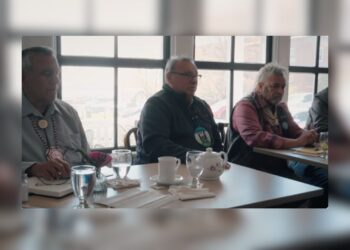
The evening events included Mi’kmaw Chief Terry Richardson, who travelled over 350 km from Pabineau First Nation to provide a “Welcome” to attendees. When discussing “the nuclear field” he stated, “all First Nations are open to it, I can guarantee you.” In the closing moments of his remarks, he shifted from speaking broadly about “all First Nations” to focusing on his own community of Pabineau, as well as various developments involving both Pabineau and Eel River Bar First Nation.
In contrast to Chief Richardson’s statement, the Passamaquoddy Chief Hugh Akagi, along with Wolastoq Grand Chief Ron Tremblay, Mi’kmaw Grand Chief Norman Sylliboy, and many Indigenous Elders and citizens across Wabanaki Territory, have repeatedly and publicly stated that they are opposed to any future nuclear power development.
Public–private alignment in nuclear development strategy
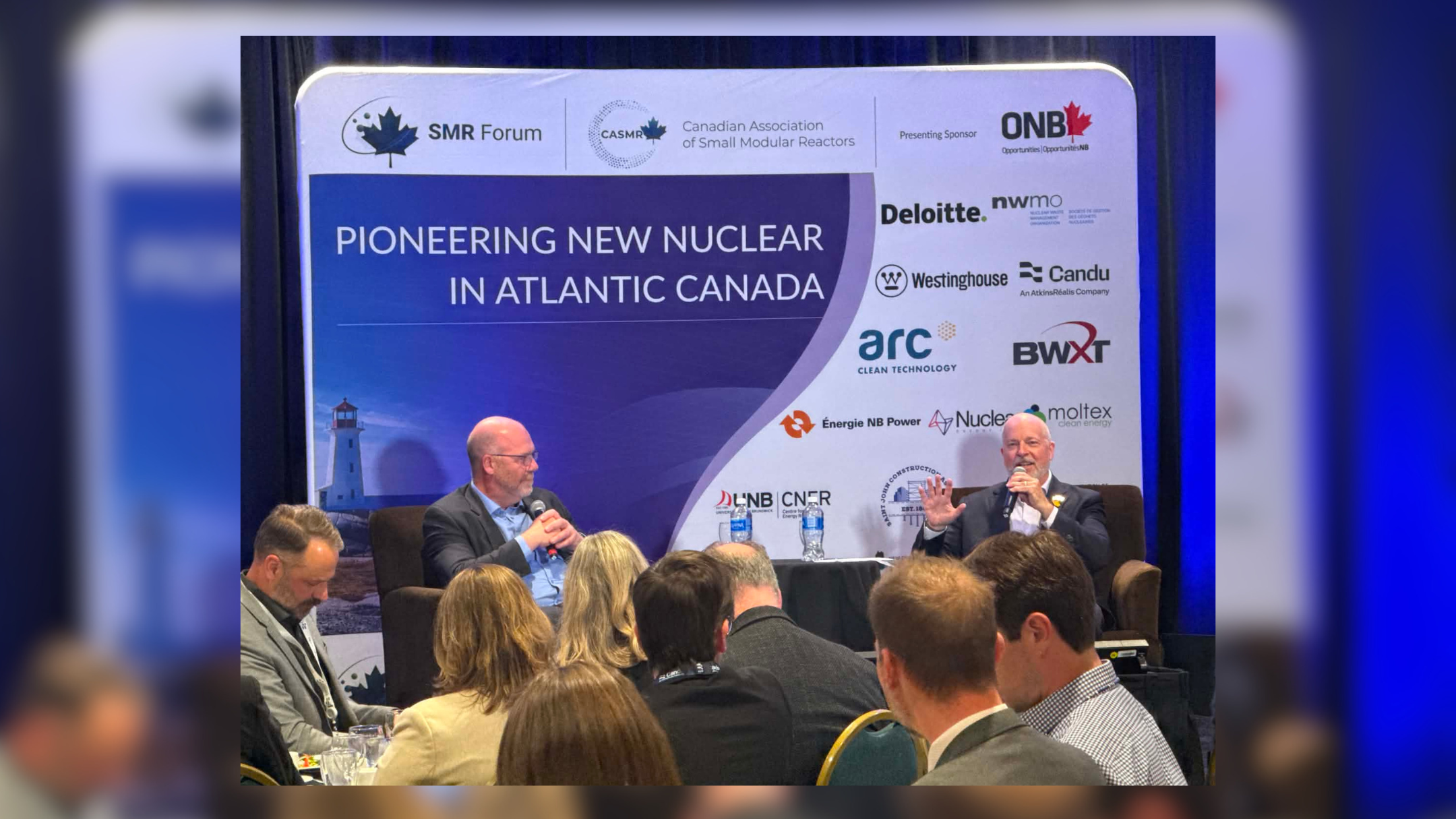
Following the Welcome, a “Fireside Chat” with René Legacy, Deputy Premier and Minister of Energy and John Gorman, President of Westinghouse Canada, a Canadian nuclear company and subsidiary of the U.S. company Westinghouse Electric.
Westinghouse Canada is lobbying aggressively to sell its nuclear reactor model, the AP 1000, to proposed nuclear projects in Ontario and Alberta. Westinghouse Electric is an American company owned by two Canadian companies, Brookfield Renewable Partners and the uranium giant Camico. They bought Westinghouse after the company went bankrupt in 2017 due to massive cost overruns and delays building AP 1000 reactors in the U.S.
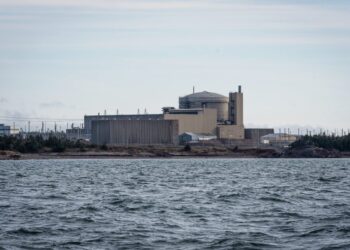
The Fireside Chat, titled “New Brunswick’s Nuclear Story and the Way Forward,” focused on strategies to shift public perception of Point Lepreau — from being seen as a massive liability for New Brunswick to being viewed as an asset.
Although during the Fireside Chat Minister Legacy used the term “clean” to describe nuclear energy and its emissions, he did not address Point Lepreau’s use of diesel fuel, which reached over a million litres (1,091,853 liters of Type B Diesel Fuel) in 2018. Nor did he discuss the facility’s radioactive air and water emissions.
Despite this, Point Lepreau is reported to be the highest emitter of radioactive tritium among Canadian nuclear facilities, releasing it into the Bay of Fundy ecosystem.
Manufactured urgency in nuclear energy discourse
The second day of the event was a sequence of carefully managed monologues — highly curated, tightly controlled, and overwhelmingly uniform in its messaging about the future of New Brunswick’s energy sector through Small Modular Reactors.
NB Power President and CEO Lori Clark’s opening comments could be interpreted as reflecting a lack of recognition of, or disregard for, Indigenous Nations and citizens in New Brunswick who do not support further nuclear power development.
The second day’s panels were tightly scheduled, presentations were polished to the minute, and the flow of information was strictly one-directional. There were no questions from the audience, no moments of friction, and no visible space for dialogue.
Opposition, when it appeared at all, was not treated as part of a democratic tension between competing energy visions. Opposition was framed instead as misunderstanding, misinformation, or a lack of technical literacy. In that framing, disagreement becomes something to be corrected rather than engaged with.
The dominant narrative throughout the forum was straightforward: nuclear energy is the solution to climate change, energy security concerns, and rising electricity demand. SMRs in particular were positioned as flexible, scalable, and essential to maintaining reliable baseload power in a transitioning grid.
The urgency was repeatedly emphasized. Attendees were told that the “window of opportunity is short,” that other countries are moving faster, and that Canada risks falling behind if it does not act decisively. This messaging left little room for reflection, and, based on the audience’s reactions, it appeared that the narrative was largely accepted without question.
The only issue consistently framed as a “problem” throughout the forum was the regulatory process. Rather than being discussed as a system designed to support safety, transparency, and public accountability, it was largely portrayed as slow, repetitive, and an obstacle to overcome. Oversight and review mechanisms were repeatedly characterized as barriers to development rather than essential safeguards.
The fact is nuclear power projects are not fast solutions. They take years to plan, license, and construct, and in many cases over a decade before becoming operational. If there were a genuine urgency to address climate and energy demands in the near term, nuclear power would not be the chosen solution.
Gaps in the conversation at the SMR forum
Equally significant were the issues not addressed at all.
There were no independent critical researchers presenting alternative assessments or panels dedicated to risk analysis. Also avoided was discussion of long-term uncertainties, such as cost overruns, lengthy deployment timelines, funding challenges, radioactive emissions, and the lived experience of nuclear communities over decades.
There was no exploration of scenarios in which SMR deployment might underperform expectations, face public resistance, or encounter unanticipated technical or financial barriers — all of which are happening in the present.
The result was a forum where complexity had been neatly edited out, leaving a streamlined narrative that required very little interrogation. One could almost admire the efficiency: by removing most of the uncomfortable questions, the need for discussion was conveniently minimized.
The need for broader energy debate in New Brunswick
The SMR Forum in Saint John presented a very controlled view of New Brunswick’s energy future — one focused on urgency, certainty, and optimism about new technology. But behind this sense of inevitability, the event also showed something important: there was little space for critical discussion at a time when energy decisions have major financial, environmental, and long-term impacts for future generations.
New Brunswick’s energy future will be defined not only by the technologies it chooses, but by the quality of the public conversations that guide those choices. A genuinely open process would include a wider range of evidence, perspectives, and possibilities — including those that question whether large-scale nuclear expansion is the most appropriate path forward.
Ultimately, the challenge is not simply about choosing between energy sources, but about ensuring that the process of choosing itself is democratic, transparent, and capable of holding competing visions in genuine balance.
Kim Reeder and Mayara Gonçalves e Lima work with the Passamaquoddy Recognition Group Inc., focusing on nuclear energy. Their work combines environmental advocacy with efforts to ensure that the voice of the Passamaquoddy Nation is heard and respected in decisions that impact their land, waters, and future.