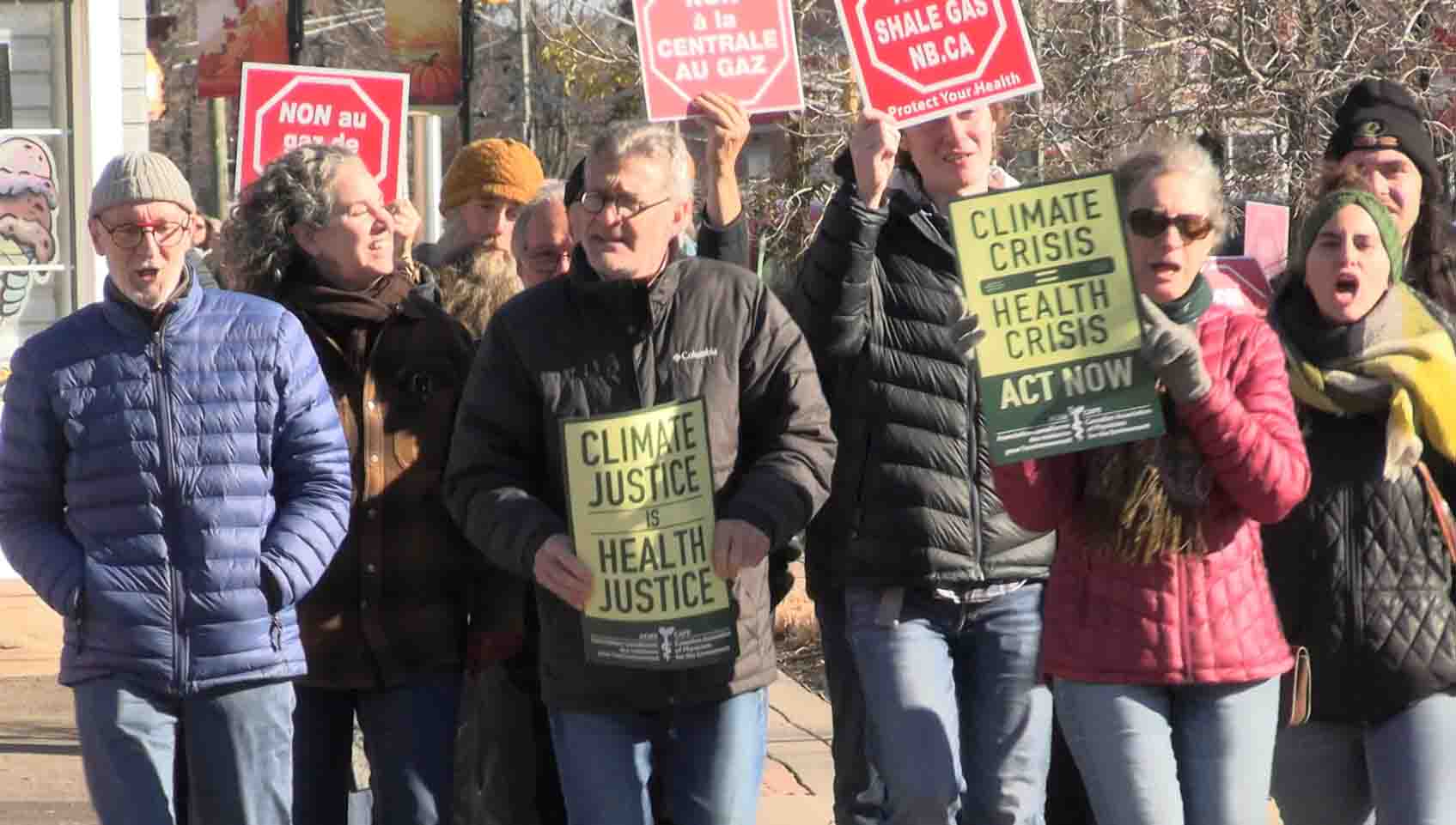
A group of Acadians who oppose shale gas fracking held an impromptu rally outside the Shediac office of MP Dominic LeBlanc on Thursday, after meeting at a nearby community centre for the official launch of a newly-formed coalition dubbed the “Coalition Acadie NON au Gaz.”
The high-powered Cabinet Minister didn’t happen to be in his office at the time of the demonstration. However, it’s likely that LeBlanc will be hearing more from the nascent Francophone coalition.
The coalition has come together at a time when the climate crisis and related issues — including plans for a gas-burning power plant in Tantramar and a hyperscale data centre in Lorneville that will also burn gas — are top-of-mind for many area residents.
Meanwhile, the provincial government is mulling whether to lift a moratorium on shale gas development, with a decision expected in January.
And in Ottawa, the federal government is pushing forward with the omnibus Bill C-39, which critics have slammed as a step backwards for environmental protections and labour rights.
On Thursday morning, about 25 environmentally-minded people turned out in-person for the inaugural event.
“I’m here because I’m a mother and a grandmother,” Shediac resident Rachelle Poirier told the NB Media Co-op.
“For decades, scientists have been telling us we’re heading towards a brick wall,” she said. “I think we’re hitting a brick wall… It’s not infinite, the air, the water.”
The coalition aims to shape the public debate among Francophone people in New Brunswick, who represent roughly one-third of the population, while countering the “simplistic arguments” put forward by oil, gas, and coal interests, and advancing responsible alternatives, said Genevieve L. Latour, a spokesperson for the group.
About a dozen organizations have become members so far. Examples include Maritimes Against Climate Change, the Canadian Association of Physicians for the Environment, le Regroupement féministe du Nouveau-Brunswick, and Alter Acadie, to name a few.
More than 100 individuals from around the province have also signed up, said Linda Dalpé, another spokesperson for the coalition. “We are extending an invitation to Acadian and Francophone groups and individuals to join us,” she said.
Organizers said that while the coalition will work with their Anglophone and Indigenous counterparts, it’s important for Francophone people to have their own organizations.
The coalition includes a scientific committee headed by J.P. Sapinski, a professor of Environmental Studies at l’Université de Moncton. That committee will be made up of professors and grad students from the university, along with citizens who have developed expertise in fossil fuel-related matters, he said.
“The goal of the scientific committee is to offer independent expertise to deal with disinformation from industry and governments around all issues surrounding gas, gas-fired power plants, shale gas, and gas-powered data centres,” he said.
Speaking to reporters, he said that it’s important to push for an end to fossil fuel development due to issues including health risks associated with fracking.
Doctors have said those risks include birth defects and premature births among people living near shale gas developments. “The impacts on health are very well-documented,” he said.
And while proponents of fracking argue that it will result in greater prosperity, Sapinski said that economic costs will include greater pressure on the already-overburdened health care system.
Cuts to emissions worldwide haven’t been fast enough to prevent global warming from crossing a crucial 1.5 C threshold in the coming years, according to a recently-published report from the UN Environmental Programme.
If emissions aren’t urgently curbed, Sapinski warned, “feedback loops are going to kick in.” For example, that could mean that out-of-control wildfires will consume the boreal forests, and that “both ice caps will melt irreversibly” causing massive sea level rise. “We will be underwater here.”
Following the media conference on Thursday morning, members of the coalition met privately to discuss strategy. That session featured speakers who were involved in the earlier movement that eventually resulted in the current moratorium, according to organizer Sylvain Comeau.
Participants in the strategy session ultimately decided to head over to Minister LeBlanc’s office to “see if we can have a meeting with him,” Comeau said.
A member of the Liberal MP’s office staff said he wasn’t in the office but gave Comeau a business card and said they could set up a meeting. Comeau called that “un beau commencement” — a good start.
Editor’s note: Interviews conducted in French were translated by the reporter. David Gordon Koch is a journalist with the NB Media Co-op. This reporting has been made possible in part by the Government of Canada, via the Local Journalism Initiative.