Fredericton theologian George Feenstra and sociologist Mike Fleming recently hosted a public dialogue on poverty and social inequality at St. Thomas University.
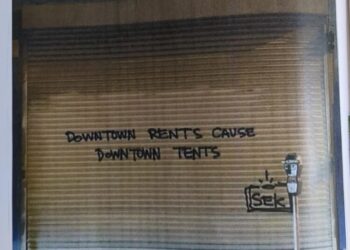
“It’s a dreadful thing to be poor not because poverty is hard but because social reality defines poverty as failure or as that otherness that is not acceptable,” said Feenstra. As a minister in Vancouver’s east end, he witnessed the systematic harassment and forcible removal of “all the poor people, the crack addicts, the street sex-trade workers, the beggars, etc.” from that city’s core as a result of a visit from the International Olympic Committee and subsequent aggressive gentrification of the area.
“We think it’s normal that good people have good things so it seems to follow that people who don’t have good things aren’t good people. So it’s easy to invoke police power to move them out of view.”
Feenstra knows that’s a hard thing for people in an enlightened western society to come face-to-face with. His personal experience with poverty suggests that this is not an aberration and that it goes on more often than not. “And it goes on systemically.” Feenstra argues, asserting that there are social processes and structures that make it impossible for the most vulnerable people to escape from being perpetually mistreated..”
Sociologist Mike Fleming agreed that the root of the problem is a structural one, citing works of famous sociologists C. Wright Mills and Patricia Hill Collins, Brazilian educator Paolo Freire and political philosopher Iris Young. “We’re too concerned by necessity about our own lives. Paying the bills at the end of the week, getting groceries, the everyday impacts of living in modern society. Mills calls for a way of bridging the gap between these individual traps and the broader social structure in which we live. Making that connection, recognizing that we’re not alone and that the other people are not alone. Recognizing that the person sleeping on the walking trail near Smythe Street is not sleeping there because of a series of bad choices they made but often because of a social structure that requires it of them.”
Fleming said it is a popular misconception that oppression is something that occurs in other parts of the world; that while we have inequality — an individual problem, we no longer have oppression — a structural problem.
Several audience members voiced their concern about feeling helpless in knowing how best to bring about change. Feenstra responded that one of the cornerstones of the democratic society is the responsible citizen and moving from one’s own comfort zone into the public domain is critical. “If the citizen abdicates and goes into a kind of passive-receptive mode where all they do is have their little corner of comfort and security reinforced and the citizen doesn’t learn how to think through things then our dilemma persists.”
Edee Klee is a member of the NB Media Co-op.

![University security closely monitored pro-Palestine activists, documents show [video]](https://nbmediacoop.org/wp-content/uploads/2024/11/20231129_131826-120x86.jpg)