During the early afternoon of May 10, 2022, Chief Hugh Akagi of the Peskotomuhkati Nation took the stand at a public hearing concerning an application for a 25-year renewal of the Point Lepreau Nuclear Generating Station by NB Power. If granted, the requested licence would be the longest in Canadian history.
That day, sitting among a crowd of journalists and activists, I took notes while watching the afternoon unfold.
“When we deal with Canada agencies, I’m always dependent upon legal advice,” Chief Akagi told the commission. “One of the biggest warnings that always comes across my plate is: ‘Be very careful. An agreement sounds good, but it’s a legally binding document and it can compromise your treaty rights.’”
“What about the real conversations about what we’ve lost?” he continued. “They took the land. They took our resources, our livelihoods. That’s the currency I would like to talk about. These are not conversations that are popular in any room.”

“I have never considered signing on the dotted line. There is no checkbox for me,” Chief Akagi continued. “I understand the need for agreements, but I am asking you, please understand that I will not hurt my Nation.”
As Chief Akagi finished, the crowd began to cheer and clap; applause rang throughout the Delta Hotel’s ballroom.
Saddened, Chief Akagi said: “No, don’t clap. This is not a performance. If people clap it’s a performance. This is who I am.”
From my seat, I watched applauding onlookers stuff their hands in their pockets. I thought over Chief Akagi’s words. His critique, I realized, was multifaceted, directed against the very existence of the public consultation process. He was attempting to expose the Canadian Nuclear Safety Commission’s (CNSC) public hearing process for what it is — a theatre for feckless government and industry posturing.
That evening, I spoke with Chief Akagi in his hotel room.
“It was a bit of a feel-good exercise,” he told me. “You can say things in a meeting, in public, but it’s only through time that we will find out if they really did hear our messages, and if they really will help us make a difference.”
The Chief had misgivings about how the hearing process worked. “They’re basically avoiding the issue,” he explained. “Didn’t you find it ironic that every question was being bounced back to one expert? Can you be an expert on everything? They’re very smooth, very polished, and the answers they gave were to basically satisfy the commission. There is no action item in that discussion.”
During the hearing, representatives from NB Power and the CNSC did seem to confuse attendees. I wondered if it was intentional. Both bodies mixed up details surrounding decommissioning costs and deep geological repositories, all seemingly to sidestep questions from interveners.

Historically, “they have bought compliance,” Chief Akagi explained. “We almost never hear words like justice in that room because that’s not part of the agenda. It’s so easy for them, with all their money, all their authority, all their manpower, to minimize us and to destroy us. It’s not like the good old days, where if you wanted to solve the Indian problem, you solved the Indian problem. Today, they’ve got to look like they’re actually supporting the Indian while they’re solving the Indian problem.”
During the hearing, the question of Indigenous sovereignty was ignored by both NB Power and the CNSC’s staff.
“In Canada, all these agencies, including the Supreme Court of Canada, they want to define sovereignty,” the Chief told me. “How can we even think we’re looking at sovereignty when we have to go to the other entity to ask for it? If you have to ask for sovereignty, you don’t have sovereignty. It has to be something that comes from within. They cannot help us define sovereignty. Their recognition is not sovereignty.”
My conversation with the Chief left me with some unanswered, albeit basic questions: Who does public consultation serve? Is involvement within public hearing worth activists’ time and energy? Is the CNSC really concerned about investigating issues being levied by the public?
The very organization of the public consultation process obfuscated the goals of environmentally conscious activism. The CNSC’s public hearings held in January and May concerned a very limited portion of the nuclear debate: They focused on the length of NB Power’s licence of the Point Lepreau Station. Questions regarding Small Modular Reactors, nuclear waste management, and the future of nuclear expansion were dismissed by NB Power and the CNSC staff as irrelevant to the consultation.
Yet, the nuclear establishment is a risk-generating industry, and by segmenting nuclear consultations into easily digestible, bite-sized pieces, governmental panels like those held in Saint John make ending or even changing the nuclear establishment impossible. Activism becomes performative rather than subversive. In the end, involvement within the hearing process legitimizes nuclear power as an available tool for federal and provincial jurisdictions. Critique becomes mere depoliticized theatre.
According to one critique levied by Darrin Durant and Genevieve Fuji Johnson, scholars with experience researching public policy, “the dominant actors in nuclear decision making tend to underemphasize their role in generating risks.” Public consultations and hearings “can be a subtle means of promoting a narrowly instrumentalist and pragmatic view of the issue in dispute,” allowing governmental bodies to guide activists into doing the task of managing risks rather than opposing them.
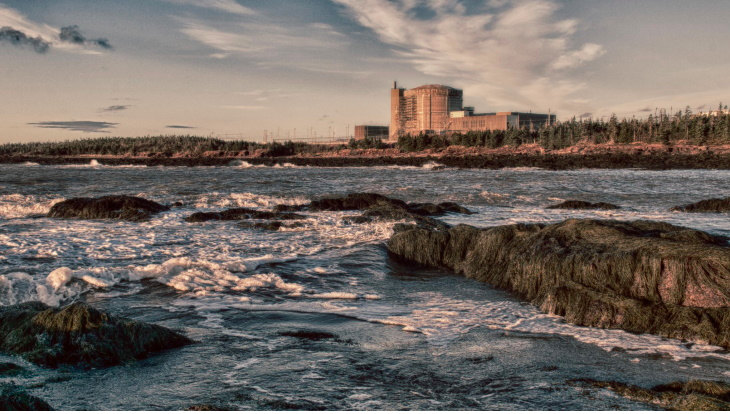
Since fundamental concerns about the future growth of the nuclear establishment are entirely absent from hearing proceedings, environmental and Indigenous resistances are placed on the defensive. Radical inquiries into the feasibility of a nuclear future are instead transformed into depoliticized technical questions about risk management and business logistics. Activists are made to debate the length of reactor contracts, rather than discuss whether or not those contracts ought to exist in the first place. Indigenous representatives are made to publicly decide how much of their land should be used to store volatile nuclear waste, rather than suggest none should exist in the first place.
Indeed, the very question of why and how Indigenous sovereignty is being infringed upon is made secondary to the issue at hand.
Euphemistic language plagues public consultation. The concerned public are converted into business partners, and the ‘invisible hand’ of the nuclear industry is said to be able to enrich all New Brunswickers equally, lifting our collective ‘energy boat’ while leaving nobody behind.
This misrepresentation bypasses uncomfortable truths.
While the nuclear machine continues to crush its grassroots opposition, hefty state subsidies keep the otherwise sickly industry afloat. According to Energy Probe’s estimate, in 2005, state subsidies awarded to Atomic Energy of Canada Limited had ballooned to at least $21 billion, or 12% of the federal deficit. Close-knit relationships fostered between pro-nuclear officials in the federal and provincial governments, business leaders, and nuclear technicians all mean that public-private partnerships funnel public funds toward the very top of the nuclear establishment.
According to Gordon Edwards, president of the Canadian Coalition for Nuclear Responsibility, “every new Minister of Natural Resources is briefed by a phalanx of nuclear advisors.” Drawn from the broader annals of the nuclear establishment, these advisors are uniformly “committed to the vision of a nuclear-powered future.”
Absent from the conversation, then, is the fact that the Canadian nuclear industry is a wasteful, risky, and climate-action-postponing establishment keen on gathering profits for shareholders while relying on untested technology that will only be made available decades into the future.
Indigenous sovereignty, sustainable non-nuclear futures, and critical perspectives are lost in the fray.
Harrison Dressler is a researcher and writer working out of the Human Environments Workshop (HEW) funded by RAVEN. He writes on New Brunswick and Canadian history, labour, politics, and environmental activism.




![NB Update: What comes after the crisis in local journalism? [video]](https://nbmediacoop.org/wp-content/uploads/2025/06/LabourUpdateApr132025-120x86.jpg)