

Editor’s note: This article is the second in a two-part series. Part 1: “The ghost of divine right: Colonial mindset haunts debate over Indigenous title in New Brunswick.”
In his four published commentaries, retired Judge Joeseph T. Robertson blames the Wolastoqey Nation for creating an unprecedented legal conundrum by asserting first possession Indigenous title claim over their traditional territory. In part one of this essay, we have seen that Judge Robertson’s reasoning is logically mistaken in terms of historical sequence. The unprecedented legal conundrum has been created by the imposition of a British Crown-based legal system of colonial property rights over the Wolastoqey Nation’s traditional territory without their consent.
Nonetheless, Judge Robertson has the temerity to insist that the only proper way to deal with this legal conundrum is to challenge the Wolastoqey Nation’s territorial title claim within the legal system that was imposed on them without their agreement. He doubts the title claim will withstand a litigation process that requires a substantial aggregate of historical evidence to support its validity, and thus will fail.
Leaving to one side the unanswered question of what gave the British colonial culture the right to impose its legal system on the Indigenous Wolastoqey culture, one way to test the historical evidence is to take a look at the canoe and portage map of the province prepared by W. F. Ganong in 1899. The travel and transportation routes throughout the Wolastoqey Nation’s traditional territory show that the evidence of its occupation and use is well substantiated.

Or take heed of the story told by New Brunswick’s pioneering archeologist, George Frederick Clarke. While following the trail of a moose deep in the great woods of the province, his companion looked down and spotted an arrowhead revealed in the muddy hoofprint of the moose. He picked it up and said in a hushed voice, “Someone has been here before us.”
There would be no lack of evidence to meet the judge’s proposed challenge should such a court case be undertaken.

Indigenous title and the basis of property rights
When we set the Wolastoqey Nation’s title claim alongside the most well-reasoned statement of property rights to emerge in the development of constitutional government, we find a surprising confluence. It fell to John Locke (1632–1704) to define the reasoning that legitimizes the holding of land as property. This reasoning has now been widely accepted and not substantially improved on since he formulated it in opposition to the Divine Right of monarchy.
Locke reasoned, that the earth, and its potential for supporting human life, was given by God, not to the King and a hereditary monarchy, but to “all people in common without exception.” He further reasoned that the right to hold property in land was legitimately acquired when “men mixed their labour” into accessing the potential of the land and its resources to sustain life. He further argued that the right to the earth’s resources has standing “only if and when there is enough and as good left in common for others.”
Although Locke retained a theological origin for the human-earth relationship, his reasoning about the scope of access to land and its resources — “all people in common without exception” — opened a sense of equity and justice that has been fundamental to social development and the evolving arrangements for constitutional government ever since.
The image that comes most readily to mind from Locke’s right to hold land as property is of the hardworking family investing their labour in a land grant and making it a self-supporting and commercially viable farm, which is how much of the U.S. and Canada was settled by European immigrants. However, this is only one way to “mix labour” into accessing the potential of the land to provide the resources that sustain life.
A sustainable livelihood based on engagement with forests and rivers required a large component of disciplined labour and detailed knowledge of the terrain as well. An economy based on hunting, fishing, and harvesting the naturally occurring food sources of the forest and riverine environments, with a little planting of food crops on the side, which the Indigenous people of the Wolastoq watershed also practiced, was a labour-intensive way of life. Gathering and crafting forest materials into shelters and the making of canoes and leather clothing was a major “mixing of labour” into accessing the potential of the land, as was the crafting of stone, bone, wood, and fibre tools. Accessing the resources of the coastal and marine environment of the Bay of Fundy must also be added to this picture.

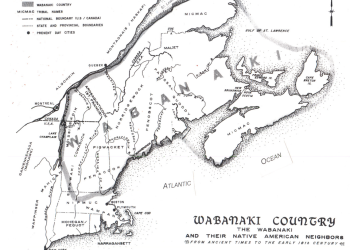
It makes sense that the settlements of the Wolastoqey Nation would have been along the Wolastoq, but the map of canoe and portage routes over the full extent of their territorial claim indicate occupation and use as well. At this point, there is a convergence of the Wolastoqey Nation’s title claim and Locke’s widely accepted definition of what legitimizes property rights in land and the land’s resources.
A 300-year treaty violation
An Indigenous Elder recently asked, “Who is ‘truth and reconciliation’ for? We haven’t done anything wrong.”
There comes a time in what is now called the “truth and reconciliation” process for the historically imposing culture to stop contesting Indigenous nations’ title claims over their traditional territories in the province of New Brunswick. The opportunity has now come to enter a new era of respect and full recognition of the historical substance and present reality of Indigenous title claims.
Judge Robertson’s legal conundrum of colonial property rights and Indigenous title existing simultaneously over the same territory is not likely to be resolved by the legal system that caused it. The Peace and Friendship Treaties of 1725–26 between the British Crown and the Indigenous nations of this region did not require the extinguishing of Indigenous title to their territory, but rather the sharing of land and resources. Since these treaties, and similar subsequent treaties, are the only governing documents that define Indigenous-settler relations, they remain in effect to this day.
But for the last 300 years, in contravention of these treaties, the colonial legal system has been converting Wolastoqey land into private and corporate property without any legal basis to support this appropriation. Colonial and then provincial administrations simply assumed all land was Crown land which they had the right to dispose of as they saw fit. But it wasn’t, and they had no legal right of disposition, according to the Peace and Friendship Treaties.
Colonial and provincial property rights are an overlay on Indigenous territory that was never legally acquired. An administrative violation without a legal context has been perpetuated for 300 years. The legal system that looked the other way during all this time is in no position to adjudicate this conundrum. It seems likely an extra-legal process of good-faith negotiations will be needed to address and handle the complexity of the case.
Despite Judge Roberson’s objections, the turn of the current government in this direction may signal that a new era of respect and recognition has arrived with regard to Indigenous territorial title claims in New Brunswick.
Keith Helmuth is a co-author of Tappan Adney: From Birchbark Canoes to Indigenous Rights and the publisher of Chapel Street Editions. He lives in Woodstock, New Brunswick.





![No timeline yet on pay equity bill promised during election campaign [video]](https://nbmediacoop.org/wp-content/uploads/2025/03/PayEquityMar112025-120x86.jpg)
