

Editor’s note: This article is the first in a two-part series.
Judge Joseph T. Robertson has written four commentaries of legal analysis and considered opinion on the question of property rights and Indigenous title that have been published in the Telegraph-Journal.
The judge, although retired, inevitably speaks from within the shadow of the bench. This has the effect of giving his analysis the scope of legal reasoning and his opinion the weight of judicial ruling.
In making his case for why the Government of New Brunswick should continue with litigation against the Wolastoqey Nation’s title claim to their traditional territory rather than turn to negotiation, he argues that the claim must be put to the test to see if it meets the legal standard of historical evidence. Challenging the legitimacy of the claim in court, he argues, is the only way to conduct this test.
In making this demand, Judge Robertson is reasoning from a particular feature of his cultural tradition. It is a feature on which the worldview of legal reasoning on property rights in the British tradition was originally based and from which it has evolved.
In order to more fully understand the cultural feature on which Judge Robertson’s arguments rely, it is helpful to uncover a bit of British intellectual and cultural history before turning to the context of Indigenous title. Although the British tradition of what legitimizes property rights has evolved, it retains an attitude that continues to colour certain assumptions.
In this context, it is necessary to ask what gave the British the right to claim a certain part of this continent was the property of their King, and, thereby, displace Indigenous cultures and install their own?
Where do property rights come from?
The first solidly articulated philosophy of property rights in the British legal tradition can be traced back to Sir Robert Filmer who lived during the reigns of King James I (1603–1625) and King Charles I (1625–1649). Filmer was trained in the study and practice of law, but his forte was political and legal philosophy based on a theological reading of history.
The feudal system had come to an end at this time. Legitimate governance and legal authority were increasingly contested. Hobbes and Locke were working toward a contractual and constitutional basis for legitimate governance and legal authority, but their efforts, being abstract and ahistorical, were not widely influential at the time.
Filmer, in vivid contrast, supported monarchy. He supplied a widely persuasive argument for monarchy being the only legitimate form of governance and legal authority. He anchored his argument in the universally held (in the West) theological worldview of the time and supported it with historical narratives, both biblical and post-biblical, that matched this theological worldview. In addition, Filmer was uncompromising; monarchy was absolute. All legitimate authority and law making emanated from the King. In his view, Parliament and its two houses were consultative bodies, nothing more.

The logic of Filmer’s case with regard to owning land — property rights — goes like this: God is the creator of the earth and is therefore its owner. The King is God’s divinely ordained authority on earth. God bestows on the King the complete and absolute authority of divine right including ownership of all the land and its resources in the monarch’s kingdom. This means the King can assign property rights in land to his subjects at Royal discretion.
In addition, divine right includes complete and absolute authority to create and adjudicate law, allocate and utilize the kingdom’s resources, make all decisions and take all actions required for the governing of the kingdom, or assign the authority to administer such duties and responsibilities to agents of the Crown.
Not only did this theologically-based, political and legal philosophy fit well with the contemporary worldview, it set the stage for the globally expanding reach of the British Empire. How was it that when the British began to explore and then settle vast reaches of this continent, they could claim that the territory was now owned by the King?
It was simply by virtue of the divine right with which God had invested the King that this ownership of new territory was established. A fiat declaration of the King’s ownership was all that was needed to extend the “legal” context of the monarchy. As the monarch’s kingdom expanded, the divine right of ownership was considered to apply as fully to newly discovered territories as it did to the home territories in Britain.
Now it is true, as the decades turned into centuries, the theological warrant of divine right faded, and civic agreement around contractual and constitutional governance and legal authority came more and more into effect. But it did not disappear. A nod to the ghost of divine right occurs every time we speak of Crown land.
Crown land is a concept in which the shadow of divine right continues to be seen. A direct line of descent can be traced from King James I, who insisted on absolute monarchy, and from Sir Robert Filmer who wrote an influential book of legal philosophy to back him up. (Patriarcha or the Natural Power of Kings)

While nobody today would likely argue that Crown land is legitimized by divine right, it is the case in the development of constitutional government that a remnant of authority, functioning like divine right, remains. For example, the provincial government of New Brunswick retains ownership of all sub-surface mineral rights and can dispossess private property owners of their land through the legal process of expropriation. The legal right of expropriation, for example, was also dramatically exercised in the creation of the Mactaquac dam and its headpond.
When the worldview of divine right lost credibility, civic agreement legitimized constitutional government, which gave itself the authority to legitimize property rights; or, as the case may be, to abridge them. In either case the lineage of the tradition goes directly back to the authority of the Crown and the divine right of the King.
Judge Robertson, in his recent commentaries for the Telegraph-Journal, begins his legal reasoning in the modern era of civic agreement and constitutional government. But the whole tradition of the Crown’s authority and the cultural attitude of the right to impose this kind of legal reasoning hovers just off-stage. It is as William Faulkner said; “The past is not dead. It’s not even past.” Meanwhile, the reality of Aboriginal title pre-dates by thousands of years the authority of constitutional government, the Crown, and the divine right of the King.
So, we come back to the question which was earlier asked, and now returns with a sharper focus: What gives an invading culture the right to impose its legal system over the territory of a long settled Indigenous culture on which it is encroaching?
Where does first possession Indigenous title come from?
Judge Robertson asks, how can private property rights and Indigenous title be said to exist at the same time over the same territory? He sees the proposition as a legal conundrum which is being caused by the Wolastoqey Nation’s insistence that a title claim to the whole of their traditional territory remains valid even though private property rights have long been claimed over the same terrain.
But in the matter of historical sequence, the causal factor of this legal conundrum is the overlay of property rights imposed on traditional Wolastoqey territory by the invading culture. Historically, when land ownership passed from Indigenous cultures to settler cultures it did so in one of three ways: 1) as the result of defeat in war; 2) treaty agreements that explicitly ceded territory to the invader; 3) the purchase of territory in which the title passed from one owner to another.
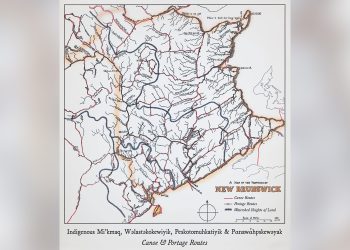
None of these circumstances occurred with respect to the history of the Wolastoqey Nation’s relationship with their traditional territory. In contemporary terms, title to their claim was never breached. It stands as a historical reality from as long as their ancestors have lived on and derived their means of life and livelihood from the resources of this region; perhaps for 10,000 years or more. This is where first possession title comes from.

The well-known Peace and Friendship Treaties that were agreed to, starting in 1725-26, make no mention of ceding land or surrendering territory. What is stipulated is that the Indigenous peoples of the region will not “molest” the incoming settlers on their homestead farms, and, in return the Indigenous people will not be “molested” in their ability to conduct and maintain their traditional way of life.
The logic of the promise made to the Wolastoqey Nation implicitly recognizes access to the resources of the traditional territory on which Indigenous communities relied to conduct and maintain their traditional way of life. To remain “unmolested” in their way of life required continued access to and use of the resources of their traditional territory and freely travelling within it—an oversight and caretaking function, the kind of collective, proprietary relationship that warrants the designation of “title.”
While the promise made to the settlers was kept, we know, of course, that the Wolastoqey communities did not remain “unmolested” in access to the resources of their traditional territory and thus to the conduct of their way of life. Their territory was steadily encroached on by colonial settlement and eventually parceled out as private property, corporate holdings, or Crown land, as if it had all been ceded and their title extinguished; which it wasn’t and never has been.
Thus, Judge Robertson’s conundrum is a dilemma created by the imposed legal system of which he is an advocate rather than a problem caused by the Wolastoqey Nation’s title claim.
Keith Helmuth is a co-author of Tappan Adney: From Birchbark Canoes to Indigenous Rights and the publisher of Chapel Street Editions. He lives in Woodstock, New Brunswick.





![Is a Moncton company helping to build jet fighters bombing Gaza? [video]](https://nbmediacoop.org/wp-content/uploads/2024/06/ApexMay192024-120x86.jpg)
