Over the past year, as the U.S. national security apparatus escalated its campaign against civilians, uncomfortable questions surfaced in Canada about the role of Canadian companies in enabling that machinery.
Several Canadian firms have been linked to U.S. Immigration and Customs Enforcement (ICE), including through investments affecting many Canadians — often without their awareness of the connection.
Last month, reports revealed that major Canadian pension funds and banks – such as the Canada Pension Plan (CPP), the Ontario Teachers’ Pension Plan, the Caisse de dépôt et placement du Québec, and Desjardins — have provided tens of billions of dollars in support to U.S. companies that have contracts with ICE.
According to research by Stand.earth, CPP alone has invested US$1.6 billion in companies that hold major ICE contracts.
These investments are in addition to other Canadian business ties. Last year, it emerged that ICE ordered 20 armoured vehicles from Brampton-based defence manufacturer Roshel and Ottawa’s ICOR Technology supplied ICE with a law-enforcement robot. Vancouver’s Hootsuite provides social media management services to the Department of Homeland Security, which oversees ICE, and a U.S. subsidiary of Toronto-based Thomson Reuters gives ICE access to a law-enforcement database.
These are not abstract relationships. They risk placing Canadian companies — and even Canadian pension holders, indirectly — in the chain of responsibility for actions that many human rights observers have condemned. Yet Canada has no binding legal framework for holding companies accountable for harms caused abroad.
Other countries do.
When the U.S. subsidiary of French technology giant Capgemini signed a contract to provide ICE with surveillance tools, public outrage in France was swift. The company’s CEO attempted to distance the Paris-based parent from its American arm, claiming ignorance and limited control. The French finance minister publicly rejected that defence, insisting that multinational corporations have responsibilities regarding their subsidiaries’ conduct.
French law backs that position.
Since 2017, France’s “duty of vigilance” legislation has required large corporations to identify and prevent human rights and environmental risks linked to their global operations. Companies can be held liable in French courts for failures abroad. A European-wide regulation inspired by this model is set to extend similar obligations across the EU by 2029.
Canadians do not want their corporations quietly embedded in systems that contradict this country’s stated commitment to human rights.
Faced with mounting scrutiny, Capgemini’s board announced in February that it would sell its U.S. subsidiary, acknowledging that oversight had fallen short.
Canada imposes no comparable duty. Instead, the federal government relies heavily on voluntary corporate codes of conduct, guidelines without teeth. When controversies arise, accountability depends largely on public pressure.
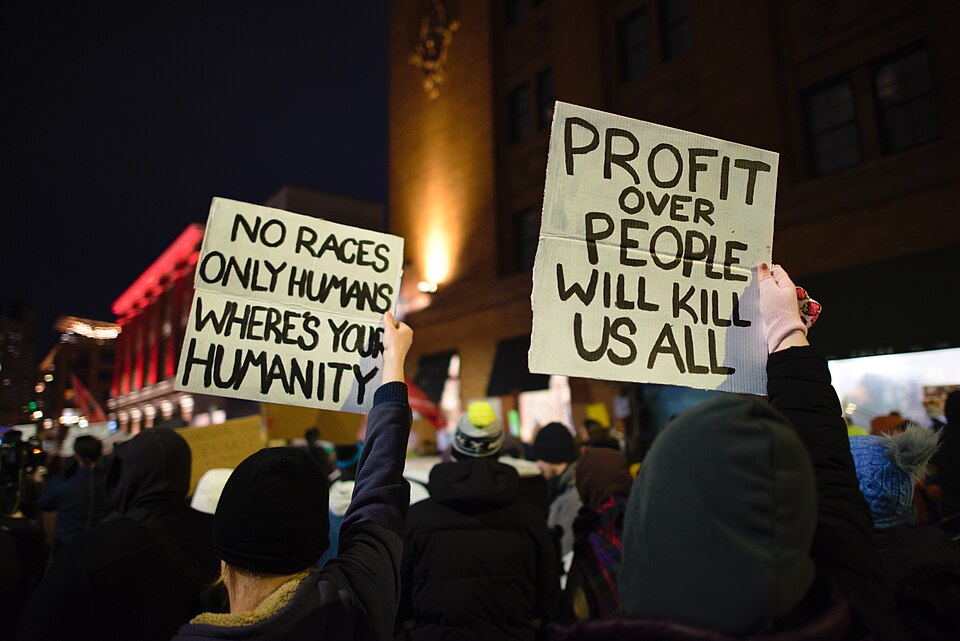
And that pressure is building.
In February, protesters gathered outside GardaWorld’s Montreal headquarters over its involvement in the Florida detention facility widely known as “Alligator Alcatraz,” where allegations of abuse have circulated. The company has since been awarded a contract of up US$704 million to renovate and operate a new detention facility in Arizona, drawing further criticism.
![NB Update: What comes after the crisis in local journalism? [video]](https://nbmediacoop.org/wp-content/uploads/2025/06/LabourUpdateApr132025-350x250.jpg)