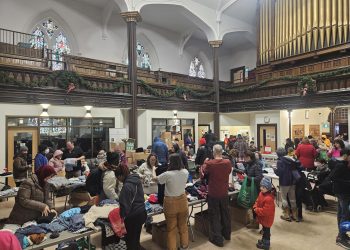
A Saint John audience was recently asked, “What are things that all people need?” Food, shelter, safety, water and freedom were heard from the crowd gathered at Haven Music Hall.
Sarah Durham and Quinn Carvey of the Saint John Community Coalition, a network of grassroots organizations, organized the “Basic Needs” panel with service providers on September 19.
Misty Schofield, a social worker with Fresh Start Services, a local shelter, Meghan Gulliver, a counselor with Port City Counseling, and Martha Maclean, a dietitian and organizer with the Saint John Food Purchasing Club comprised the panel.
Schofield, an Indigenous Red River Métis woman, spoke about differential access to social programs due to racism and sexism. Indigenous people are excluded by being removed to separate areas, she said.
Gulliver, who focuses on radial mental health practice, added ableism to the list of how people are excluded from social programs.
People with serious mental illness or addictions often face violence and marginalization. Gulliver pointed to the vicious cycle of poverty-homelessness-food insecurity, and an overstretched health care system that further exacerbates this cycle.
The conversation turned to gaps in social services and health care in the port city. Charitable models for food and housing, initially envisioned as interim solutions, have become mainstream and permanent to fill the gaps neglected by the state, noted MacLean.
“The issue is not just hunger, it is food security, nutrition and the ability to choose,” added MacLean.
Gulliver and Schofield discussed the carceral nature of state intervention that involves the policing of the poor, the mentally ill, substance users and other marginalized communities. They pointed to the recent police killing of Steven “Iggy” Dedam, a Mi’kmaq man, when he was in distress, and to the controversy around Premier Higgs’ announcement around mandated rehab for substance users.
The panelists emphasized the need for abolishing the police in mental health contexts and the need for building mutual aid peer networks instead.
Prison also becomes part of the cycle for marginalized people, who then face further barriers in accessing social supports after getting out, Schofield said. Police and state institutions, including social workers, have a history of harm in indigenous and marginalized communities. “Yet we are misleadingly taught to equate these institutions with safety,” Gulliver added.
Gulliver discussed the neoliberal, cis, male and settler normative definitions of efficiency and productivity focusing excessively on personal responsibility and how this results in exclusion of certain groups from access to services and funding.
On alternatives to the neoliberal model and the feeling of helplessness against the global economic system, Schofield proposed mutual aid and contrasted it with the top-down charity model. She mentioned the ubiquity of sharing food and resources in Indigenous cultures. She also used the financialization of housing and its relation to rising homelessness as an example to advocate for more socialist economic models.
Gulliver emphasized the value of listening to people on the margins and elevating their voices instead of deciding for them. “Despair is the tool of empire,” she said.
MacLean noted that there are enough resources, but the lack of political will and excess bureaucracy needs to be challenged through collective organizing, combating misinformation, and going beyond theoretical top-down models.
When asked about their individual experience working on the ground, Schofield, a social worker and an Indigenous woman, said she often deals with aggression and condescension from law enforcement, state officials and even her colleagues at times.
“Service users are not supposed to be service providers,” Gulliver added, pointing at the inherent biases in the system of mental health care.
Schofield noted the frequent moral judgments of who is deserving of social services and who isn’t. Further, atomized thinking is entrenched in society but “no one did it all by themselves,” she said.
“We can appeal to people’s curiosity and invite them in to support local mutual aid,” MacLean said. “People aren’t poor or ill by choice, it is mostly by design.”
“People don’t realize that they can check all the right boxes and still end up in poverty,” added Gulliver. She highlighted the importance of having conversations that challenge power and recognize systemic issues stemming from neoliberalism, patriarchy and colonialism.
“Most of us are lot closer to people at the bottom than to people at the top. We might be one wrung up from someone, but the overlords throw breadcrumbs and we fight over them,” an audience member quipped.
The final topic for the panel concerned the collection and use of data in policymaking and advocacy for basic needs.
“New Brunswick doesn’t do a good job with data collection, a lot of important information, like the cost of food, is either hidden or not collected,” MacLean said. This is a convenient way of obfuscating systemic issues.
Schofield commended the work of Human Development Council in Saint John for collecting data on various social indicators and making it accessible to the community. She also emphasized the need for respecting people’s autonomy, “data can always be used to target marginalized groups and people should be given the option to opt out of giving identifying information.” Social services should involve the least amount of data and people should not be penalized for opting out, she said.
“Qualitative data in the form of stories and lived experiences is equally important,” Gulliver added. Outcomes can be different for people with different intersectionalities and any analysis of these outcomes must include such qualitative features, she said.
“Stories are important when talking about data, which can be abstract. People relate to stories way more,” an audience member commented.
In their closing remarks, the panelists advised against making assumptions and judgments about people on the margins and reiterated the need to build communities of care, where relationships are not transactional. “Make eye contact, see them and treat them like the next person,” Schofield said.
This panel was the second in the Connections panel series, designed to provide space for difficult, but important conversations relevant to the community in Saint John. The first one, on August 29, titled “Systems of oppression” was a broad discussion on systemic economic and cultural forces. The next, on October 24, will be on “Gender and Sexuality.” Find more information and stay abreast of future panels by registering here.
Nomaan X is an organizer with the Saint John Community Coalition and Fredericton Palestine Solidarity, and a teacher on the side.