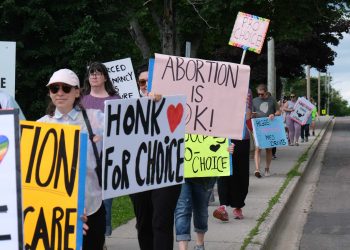
I was crossing the New Brunswick border in November of 2020 when I first read about Clinic 554, which at the time was up for sale due to lack of funds. It was Fredericton’s only abortion clinic, where the owners were frequently paying out of pocket to cover the costs of the procedure. Having spent my life between Toronto and Montreal, this came as a shock to me, but my move to the east coast had been on a whim, and I felt I would navigate reproductive health care the same way I would navigate every other aspect of arriving somewhere I’d never been: somehow, and later.
Now, four years later, I am miscarrying after two failed abortions and countless appointments with health care professionals who either didn’t know what to do or couldn’t do it.

Doctors, nurse practitioners, OBGYNs, and nurses gave me what at times felt like randomly-generated information. I was told I would lose every possible future pregnancy if I didn’t receive a blood product injection within 72 hours of my miscarriage beginning. I was told there was no need for the injection. I was told I could have the injection at any time. I was told things were looking optimistic at my eight-week scan when I was measuring only six weeks along. I called clinics who told me they didn’t do bloodwork, couldn’t refer me elsewhere, weren’t taking appointments until the end of February. I brought my medical abortion prescription to a pharmacy where I was told the pill could be ordered, but I should go somewhere else. Every time I asked anyone anything, the information contradicted something else I’d heard.
Twice I laid on my bedroom floor for hours, waiting for Misoprostol to dissolve inside of me, braced for the severe pain detailed by countless users on online forums, only to discover that nothing at all would happen. I wondered if this had been because I was prescribed Misoprostol alone, rather than in combination with Mifepristone, the other “abortion pill.” I received contradictory responses to this question as well. I talked to more doctors and nurses. “Truthfully, I have no idea,” said one nurse during an online medical appointment. She suggested I get an ultrasound and sent the addresses of two clinics in the city. I called both, and neither had an ultrasound machine.
A clinician at my university told me to go back to the ER and get bloodwork and an ultrasound immediately. The triage nurse at the hospital immediately sent me home, as miscarriage and abortion are not emergencies.
I stopped asking, “How can I get an abortion?” and started asking, “What’s going to happen if I don’t?” One doctor told me I could wait a maximum of three weeks for my body to miscarry on its own, at which point I would need a procedural abortion. My own research told me it can take eight or more weeks for the body to miscarry naturally, but that would also mean losing more weeks of my life to the pregnancy symptoms. I could drive to the hospital in Moncton for a procedural abortion, two hours away, but I couldn’t get through to them when I called. It could also happen at my local hospital, but I would be, in the ER doctor’s words, “the bottom of the barrel,” waiting more than 24 hours with no food or water in preparation for surgery under general anesthesia.
The holidays were quickly approaching and it was becoming increasingly difficult to get through to anyone. I’d been spending most days in bed, continuing to experience all of my pregnancy symptoms despite the pregnancy itself no longer developing. At 10 weeks pregnant, I was starting to lose my mind. I looked pregnant, which was probably more to do with bloating than my uterus having grown, but my clothes weren’t fitting and I could barely stand to see myself in the mirror. I researched combinations of herbs that can be brewed into a tea that induces abortion. I punched myself in the abdomen. Friends in other cities offered to arrange surgical abortions and have me stay with them. Plans for Christmas dinners and brunches, New Year’s Eve, piled up in my calendar.

Online, I read stories of women waiting too long for their miscarriages to happen, getting sepsis and dying. I read about patients whose miscarriages led to infection, uterine scarring and, in turn, infertility. I read about abortions performed without pain medication, about patients taking Misoprostol and bleeding out in their bathrooms.
Finally, on Christmas Day, at 11 weeks, I started to miscarry. Four days later, it’s still happening. My hormones are dropping, meaning I have almost completely resumed my normal routines over the past few days. I’m not nauseous, I can go for walks, I’m not spending full days researching possible complications. Once or twice a day I’ve been having cramps so painful I can’t think. These have been the best days of the past two months.
It’s possible I will still need a procedure to remove what they call “retained product of conception” if my miscarriage is incomplete. But, as with all things, I will deal with that somehow, and later.
In a building beside where the abortion clinic used to be is a pro-life organization who trick pregnant people, luring them in and shaming them for considering termination. When the clinic was open, they were known to harass anyone caught entering. I frequently walk by on my way downtown, and remember when I first saw the sign and felt glad to see something called a “Women’s Care Centre.” I think of patients who are coerced or forced to carry unwanted pregnancies, who don’t have access to vehicles or are unable to spend full days
in the ER. Those who can’t get to hospitals in other cities or whose pregnancies went undetected for too many weeks and no longer qualify for the procedure. As a patient with a wanted pregnancy, I felt I was some sort of “abortion royalty,” being let through the door of the hospital, but even for me it became increasingly clear that despite treatment being offered to me, it would not be easy to get.
I don’t know if it is helpful for me to share all of this, but I’m not sure what else to do. Susan Holt, the new premier of New Brunswick, recently lifted the restriction that stopped Medicare-funded abortions in clinics. Although this is good news, it does not mean abortion care is more accessible right now.
In the meantime, here are some resources that helped me, and kept me from losing my whole mind while navigating the local healthcare system: Reproductive Justice New Brunswick’s website, My Choice NB’s website, Action Canada’s website and the Abortion Access Tracker.
If there is ever anything I can do to help someone else looking for help or answers, I am available.
Fawn Parker is an award-winning author and PhD student living in Fredericton. The original piece was published here on Dec. 30, 2024.
Correction: This commentary was corrected on January 15, 2025 at 1:15pm to remove the incorrect reference to the two-doctor rule and to clarify the ban on in-clinic abortions being related to the public coverage of abortions.