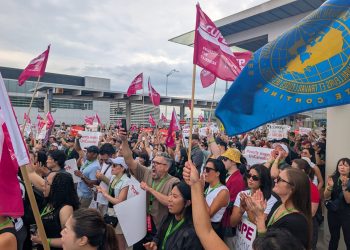
Two opposing trends are discernible in today’s Canada. On the one hand, there is the Canadian government’s increasing emphasis on militarism, especially under Prime Minister Mark Carney, through massive expenditure on the military-industrial complex in budget 2025, while cutting pretty much all other areas, and drafting plans for mobilizing more recruits into the military. But, on the other hand, there is growing resistance to militarization, including through protests and legislative efforts. A specific site of conflict between these trends is the F-35 aircraft.
The F-35 is a fighter jet, sold by the U.S. military behemoth, Lockheed Martin, at an astronomical cost (drawing criticism even from Elon Musk). Because of its technological capabilities, however, the F-35 promises to allow the United States and its military allies to maintain global dominance. In recent years, the aircraft has featured frequently in Israel’s bombing campaigns of Gaza, Lebanon, and Iran. In April 2024, US General and Director of the F-35 Joint Strike Fighter Program Office Donald Carpenter boasted that “every day, Israel puts between 35 and 39 F-35Is into the air”. But, as Science for the People Canada has carefully documented, the F-35 was also involved in earlier fatal attacks on the occupied Palestinian territories, including in May 2021, August 2022, and July 2024.
In Canada, the F-35 came into the news this past year following Carney’s call for a review of a deal, announced in January 2023, to purchase eighty eight F-35 planes, costing $19 billion. Since then, the process adopted seems to be aimed at delaying any decision. A group of bureaucrats were tasked with examining the plans and the military’s needs. They were to have completed this by the end of last summer but missed that deadline; in November 2025, the Minister of Defence refused to commit to a new timeline. The following month, the Globe and Mail announced that the Department of Defence plans to acquire “Joint Direct Attack Munitions and Small Diameter Bombs” that can be used in F-35s and other aircraft.
Opposition to the F-35
In parallel, there has been an increase in protests against the F-35, in large part because of public outrage against the genocide in Palestine. In the Gastops’ factory in Ottawa that produces engine sensors for the F-35, protestors “cut the wiring inside all of the heat pumps on the Gastops roof, locked them out with official Ministry of Health and Safety lock-out tags, shut off the gas, broke the handles for their systems, and cut the lines to their backup communication system on the way out”. That is just one example.
Canada is also not alone in this trend and there have been protests around the world aimed at halting global shipments of F-35 parts and other warfare materials. (Some protests have other motivations: for example, those aimed at blocking the deployment of the F-35 in the United States, in places like Dane County, Wisconsin and Burlington, Vermont, due to the aircraft’s impacts on local communities.) Dockworkers in multiple countries, including in the United States, in France, in Morocco, and in Spain, have refused to load ships that were involved in supplying Israel’s military. And airport unions in Belgium have called on their members to refused to handle weapons shipments to Israel. These are collective actions with personal risk, and they are growing across the world.
One site of protest has been Moncton, NB where activists have demanded that the local company, Apex Industries, stop shipping parts used in the F-35 aircraft. The company entered into an agreement with Lockheed Martin in 2013 to provide some aluminum metallic parts for “the wing and the forward fuselage” of the aircraft. At that time, Lockheed Martin announced a three year contract with Apex Industries.

Apex is one of “about 30 companies in Canada… currently involved in the F-35 program” according to Lockheed Martin. World Beyond War has compiled a list of most of these companies and mapped them. Speaking to CBC as part of a story that describes, even extols, the synergy between the company and Canada, a Lockheed Martin official explains that “more than 110 companies in Canada have contributed to the program since its inception”. The disparity between Lockheed Martin’s claims of “110” and “about 30” means that companies do not receive stable contracts, and many don’t remain suppliers for long. (Apex’s contract was extended, and in 2017, Lockheed Martin listed Apex Industries as one of the 27 top-performing suppliers for the previous year.) Nevertheless, it is these contracts and the involvement of Canadian companies that politicians play up when they want to promote a contract with Lockheed Martin.
Two examples are Prime Minister Stephen Harper in 2010 and Liberal Defence Minister Anita Anand in January 2023. Even Prime Minister Carney, when he was on the campaign trail, emphasized that his “bottom line is how beneficial the deal with U.S.-based Lockheed Martin is for Canadian workers and the economy”. Unsurprisingly, Lockheed Martin offered to create more jobs in Canada when cancellation of the contract became a possibility.
The supposed ability to create jobs is a key argument in the United States as well. In 2011, when testifying before the Senate Armed Services committee, a Lockheed Martin official boasted that the program “involves more than 1,300 suppliers in 47 states and supports nearly 127,000 direct and indirect U.S. jobs”, thus creating what national security researcher Dan Grazier termed a “veto-proof constituency bloc on Capitol Hill”. At a more global level, Project Ploughshares has documented that Lockheed Martin had entered into contracts, valued at more than US$41.5 billion, with 609 manufacturers from at least 14 countries.
Supply chain vulnerability
At the same time, the widespread nature of the F-35’s supply chain is also a source of vulnerability. For those who are opposed to the genocide perpetrated by Israel and militarism more generally, this vast supply chain allows local activists to interfere with the steps necessary for the production of the F-35 and parts being shipped off to carry out mass murder.
Thus it was that World Beyond War, an organization working to stop weapons being sent to Israel, could mobilize protestors to block the truck route into the Asco facility in Delta, British Columbia. That factory produces one of the biggest parts of the plane: the titanium bulkhead nose. Elsewhere, the confederation of trade unions, CSN, which “called for an immediate ceasefire, the halt of Canadian military exports, direct and indirect, to Israel, and the lifting of Israel’s blockade of the Gaza Strip”, managed to force a near cessation of production of the “complex structural machined parts and assemblies” needed for the F-35 by encouraging workers at the Héroux-Devtek aerospace company in Laval, Quebec to stay on strike.
And in New Brunswick, the NB Federation of Labour, the largest labour group in the province, has called on unions to refuse handling any weapons shipments for Israel. This follows a legacy of the “no hot cargo” actions in St. John: first in 1979, when workers collaborated with international activists to block nuclear supplies from being shipped to Argentina, when it was ruled by a military dictatorship; second, in 2003, when the Saint John Longshoremen protested Canadian military shipments during the war on Iraq; and third in 2018, when a picket line was formed to protest Canadian military vehicles being used in Saudi Arabia’s war on Yemen.

Putting pressure on the government
Another form of pressure on the F-35 supply chain has been at a national level. In March 2024, after months of organizing and pressure, Canada’s House of Commons passed a non-binding motion that officially called on the Government of Canada to “cease the further authorization and transfer of arms exports to Israel.” Following this motion, then foreign affairs minister Mélanie Joly confirmed that the government would halt future arms sales to Israel.
Though that assertion was a positive step, there are still many loopholes, as detailed by Project Ploughshares. In particular, as with the parts of the F-35 aircraft, Canada continues to indirectly arm Israel by exporting to the United States.
This is one of the loopholes that NDP MP Jenny Kwan (Vancouver East) has been targeting through a Private Member’s Bill in the House of Commons. The reaction from the Liberal party has been unsurprisingly negative, and the NDP lacks the seats in Parliament to force the government to comply. Yet, this Bill represents one way people around the country can exert some influence, by calling upon their Members of Parliament to support this effort.
The F-35 is a force for destruction. It is responsible not just for the devastating situation in Palestine but also, most recently, the attack on Venezuela that led to the abduction of President Nicolas Madura also featured F-35 aircraft. Canadians should try to do what they can to obstruct the production of this destructive weapon.
Janani Rangarajan is a graduate from the International Relations program at the University of British Columbia and a freelance writer. Lydia Mikhail is a graduate from the Political Science program and the Vancouver School of Economics at the University of British Columbia. M.V. Ramana is the Simons Chair in Disarmament, Global and Human Security and Professor at the School of Public Policy and Global Affairs, University of British Columbia; he is the author of, most recently, “Nuclear is not the Solution: The Folly of Atomic Power in the Age of Climate Change” (Verso books, 2024).
![Is a Moncton company helping to build jet fighters bombing Gaza? [video]](https://nbmediacoop.org/wp-content/uploads/2024/06/ApexMay192024-350x250.jpg)
![Massive increase in military spending imposed by U.S. with little media pushback [video]](https://nbmediacoop.org/wp-content/uploads/2026/10/AlexCoshSept232026-350x250.jpg)