

What did Canadians get for the $4.5 billion in public funding spent on small modular nuclear reactor (SMR) activities? Our new report assessing SMR development in Canada found the results underwhelming, to say the least.
Published in 2018, “A Call to Action: A Canadian Roadmap for Small Modular Reactors” recommended that the federal government fund SMRs and undertake other support measures. The report’s first “expected result” was that “one or more SMR demonstration [projects would be] constructed and in operation by 2026.” Our report covers not only this expected result but also what the federal government has provided in funding for SMRs in Canada.
For many years, the “Micro Modular Reactor” (MMR) proposed for the Chalk River nuclear site in Ontario was to be this first demonstration. Back in 2019, the project proponents applied to the Canadian Nuclear Safety Commission (CNSC) to prepare the site for construction.
Fast forward to 2024: instead of the reactor built and being prepared for becoming critical, CNSC announced they have “paused all work” on the MMR project. Later that year, the company leading the project filed for bankruptcy protection in the United States, leaving unpaid debts of more than $16 million including $641,307 to the Canadian Nuclear Safety Commission and lesser amounts to dozens of small Canadian businesses.
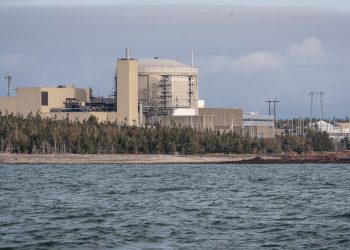
In 2018, the New Brunswick government lured two start-up SMR companies into the province from the U.S. and the U.K – ARC and Moltex – giving each $5 million and help to apply for funding from federal taxpayers. The SMR strategy called for two “advanced” reactor designs, which were not cooled with water, to be built at NB Power’s Point Lepreau nuclear site. Both designs have serious problems that have been documented extensively (for example, in the Bulletin of the Atomic Scientists) .
Over the next five years, the federal government gave more than $97 million to develop the two SMR designs in New Brunswick and the provincial government added more than $31 million to the project. Yet in late 2025, New Brunswick’s Energy Minister said the government would no longer wait for the ARC and Moltex designs because the province cannot take on the risk of first-of-a-kind reactors. These millions of dollars are essentially a write-off, funding highly paid positions at these companies at the public expense.
Of the 10 SMR designs in Canada since 2018, only one is in development. Most of the public funding for SMRs – $4.025 billion – has been spent developing this reactor design, the BWRX-300, to be built at the Darlington nuclear site on Lake Ontario. As of early 2026, workers are digging a deep shaft for the reactor vessel. Sometime this summer, we can expect to see concrete being poured into the ground.
Four billion dollars is a lot of money, but nowhere near enough to pay for the four BWRX-300 reactors planned for the site. Even the first BWRX-300 reactor is expected to cost more–$6.1 billion—and the whole project will cost at least $20.9 billion. It could cost far more—the vast majority of nuclear power projects have historically overrun initial cost estimates.
The high costs for the SMR compare poorly with other options for electricity generation. For example, estimates by Australia’s Commonwealth Scientific and Industrial Research Organisation show that each unit of electrical energy from SMRs would be far more expensive that a corresponding unit from solar and wind power plants, even when the cost of storage technologies and other means of accounting for the variability are included.
Overall, the report’s analysis found little interest in SMRs among banks and other sources of private capital. When measured in terms of their ability to generate power, SMRs are more expensive than big reactors. Given the high costs, the report suggests that exporting significant quantities of SMRs from Canada is only a slim possibility.
The report, “Eight Years on the Roadmap: Assessing Small Modular Nuclear Reactors (SMRs) in Canada,” was published by the CEDAR project at St. Thomas University. An international webinar to launch the report was hosted by Nuclear Transparency Watch in Paris. The video of the webinar was published by the NB Media Co-op.
Susan O’Donnell and M.V. Ramana are authors of the report on SMRs in Canada. Susan is Adjunct Research Professor, lead investigator of the CEDAR project at St. Thomas University, and a member of the NB Media Co-op board. Ramana is Professor; Simons Chair in Disarmament, Global and Human Security; and Director pro tem School of Public Policy and Global Affairs at the University of British Columbia in Vancouver.

![‘We’re still here, and we will always be here’: Mi’kmaq language program fosters pride [video]](https://nbmediacoop.org/wp-content/uploads/2026/09/MikmaqCampAug142026-120x86.jpg)


![Amid push for ‘nation-building projects,’ critics warn of ecological devastation [video]](https://nbmediacoop.org/wp-content/uploads/2026/10/MineBabyMineSept242026-2-120x86.jpg)
