• About
  • Join the Co-op / Donate
  • Contact
Monday, November 2, 2026
Subscribe
No Result
View All Result
The Brief
NB POD
NB MEDIA CO-OP
Events
Share a story
  • Articles en français
  • New Brunswick
  • Canada
  • World
  • Environment
  • Indigenous
  • Labour
  • Gender
  • Politics
  • Culture
  • Videos
  • NB debrief
  • Articles en français
  • New Brunswick
  • Canada
  • World
  • Environment
  • Indigenous
  • Labour
  • Gender
  • Politics
  • Culture
  • Videos
  • NB debrief
No Result
View All Result
NB MEDIA CO-OP
No Result
View All Result
Home Palestine

Why I can no longer work with Reuters

Statement

by Valerie Zink
August 26, 2025
Reading Time: 2min read
Valerie Zink's torn up Reuters press pass.

Reuters stringer resigns, citing agency’s role in enabling attacks on journalists in Gaza. Photo submitted.

Editor’s note: Valerie Zink shared the following statement on her social media platforms on August 25.

For the past eight years I have worked as a stringer for Reuters news agency. My photos covering stories in the prairie provinces have been published by the New York Times, Al Jazeera, and other media outlets across North America, Asia, Europe, and elsewhere. At this point it’s become impossible for me to maintain a relationship with Reuters given its role in justifying and enabling the systematic assassination of 245 journalists in Gaza. I owe my colleagues in Palestine at least this much, and so much more.

When Israel murdered Anas Al-Sharif, together with the entire Al-Jazeera crew in Gaza City on August 10, Reuters chose to publish Israel’s entirely baseless claim that Al-Sharif was a Hamas operative – one of countless lies that media outlets like Reuters have dutifully repeated and dignified. Reuters’ willingness to perpetuate Israel’s propaganda has not spared their own reporters from Israel’s genocide. Five more journalists, including Reuters cameraman Hossam Al-Masri, were among 20 people killed this morning in another attack on Nasser hospital. It was what’s known as a “double tap” strike, in which Israel bombs a civilian target like a school or hospital; waits for medics, rescue teams, and journalists to arrive; and then strikes again.

Western media is directly culpable for creating the conditions in which this can happen. As Jeremy Scahill from Drop Site News put it, “every major outlet – from the New York Times to the Washington Post, from AP to Reuters – has served as a conveyor belt for Israeli propaganda, sanitizing war crimes and dehumanizing victims, abandoning their colleagues and their alleged commitment to true and ethical reporting.”

By repeating Israel’s genocidal fabrications without determining if they have any credibility – willfully abandoning the most basic responsibility of journalism – Western media outlets have made possible the killing of more journalists in two years on one tiny strip of land than in WWI, WWII, and the wars in Korea, Vietnam, Afghanistan, Yugoslavia, and Ukraine combined, to say nothing of starving an entire population, shredding its children, and burning people alive.

The fact that Anas Al-Sharif’s work won a Pulitzer Prize for Reuters did not compel them to come to his defence when Israeli occupation forces placed him on a “hit list” of journalists accused of being Hamas and Islamic Jihad militants. It did not compel them to come to his defence when he appealed to international media for protection after an Israeli military spokesperson posted a video making clear their intention to assassinate him following a report he did on the growing famine. It did not compel them to report on his death honestly when he was hunted and killed weeks later.

I have valued the work that I brought to Reuters over the past eight years, but at this point I can’t conceive of wearing this press pass with anything but deep shame and grief. I don’t know what it means to begin to honour the courage and sacrifice of journalists in Gaza – the bravest and best to ever live – but going forward I will direct whatever contributions I have to offer with that front of mind.

Valerie Zink is a Regina-based photojournalist, documentarian and community organizer. She became active in the Palestine solidarity movement during the Second Intifada, when she worked as a medic in the West Bank and Gaza. 

Tags: Al JazeeraAnas Al-SharifcensorshipGazagenocideHossam Al-MasriIsraelNasser hospitalNew York TimesPalestineReutersValerie ZinkWashington Post
Send

Related Posts

Zines from Gaza rewire my associations with my own memories
Palestine

Zines from Gaza rewire my associations with my own memories

October 30, 2026

This piece is a companion to the article: “I want people to understand”: Writers in Gaza publish zines through volunteer-led...

‘We were there, you can’t do more than that’: Documentary ‘Edward Said: Between Worlds’ premieres at TIFF 2026
Palestine

‘We were there, you can’t do more than that’: Documentary ‘Edward Said: Between Worlds’ premieres at TIFF 2026

October 30, 2026

Edward Said was always a familiar name at my dinner table. Since I was a child, I walked past our...

‘I want people to understand’: Writers in Gaza publish zines through volunteer-led Coastal Lines Press
Palestine

‘I want people to understand’: Writers in Gaza publish zines through volunteer-led Coastal Lines Press

October 28, 2026

Audio excerpts of interview with Lama Alharazin, including Alharazin reciting her poem “Those who are still here” from her zine...

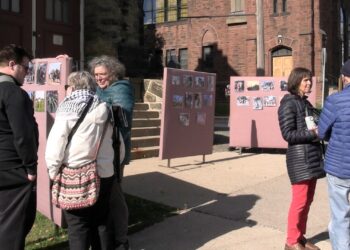
Photo exhibit shows dangers faced by journalists, daily struggle to survive in Gaza Strip [video]
Palestine

Photo exhibit shows dangers faced by journalists, daily struggle to survive in Gaza Strip [video]

October 22, 2026

Photos illustrating the struggle to survive in the Gaza Strip were on display on a downtown Moncton street corner on...

Load More

Recommended

Lawsuit citing ‘widespread exploitation’ at seafood plant signals deeper problems in migrant worker program [video]

Bill to ban recruitment fees for migrant workers, who often pay thousands for temporary jobs

5 days ago
Indigenous-led energy: Can nuclear power meet the Seven Generations principle?

Indigenous-led energy: Can nuclear power meet the Seven Generations principle?

7 days ago
‘We were there, you can’t do more than that’: Documentary ‘Edward Said: Between Worlds’ premieres at TIFF 2026

‘We were there, you can’t do more than that’: Documentary ‘Edward Said: Between Worlds’ premieres at TIFF 2026

3 days ago
Zines from Gaza rewire my associations with my own memories

Zines from Gaza rewire my associations with my own memories

3 days ago
NB Media Co-op

© 2019 NB Media Co-op. All rights reserved.

Navigate Site

  • About
  • Join the Co-op / Donate
  • Contact
  • Share a Story
  • Calendar
  • Archives

Follow Us

No Result
View All Result
  • About
  • Join the Co-op / Donate
  • Contact
  • Events
  • Share a Story
  • NB POD
  • COVID-19
  • Videos
  • New Brunswick
  • Canada
  • World
  • Arts & Culture
  • Environment
  • Indigenous
  • Labour
  • Politics
  • Rural

© 2019 NB Media Co-op. All rights reserved.

X
Did you like this article? Support the NB Media Co-op! Vous avez aimé cet article ? Soutenez la Coop Média NB !
Join/Donate