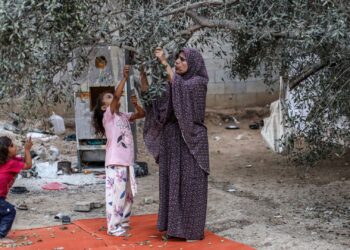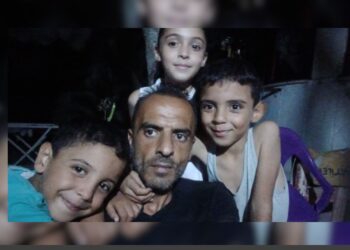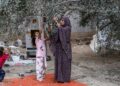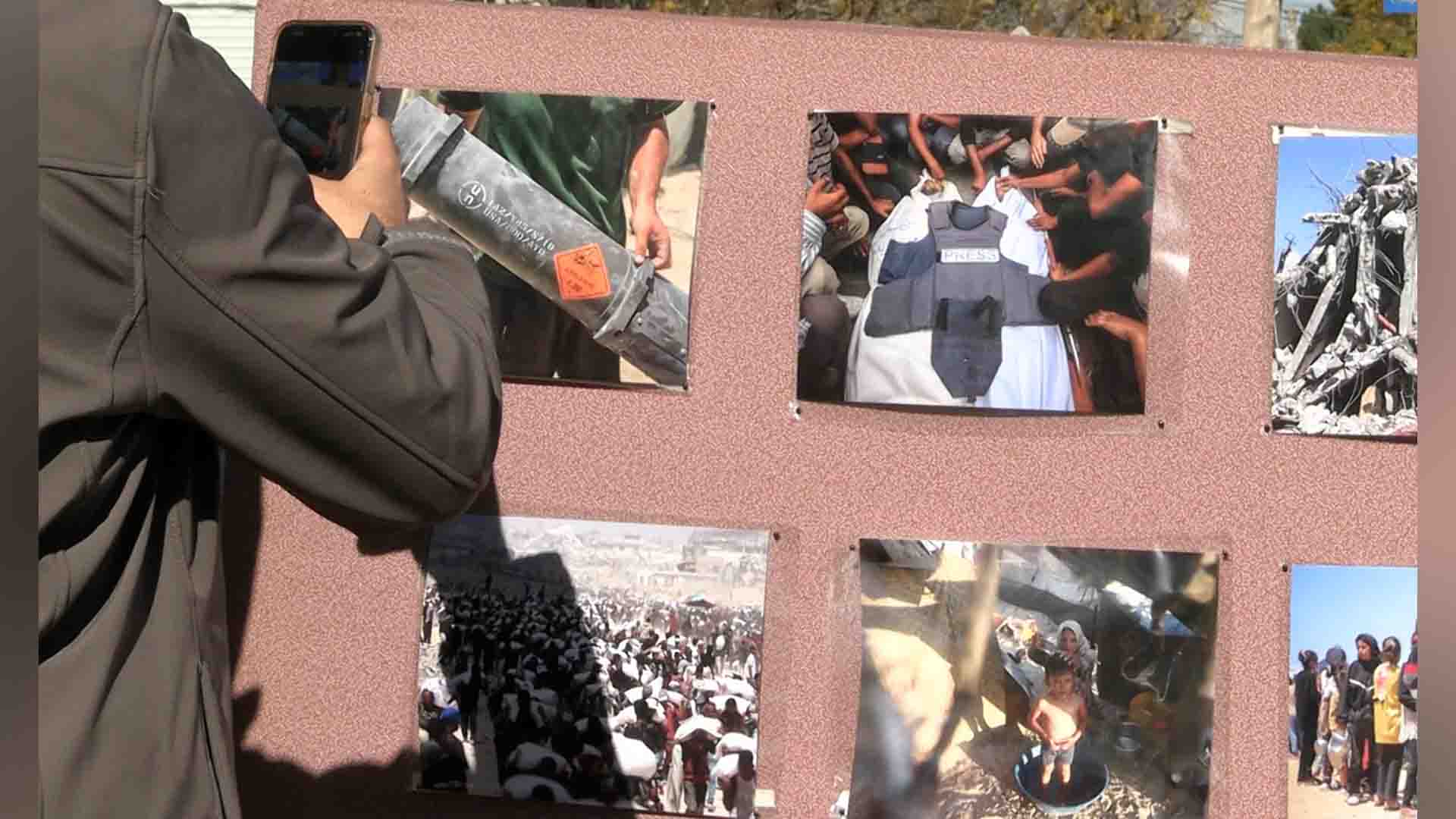
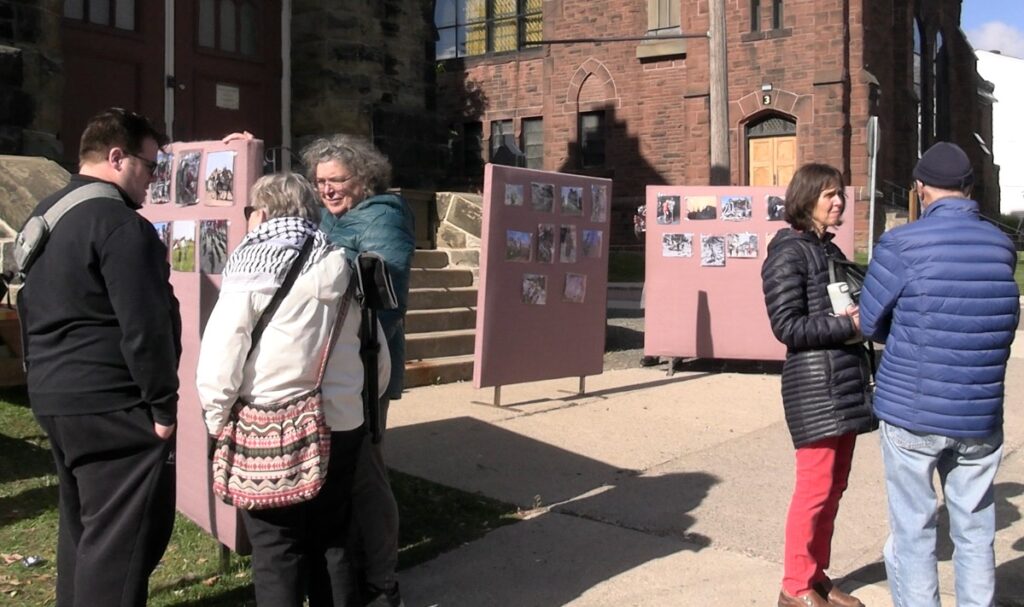
Photos illustrating the struggle to survive in the Gaza Strip were on display on a downtown Moncton street corner on Wednesday, as the NB Media Co-op and Citizens for Peace–Greater Moncton hosted a pop-up exhibit of photojournalism by Rizek Abdel Jawad.
The Gaza City-based photojournalist, who frequently contributes his work to the NB Media Co-op, reflected on the dangers faced by journalists in the shattered Gaza Strip in a message that was read aloud to a small crowd that gathered on the sidewalk outside Central United Church for the event.
Highlights from Wednesday’s event:
The exhibition doesn’t show ordinary photos, he wrote in a WhatsApp message. “The very act of taking them could have cost me my life,” he said.
“I used to photograph the sea and the sunset and capture the harvest of every season: roses, strawberries, olives, watermelons and dates,” he wrote. “Those were the images I wanted to create. But when the war began in 2023, I faced a choice: stay with my family, or bear witness to the greatest crime Israel has ever committed against humanity.”
He added: “From inside the world’s largest prison — Gaza — this is my message to you and everyone I speak with from within these walls: death draws closer every day. Here, death is reduced to a mere ‘number,’ and I do not want to become just a number.”
Over the past three years, he said, he has taken more than 10,000 photos that are ready for exhibition, part of a larger archive stored on six hard drives, each with a two-terabyte capacity, totalling perhaps 500,000 images.
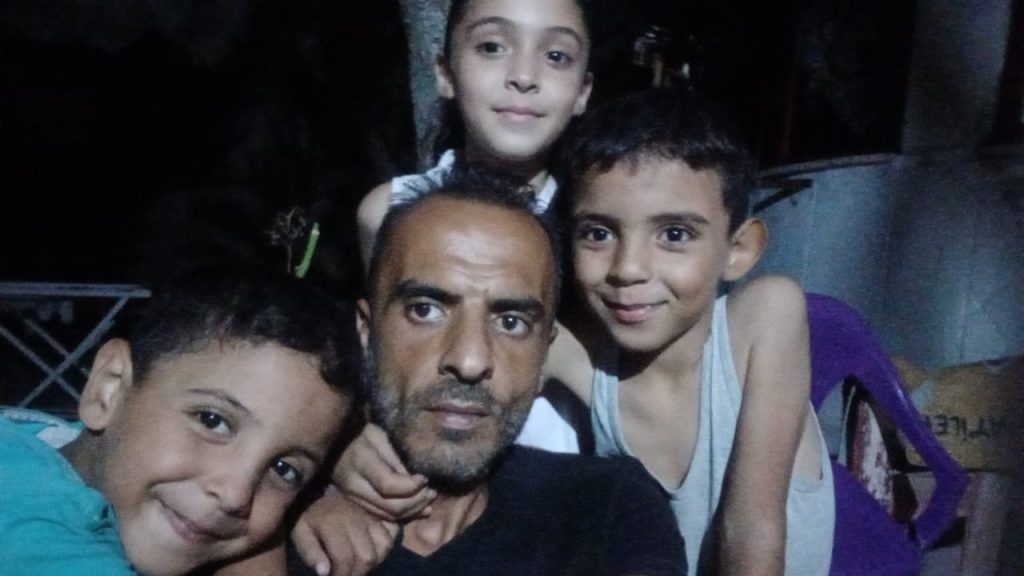
“I have no more storage space left,” said the father of three, as he appealed for support. “This is my plea to you: I may well become just another number, among those who die every day, but I could also help ensure that the world eventually sees all my photographs.”
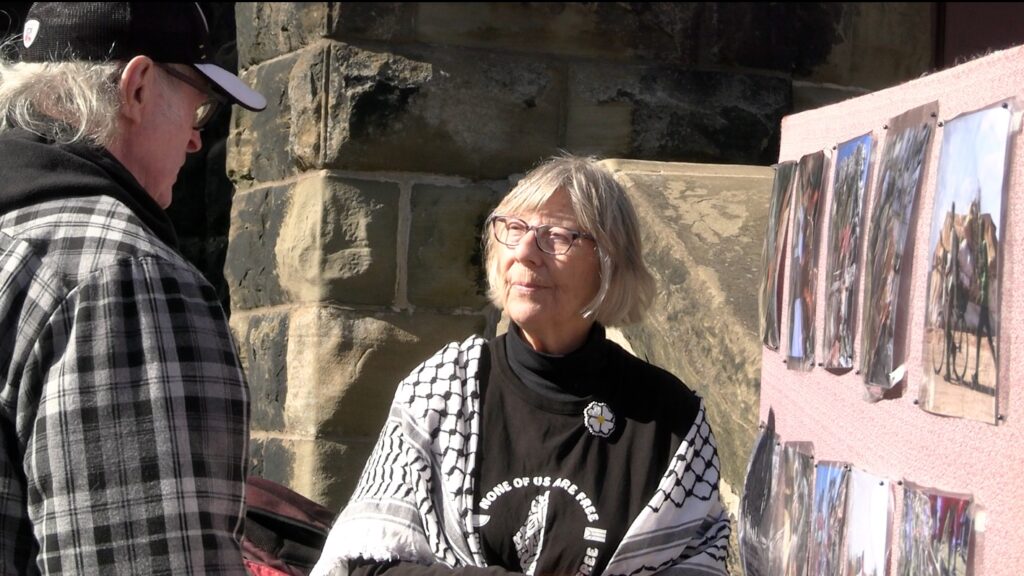
Attendees contributed more than $450 following a series of speeches. Citizens for Peace previously previously raised $60, for a total contribution of more than $520.
Speakers included Rev. Audrey Lounder of Central United Church, which allowed the event to take place on its doorstep. She noted that the regional council of the United Church, which includes Moncton, has joined the Apartheid-Free Communities network.
Lounder said ongoing efforts include pushing for congregations to “live the pledge” by ensuring, for example, that members don’t invest in “anything that supports the apartheid system that is in place in Palestine.”
Human rights groups such as Amnesty International have stated that conditions in Israeli-occupied Palestinian territory amount to apartheid, which involves serious human rights violations “perpetrated in the context of an institutionalized regime of systematic oppression and domination by one racial group over another, with the intention to maintain that system.”
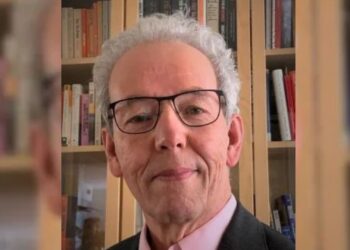
Other speakers on Wednesday included Saint John-based activist Data Brainanta and Steve Berube, a retired United Church minister who has visited the Occupied Palestinian Territories as a human rights observer. This journalist spoke on behalf of the NB Media Co-op from a reporter’s perspective.
Carol Scott, an organizer with Citizens for Peace, emceed the event and recited a poem that she wrote after attending the recent Say Their Names vigil in Saint John, where volunteers spent five days reading out the names of more than 21,600 children killed during Israel’s genocidal assault on the Gaza Strip.
Foreign journalists remain barred from the Gaza Strip, and Israeli forces have killed scores of Palestinian journalists and media workers in the bombarded territory since Oct. 7, 2023. The question of how many journalists have been killed is highly politicized, as media watchdogs face intense scrutiny. Various organizations have released different calculations over the past three years.
The latest figures from the Committee to Protect Journalists indicate that 189 members of the press had been killed by late September; the International Federation of Journalists stated this month that “at least 203 Palestinian journalists and media workers have been killed, several have been injured and others are missing. The Gaza Government Media Office recently stated that 263 journalists and media workers had been killed by the third anniversary of the Oct. 7, 2023 attacks.
In April 2025, the Costs of War project at Brown University published a report stating that the number of journalists killed in the Gaza Strip since October 2023 had reached 232.
That’s more than the combined number of journalists killed in “the U.S. Civil War, World Wars I and II, the Korean War, the Vietnam War (including the conflicts in Cambodia and Laos), the wars in Yugoslavia in the 1990s and 2000s, and the post-9/11 war in Afghanistan,” it stated.
Israel’s military campaign in the Gaza Strip, which has been widely denounced as a genocide by human rights groups and experts, is “quite simply, the worst ever conflict for reporters,” the report stated.
The 2003 U.S.-led invasion of Iraq resulted in a higher absolute number of deaths —285 journalists and media workers killed between 2003 and 2025 — but the two cases aren’t comparable because in Iraq, those casualties occurred over the course of two decades, the report added.
David Gordon Koch is a staff reporter with the NB Media Co-op. This reporting has been made possible in part by the Government of Canada, via the Local Journalism Initiative.