
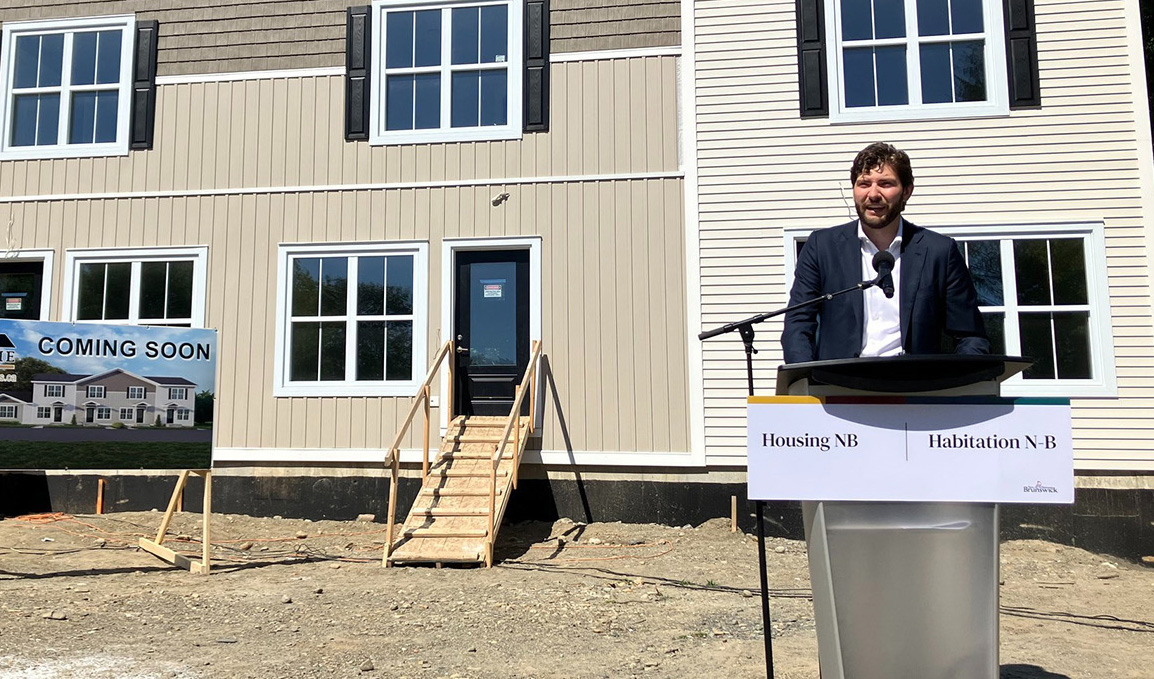
The provincial government announced Wednesday that a three per cent limit on rent increases will remain in place for another year.
“We’re keeping the rent cap in place for the 2027 calendar year to maintain that stability and predictability that tenants need, and to give us more time to improve market conditions here in New Brunswick,” Minister of Housing David Hickey said in a statement.
The rent control measure, which Premier Susan Holt’s Liberal Party promised during the 2024 election campaign, limits rent increases to three per cent year-over-year and is subject to an annual review. It came into effect in February 2025.
The policy has received mixed reviews from researchers and advocates.
Julia Woodhall-Melnik, an associate professor in the Department of Social Science at the University of New Brunswick, expressed relief that the province didn’t opt to increase the limit on rent hikes.
However, she renewed calls for vacancy control, a policy that would limit landlords’ ability to increase rent when units are vacant. She also called for progress on a promised overhaul of the Residential Tenancies Act.
The provincial government has stated that it aims to introduce a “fully revised Act” in the Legislative Assembly this fall.
Woodhall-Melnik, a researcher and affordable housing advocates with UNB’s Housing, Mobilization & Engagement Research Lab, added that “we would like to see a moratorium on rent increases and the decommodification of housing in general.”
Matthew Hayes, a professor of sociology at St. Thomas University, said that New Brunswick’s rental inflation remains about double the national average “so the current rent control is still not enough.”
Rent increased by 3.5 per cent across Canada between May 2025 and May 2026, compared to 5.5 per cent in New Brunswick during that time, according to the Consumer Price Index.
Reining in rent increases will require “better enforcement, better protections against eviction, and preferably, rent control tied to individual units, rather than tenancies,” Hayes said.
The anti-poverty group ACORN released a statement welcoming the rent cap’s extension, saying it helps prevent homelessness for many families amid “unprecedented rent increases.” However, “temporary rent caps are not enough,” it stated.
The group renewed calls for reforms to the Residential Tenancy Act including permanent rent control and the end of “landlord-use evictions, fixed-term lease abuse, and cash-for-keys agreements.”
The group also called for measures to “prevent landlords from harassing, pressuring, or unlawfully removing tenants from their homes.”
In particular, ACORN called for “a dedicated Residential Tenancies Tribunal compliance and enforcement unit to ensure tenant protections are properly enforced.”
Thursday’s statement from the provincial government cited efforts to “help tenants, landlords and developers” that also included the removal of HST on multi-unit development projects.
The previous government under Conservative Premier Blaine Higgs introduced a short-lived 3.8 per cent rent cap in 2022, following widespread reports of steep rent increases at the height of the COVID-19 pandemic.
However, Higgs let the policy expire at the end of that year and resisted pressure for a permanent rent cap until his defeat at the ballot box in October 2024.
The current rent cap will come up for review again in May 2027.
Updated with more information, including a statement from ACORN, at 8 p.m. on June 25, 2026.
David Gordon Koch is a journalist with the NB Media Co-op based in Moncton. This reporting has been made possible in part by the Government of Canada, via the Local Journalism Initiative.

![Alternative court program in Elsipogtog should be extended across New Brunswick: legal aid lawyer [video]](https://nbmediacoop.org/wp-content/uploads/2026/07/MatthewHabermacher-350x250.jpg)
![Student accepted into UNB grad program stranded in Gaza awaiting Canadian study permit [video]](https://nbmediacoop.org/wp-content/uploads/2025/11/BiometricsNov72025-5-350x250.jpg)




![Alternative court program in Elsipogtog should be extended across New Brunswick: legal aid lawyer [video]](https://nbmediacoop.org/wp-content/uploads/2026/07/MatthewHabermacher-120x86.jpg)
