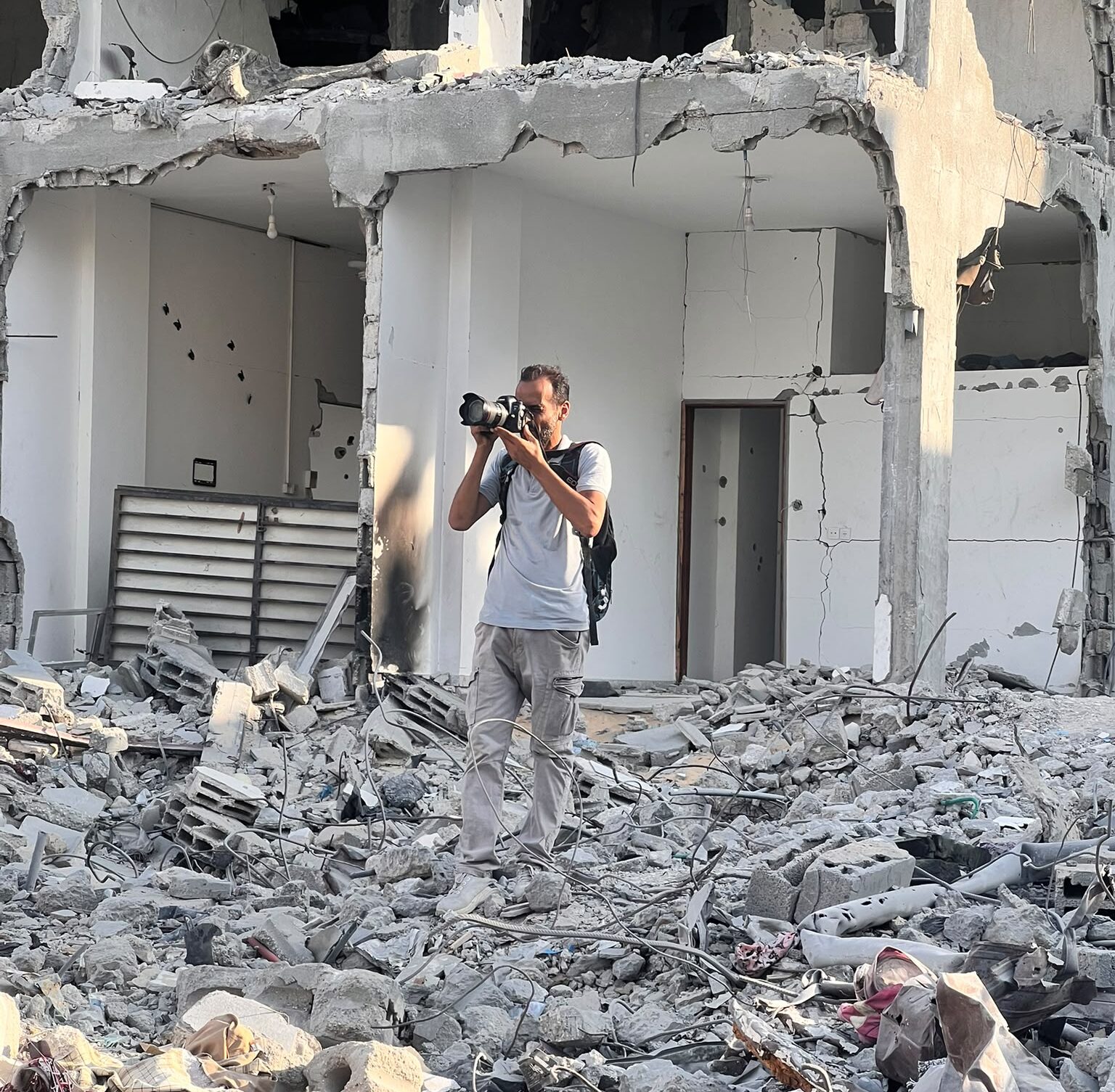
Editor’s note: Today marks 1,000 days since Israel launched its genocidal war on the Gaza Strip in response to the attacks of Oct. 7, 2023. Rizek Abdel Jawad, a Palestinian photojournalist now forced to live in a displacement camp in Gaza City, is a frequent contributor to the NB Media Co-op. In this personal essay, he reflects on the devastation wrought by the Israeli military (with the complicity of many countries, including Canada). More than 90 per cent of the Gaza Strip has been destroyed and Israeli forces control 80 per cent of the territory, according to Al Jazeera.
A thousand days into this war of annihilation is a lifetime for the Gaza Strip, as we try to remember a time before death became a daily occurrence, before the sky became a gate that never closes on missiles, before waiting for morning became an experience which many of us don’t survive.
A thousand days have passed, and the war has only paused to catch its breath before returning more ferocious and widespread, as if it is not fighting a territory but attempting to erase the very meaning of the territory itself. It targets not just people, but memory, language, homes, names, and everything that proves life once existed here.
On this thousandth day, Gaza is not as the world once knew it. The neighbourhoods that once teemed with life have been reduced to rubble, the roads that once connected people now separate them, and the tents that were erected as temporary shelters have become entire cities of fabric, offering no protection from the summer heat, the winter cold, or the bombardment that no longer distinguishes between house and tent, between a sleeping child and a mother waiting for bread or a cup of water.
Behind this staggering number lies a tragedy that statistics cannot fully capture, but from which they can begin: more than 73,000 martyrs have fallen so far, and more than 173,000 wounded. They carried bodies burdened with pain and injuries that will haunt many of them for life, while thousands remain missing under the rubble or their fate unknown, their families waiting between fading hope and a reality they dread to hear.
But the numbers in Gaza are not mere statistics. They represent families erased from the civil registry, mothers who have lost all their children, and children born in war who have known nothing of the world but tents, hunger, and the sound of war planes. They represent fathers who buried their children with their own hands, only to return searching for a place to bury their dreams as well.
A thousand days of repeated displacement, until a person could carry their home on their shoulders, then lost even the ability to carry what little remained. A thousand days of hunger that transcended mere need, becoming a weapon that stalks people in bread and water lines and aid centres. A thousand days of hospitals that fought without medicine, without electricity, without fuel, while doctors performed surgeries by the light of their phones or amidst the sounds of shelling.
During these long days, no school, university, mosque, church, hospital, street, or market was spared the ravages of war, until it appeared that the entire place was being uprooted completely.
In the face of this immense devastation, the Palestinian people continued to resist in their own way. They resisted by erecting tents over the ruins of their homes, by sending their children to rudimentary classes in displacement centres, by kneading bread if flour was available, by sharing their meager rations, and by insisting on naming their children, born during the war, names that embody the meaning of life, as if to say that the future is still possible despite everything.
The thousandth day is not the end of the war, nor the conclusion of the story, but it is a watershed moment in the history of all humanity. What happened in Gaza was not merely a military confrontation, but a harsh test of the meaning of justice, conscience, and the limits of a world that witnessed all this suffering while continuing to count the days of the war more than searching for its end.
History will one day record that a small territory on the seashore stood for a thousand days against fire, hunger, siege, and death, and that a people who were buried every morning still managed to rise every evening to rearrange their tents, count their martyrs, comfort their children, and believe that no matter how long the night, it cannot erase one truth: that they will not be broken. Gaza, though burdened with rubble, will remain a witness that a person can lose everything except their dignity.
Rizek Abdel Jawad is a photojournalist based in Gaza City. To see more of his work, follow him on Instagram and Facebook. He is part of the Connecting Gaza initiative, which helps families in Gaza survive. You can support them by going to www.connectinggaza.org/donate.

![Is a Moncton company helping to build jet fighters bombing Gaza? [video]](https://nbmediacoop.org/wp-content/uploads/2024/06/ApexMay192024-120x86.jpg)