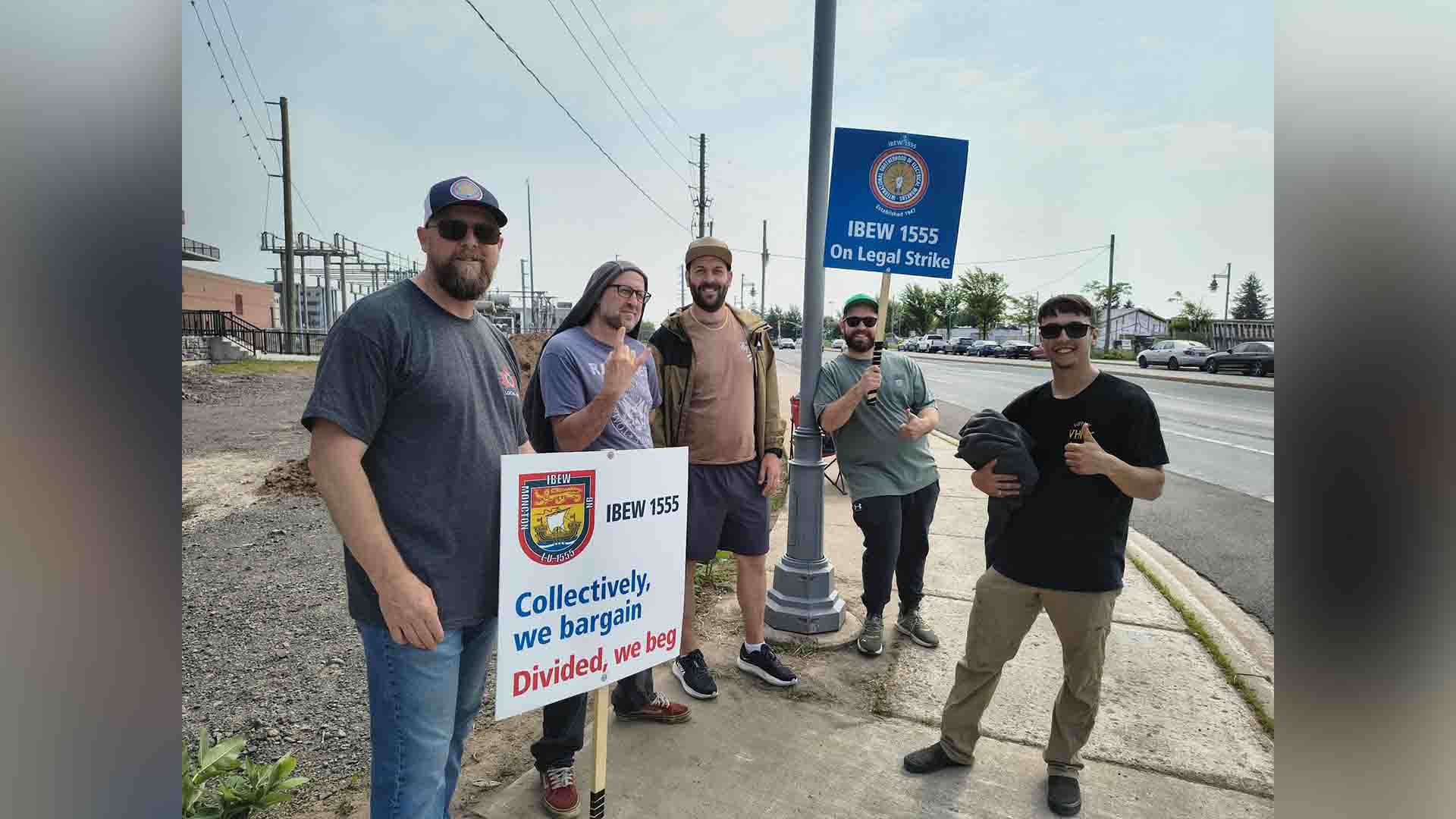
Local 1555 of the International Brotherhood of Electrical Workers was among several unions in the skilled trades that were on strike in New Brunswick this year. A feature of many of the strikes was cross-union solidarity. While walking on the IBEW 1555 picket line in Moncton, there were countless visitors offering support.
At one point during July’s heatwave, a minivan pulled over on the side of the crowded artery of Assumption Boulevard, delivering over 30 iced coffees from Tim Hortons. On another day, George Leaman, a well-known labour activist and vice president from the New Brunswick Federation of Labour, arrived on the line waving a large flag, belting out chants of “So-So-So-Solidarity” and telling an endless string of dad jokes to the beleaguered workers on the line. His presence would be a regular fixture on the picket line during those three months.
I walked down Assumption Boulevard carrying a box of homemade cookies for them and myself. When I arrived at the picket line, instead of the defiant mood I expected to see, the workers on the picket line were stressed but determined.
The cause of their stress? No strike pay, no chance of retroactive pay and the existing burden of lower wages compared to their non-union counterparts. The local has only had two prior strikes over its decades of existence, so they never established a strike fund. Without strike pay, such a fight would concern even the most hardened trade unionist as the bills stacked up.
If that wasn’t enough, the bosses were not playing nice, according to the striking electrical workers. While visiting the line, many were quick to state that the bosses were bargaining in bad faith. The employers apparently felt confident in their ability to wait the workers out.
In one case, the IBEW pushed back on social media by publishing a video that featured rank and file union members in Moncton ripping up a contract which they said the employers had sent to them directly. Sending the contract to workers directly, instead of going through the union, is a violation of the negotiations process, IBEW officials said.
The NB Media Co-op reached out to the employers, represented by the Electrical Contractors Association of New Brunswick, to get their side of the story. Krista Lewis, the head of the association, denied sending the contract directly to union members, saying that the association in fact submitted an application for a final offer vote to the labour board.
Lewis rejected the characterization of an unfair negotiation process, and maintained that the employers’ actions were in full compliance with the Labour Relations Act.
The union filed a complaint about the matter with the New Brunswick Labour and Employment Board, and a hearing took place at the end of August. A decision is pending, according to the labour board.
Regardless of the outcome of that complaint, workers rejected the offer in an August mail-in vote, and a collectively bargained contract between IBEW 1555 and the employer was ratified on Sept. 11.
Throughout the strike, it was clear that these workers have families, friends and other people who care about them. Besides the flow of food from the community, we saw other unions step up to defend these workers. The “calvary” was starting to arrive.
For example, the Bakery, Confectionery, Tobacco Workers and Grain Millers International Union (BCTGM) Local 406 announced on social media that their union had committed a “sizable donation” to the IBEW local to support the workers.
“We felt it was wrong that these workers had empty fridges while asking for basic dignity in their work,” said Jesse Landry, president of the Moncton & District Labour Council and a member of BCTGM 406.
“Workers built this movement to support each other and that is what we will continue to do,” he said. “There is power when working people organize together.”
Support came in from a variety of places. IBEW 1555 membership coordinator James Hoffe shared that the New Brunswick Federation of Labour through its affiliated unions, alongside the New Brunswick Building Trades Union, all “made the difference” during the strike.
“Each one helped our bargaining power, either by helping to stand on the line with us or by providing some coffee or donuts to keep the members’ spirits high out on the picket line.” Those unions stepped up so that the IBEW members “could survive being off work for such a period,” he said.
All of this combined gave the striking workers enough power to overcome their far wealthier bosses. IBEW 1555 workers won an 18 per cent wage increase and ended a tiered pay system with their strike, Hoffe said. Under this tiered system, workers received different pay rates based on the size of the worksite or contract.
The NB Federation of Labour also organized support for the striking IBEW workers. Federation president Chris Watson said the organization “mobilized support by reaching out to our affiliates, raising awareness of their fight and calling on the labour movement to stand with them.”
Watson said the federation “issued a financial appeal, encouraging unions to contribute so these workers could continue their fight for a fair collective agreement.”
He added that when workers take a stand “they need to know the movement is behind them. Financial support helps ease the pressure on striking workers and their families and strengthens their ability to hold the line. This was about putting solidarity into action and showing IBEW 1555 that they did not have to face this fight alone.”
That solidarity even transcended labour unions to include grassroots anti-poverty organizations. On one occasion, members of ACORN and the New Brunswick Common Front for Social Justice (myself included) visited the picket line following an ACORN rally nearby. People who joined the picket line also included at least one NDP organizer.
All of this support comes together as a perfect storm. It reminds the workers that people care about them and believe in them. It reminds them that their fight is not only against their bosses, but part of a broader fight for democracy in the workplace and social justice in our communities. Most importantly, it gave them the tools to win this fight. Solidarity feeds our neighbours, it protects our most vulnerable, and it reminds us that when ordinary people work together, we can overcome extraordinary odds.
This type of community and union mobilization is based on mutual support and co-operation. It represents the idea that if we broaden the fight and work together, it becomes far easier to win.
Unions in Europe and Asia in particular have even embraced a proud tradition of sympathy strikes to support one another in these goals. Recently, Italian dockworkers threatened a strike to protect a flotilla of activists bringing aid to genocide-stricken Gaza.
Meanwhile in Canada, Carney’s Bill C-39 could be used to prevent similar strike action in Canada. Labour leaders have warned that it would give the federal government “broader unilateral power to end a legal strike than exists in any other G7 country.”
During the latest attacks on labour, it is important to remember that winning collective agreements is not just between the union reps and the bosses. There was a time when unions often did not represent a majority of workers in a workplace, but continued to agitate for change. This practice, known as “minority” or “solidarity” unionism allowed workers to collaborate on small scale issues as their union slowly grew in power. While they did not often have the power to strike, minority unions were able to organize on-site actions focusing on immediate improvements to worksite conditions, scheduling, safety, access to tools/technology, and choice over manager. This practice, for example, was heavily used on both sides of the Canada-U.S. border during the effort to organize Starbucks workers in the late 2000s and early 2010s. In North Carolina, this model has been adopted by civil rights activists to win tangible victories in the workplaces.
Minority unions even developed mutual aid networks between worksites and employers as workers transferred between them. As they won their small-scale victories, the organizing workers proved themselves capable to their fellow workers and were able to grow their membership and power.
They used the weight of co-operation against their bosses, and directly supported one another. This model also helped establish many of the mainstream unions we know today, as they had to adopt creative approaches to establish themselves and win majorities within their given industries.
Minority unionism isn’t a magic bullet, but a model designed to succeed in the spaces most hostile to unions. The practice has its advantages and disadvantages, and it has fallen out of popular use as unions have increasingly been forced to rely on the bargaining process to win gains for members, but yet, it still remains a powerful cornerstone to build majority support in the workplace.
In this way, workers themselves win change in the workplace, and not necessarily through contract negotiations. Solidarity unionism can be a model to revive the labour movement in our province.
The IBEW members on strike this summer will remember who showed up for them. When the next strike occurs, it will be their turn to bring coffees, tell jokes and make donations to support their fellow workers. It is the simple and practical idea that today’s fight won’t be the last one, and we must constantly be building on our victories together.
Alex Gagne is a socialist, anti-fascist organizer who has participated in various campaigns across the province for the past 14 years. They are a former Vice-President (language) of the New Brunswick NDP, a former organizer for ACORN Canada and a graduate of St. Thomas University. NB Media Co-op staff reporter David Gordon Koch contributed to this report.