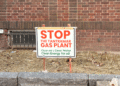
Controversy over the proposed gypsum mine/quarry by J.D. Irving’s Hammond River Holdings near Upham in the Hammond River Watershed in southern New Brunswick has evoked confused and contradictory comments from the Department of Environment and Local Government. This ongoing drama has been the subject of several recent NB Media Co-op articles. The current situation is only the latest example of an entrenched history of industrial capture of New Brunswick’s provincial regulators, ostensibly mandated to protect the province’s people and environment.
In 2014, the provincial Ombudsperson Charles Murray issued a scathing report on the failure of the government’s Department of the Environment to implement one of the vital regulations protecting the province’s clean water, the Water Classification Regulation of the Clean Water Act. Murray observed that the “complete ineffectiveness” of the regulation was and is “in some respects worse than having no regulation at all” and “like a smoke detector without batteries, [the regulation] provides no protection and may induce less vigilance. It appears to address and remedy a problem when in reality it does nothing of the sort.”
And so it is with too many of the province’s so called “regulatory safeguards” of the public interest and the environment. We have regulations on the books that give the appearance of regulatory vigilance, and we the taxpayers employ, at great expense, civil servants whose job it is to enforce those regulations. Yet, when push comes to shove, inevitably governments find ways to ignore, manipulate and abuse the very safeguards the public perceives as defending its common interest.
The responsibility for regulation primarily falls to specific departments depending on the act, e.g. the Department of the Environment has primary responsibility for enforcing the Clean Water Act, and the Clean Environment Act, and various incarnations of departments of natural resources and energy regulate Crown forests, and mineral and petroleum extraction. However, multiple departments ultimately hold collective responsibility for regulation through obligatory participation on technical review committees (TRC) that review all projects undergoing environmental impact assessment.
The Environmental Impact Assessment (EIA) process is designed to identify all possible negative impacts to the environment that will result from a proposed industrial development, and to ensure that proponents will have the ways, means and will to mitigate those impacts. Given the TRC oversight, when the regulatory system fails, it is a systemic failure.
Exhibit A: Regulator employs double-speak to skirt EIA requirements
The aforementioned proposal by Hammond River Holdings to develop a gypsum mine in Upham is hampered by a troublesome “designated” or “regulated” wetland as re-defined in 2011. A fraction of a regulated wetland intersects the proposed project location. In typical fashion the province has seen fit to truncate and exempt the portion of the wetland that lies on the Hammond River Holding property. Unfortunately, the government cannot keep up with all its manipulations and some government documents contradict others on the state of affairs with regard to this wetland. Meanwhile the citizens of the Upham area are forced to contend with government doublespeak on whether an EIA is required or not.
Exhibit B: Regulator fiddles with data to benefit the Potash Corporation of Saskatchewan
In 2006, University of New Brunswick researchers Wilson, White and Roulston documented the location of the Penobsquis fault line intersecting the Picadilly potash deposits south of Penobsquis in southern New Brunswick. Shortly after Potash Corporation of Saskatchewan registered in July, 2007 for EIA of the proposed Picadilly extension of the ongoing potash operations in Penobquis, the province’s Department of Natural Resources and Energy relocated the fault line north of the Picadilly potash deposit on provincial geologic map MP2008-186A. Consequently, the fault was not a factor in the EIA; the Picadilly Mine was approved without reference to the fault. Following EIA approval of the Picadilly Mine, Map MP2008-186A was subsequently revised in 2011 and the fault line was once again shown to intersect the Picadilly potash deposit. These questionable maneuverings were accomplished at a time when the province was already aware that domestic water wells in the Penobsquis area were likely being depleted by the potash mine operations.
Exhibit C: Regulator re-defines wetlands to benefit J.D. Irving
In 2011, J.D. Irving registered a proposed peat harvesting operation in Juniper for an EIA. The EIA was required because the proposed peat harvesting would impact a provincial wetland. Shortly after the EIA registration, the province undertook a re-definition of wetlands, redefining as “designated” or “regulated” only a fraction of all wetlands, and exempting all of the wetlands involved at Juniper from regulatory oversight. Subsequently, the Juniper peat operation was removed from the registry of scheduled EIAs, and the project was permitted to proceed without EIA. It is important to note that skirting EIA also allowed J.D. Irving to avoid a regulatory obligation for formal Indigenous consultation.
Exhibit D: Regulator fails to observe its own regulations in order to benefit Sisson mine development
This century has observed a litany of abuse of Indigenous rights, and abuse of the Clean Water Act and Clean Environment Act as the province has chased the elusive and illusive Sisson Mine project. The proposed Sisson Mine in the Upper Nashwaak Watershed involves a massive open-pit tungsten and molybdenum mine along with a tailings impoundment far more massive than the ill-fated pond at Mount Polley in British Columbia. Successive New Brunswick governments first procrastinated, and then ignored their obligations under the Classification Regulation of the Clean Water Act. Governments were, and continue to be intimidated by the regulation as it empowers the local watershed populace to weigh the pros and cons of the mine project, and to decide the project’s fate. Similarly, federal and provincial governments have abused and ignored their constitutional and treaty obligations with regard to Indigenous rights. As mentioned previously, in 2014, the provincial Ombudsperson chastised successive governments for their abuse of the Water Classification Regulation; all to no avail. Subsequently, the province continued to ignore the Water Classification Regulation and to also abuse the Clean Environment Act by imposing time constrained EIA Conditions of Approval for the Sisson mine, only to subsequently fail to enforce those same conditions. All these government actions and inactions render these Acts and their regulations meaningless.
Exhibit E: Sacking of the province’s Chief Medical Officer of Health
The crowning glory of government abuse of regulatory oversight is the firing of the very competent Chief Medical Officer of Health, Dr. Eilish Cleary in 2016. In 2012, Dr. Cleary and her team assembled an internationally acclaimed framework for Health Impact Assessment (HIA) of shale gas and other industrial initiatives. Although the Health Impact Assessment was not popular with politicians, the government of the day managed to live with, and to subsequently ignore the impact of Dr. Cleary’s Health Impact Assessment framework. But when the work of the office of the Chief Medical Officer threatened to constrain glyphosate herbicide spraying in the province, the Chief Medical Officer was summarily fired.
All of these actions reinforce the Ombudsperson’s warning that the illusion of safeguards without the necessary “batteries” is a disservice to the public. We are experiencing a period when politicians and civil servants increasingly exhibit a smug and loathsome air of superiority in their freedom to lie, delay and obfuscate the truth, and to hide behind time-wasting “Right to Information” requests when acting as industry hacks in dealing with the public. It is time for a new paradigm of truth, respect and transparency between the government and the people who employ them.
Lawrence Wuest is an ecologist and resident of the Upper Nashwaak Watershed.


![NB Update: What comes after the crisis in local journalism? [video]](https://nbmediacoop.org/wp-content/uploads/2025/06/LabourUpdateApr132025-350x250.jpg)