August 9, 2050 (Maritimes)
Dear Friends,
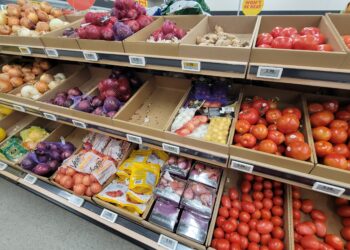
No one remembers what led to the nickname. Was it out of mockery, or a moment of anger, or just the innocent pleasure of wordplay—one of the few amusements that remain among the ruin and disarray? Even today in the various communities of the Maritimes, the only way to refer to the former gas stations where people now meet on Saturdays is through the anagram “Virgin.” It was at the “Virgin” on the corner where we relearned the local economy. It was after the spectacular collapse of the oil regime, that citizens with vegetable gardens and agricultural plots began to gather spontaneously in these spaces so centrally located in different communities. At the beginning, people came not so much to buy and sell, but to exchange advice and information and seeds and perfect their own farms and gardens.
Against a backdrop of tension, which the most pessimistic among us thought would descend into civil war—after all, there was no lack of competing identities that might spark a feud—the starving populations found themselves, week after week, in front of the long-abandoned “Virgin” stations hoping to find a few ears of corn, a cauliflower, or spelt grain to store for the coming days. Of the stations themselves, there was almost nothing left. The signs had been vandalized by stones, which might have been thrown in moments of anger or out of sheer boredom. What was left of the bathrooms were being used to store plants that could not yet be exposed to the light of day. The counters were the places where a clerk could administer what we call “duties.” Most of the goods lay on the building floor, or around about the building on mats and other markers the farmers brought in.
Rumour had it that, in the whole territory, only five gas stations still operated, distributing, at a low flow rate, the overpriced fuel that was still being paid for by a wealthy social class that remained clung to their steering wheels even while hiding in their walled cities. It was surprising, because the road system had gradually become impassable from the vindictiveness of a population hostile to urban elites. The army and the long-distance truckers who worked for this class that remained integrated into what continued to be called by default Capitalism, were monopolizing the oil that was still being extracted off the coasts of Nigeria and Brazil and some muddy tar sands of Western Canada. It is possible that more of these gas stations were in operation, but only a few more. One man who was not afraid to cover long distances by bicycle, himself a former shopkeeper, claimed he could list eight areas where he had seen gas stations in operation.
At the Virgin, accounts were kept in terms of “duties.” We referred to it as actual currency. Farmers eventually found it necessary to use a market system to recruit the labour they needed to develop the operation of their farms and small plots. Even in cities, we grew rooftop gardens, and abandoned houses were used as winter storage facilities for the harvest. Each portion of food thus required a duty, to the point that, what might initially have simply been a kind of barter, became a complex way of thinking about trade, without it taking place on a bilateral basis. The holder of a duty, who had just received a basket of foodstuffs for the week, could, in a second step, give it to a third party in return for a favour that the latter would deliver on time. Every Saturday, the clerk who kept accounts, ensured that no one exceeded the duty they had to pay to another.
Everyone knew, if we bothered to remember, that “Virgin” was the nickname given to the place.
But, the turn of phrase became commonplace in our vocabulary. “What was their real name again?” a bystander wondered one day. For anyone with a psychoanalytic mindset, there were several ways to deconstruct the latent meanings of the nickname “Virgin.” The years following the collapse of the system were so hard, each family could count many deaths. We saw in the name something like a salvation, a resurrection, a new beginning. But there was also something ironic in the term. No one was virgin and no one was naïve considering the winters we had to go through waiting desperately for a truck carrying food to a dysfunctional supermarket to arrive. People waited desperately for the trucks, until a violent act of highway robbery convinced the truckers themselves to put a halt to their dangerous practice.
The weekly meetings at the Virgin, were therefore a sign of hope and new form of social organization which heralded a much more austere and demanding era than before for some, and yet which also heralded a kind solidarity, and mutual aid, and friendship, and meaning with a degree of intensity that none of us had even imagined possible in the old days.
Alain Deneault
Alain Deneault is a Quebec philosopher and Doctor of Philosophy from the University of Paris-VIII who lives in the Acadian Peninsula. He is a member of the Collège international de philosophie in Paris.
This Letter from New Brunswick’s Future appears in its original French in Astheure. It was translated from French for the NB Media Co-op by Abram Lutes and Daniel Tubb.
In the optimistic spirit of the Alexandria Ocasio-Cortez’s Message from the Future, this letter is a speculative and fictional look back from the future to imagine what New Brunswick could be like if we could meet our climate change obligations. It is fiction, but it need not stay fiction. Each letter offers a vision of what New Brunswick could be like in the future if the province is able to fight climate change and to achieve the IPCC climate goals.
Read the other Letters from New Brunswick’s Future here.
This series is sponsored by RAVEN, and edited by Daniel Tubb and Abram Lutes. Daniel is an environmental anthropologist at the University of New Brunswick in Fredericton and a co-investigator with RAVEN. Abram Lutes is an environmental action reporter with the RAVEN project Summer Institute and a member of the NB Media Co-op Board of Directors. If you would like to contribute your own letter, read the Call for Letters from New Brunswick’s Future and send a short outline of your idea to Daniel Tubb at dtubb@unb.ca and Abram Lutes at abram.lutes@gmail.com.