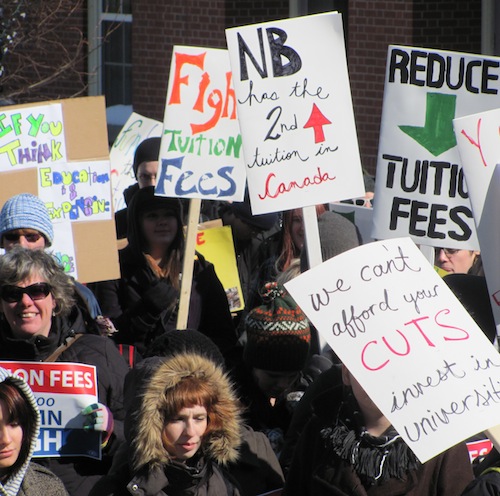
 The teach-ins started during Occupy Fredericton continued on Jan. 17th at Saint Thomas University (STU) with a presentation titled “Occupy Tuition: What Students Can Learn From the Occupy Movement” by STU Sociology Professor Matthew Hayes. Hayes spoke to a classroom packed with thirty students, professors, and members of the general public invited to the event.
Hayes spoke of the narratives surrounding the cost of university education being conveyed by society. One example told to students by the government and banks is about the “personal investment” of a student’s education. The money spent on education is seen as positive because of the rate of return it will provide the investing student with. The more one spends on education, the higher the salary one will get. This reduces the educational experience to its sole dollar value for the individual, while a university education is a transformative experience for students.
Using statistics and examples on the rate of interest paid on student loans and the “sticker price” analogy, Hayes clarified the reality of the educational investment system for the audience. Because of higher tuition fees and student loans, students are paying much more money than the actual tuition fees. Hayes mentioned that the resulting condition to the university will be that programs with higher salaries (medicine, law) will be favoured while those with lower salaries will be naturally phased out of the university curriculum. In this inequality of value of programs, women, indigenous persons, immigrants and other marginalized groups will suffer discrimination, both at the educational level and in the labour force.
Hayes contrasted this contemporary dominant narrative with the reality of the historical existence of tuition. Prior to the 1980s, tuition was kept low in Canada because the narrative surrounding education was one of education seen as a public investment. Nowadays, education is seen as a personal investment. The future consequences of the continuation of this system will lead to society with entrenched social class inequality.
Hayes posited a need for a shift in tuition debate from an individual and personal experience into a public one. The discussion brought to light by the worldwide Occupy movement about inequality should be kept in the limelight. The Occupy movement exposed the need for public discussion and outcry about the question of inequality, a demonstration that showcased new ways of protesting. According to Hayes, many structures that are currently in place that were meant to protect students’ rights are not longer functional. People should no longer expect these organizations to act on their behalf. This is especially true in the case of students with respect to the national student organizations. People need to form their own coalitions (a fact that has arisen from the Occupy movement) in order to move forward on issues.
In referring to the tuition increases posited by the NB government for their upcoming budget, Hayes suggested that students should make it “uncomfortable” for the government to increase tuition and they should do it in the public sphere. Hayes reminded students that the current deficit was brought on by extensive tax cuts in the past, a system of taxes that is profiting only the top earners in the province and not the families of the average student in New Brunswick. The structural deficit that the NB government talks about is one that was caused by the Liberals and is a result of revenue problems. This revenue problem has been compounded by the recent financial crises. Hayes asked the students present to ask themselves whether or not they should be the ones to pay for the financial crises. There are other practical solutions such as inheritance taxes and a general mindfulness of the problem of consumerism in today’s society.
According to Hayes, students are in a privileged position to lead the discussion about these issues. Craig Mazerolle, VP Education of the STU Student Union, encouraged students to participate in the public forums being held about the Budget by the Minister of Finance. Teach-ins will continue on Tuesdays at 4pm at St. Thomas University, James Dunn Hall 108, and on Saturdays at Conserver House, 180 St. John St., Fredericton. All are invited. Check out the schedule.