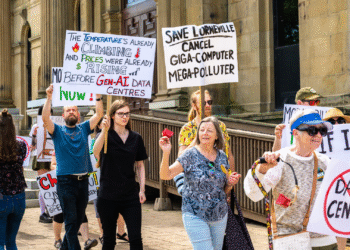
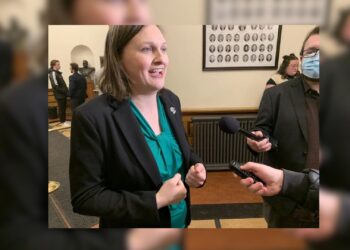
On May 16, the Green Party of Canada leader Elizabeth May announced the federal Green Party’s Mission Possible, a promising plan to tackling the climate crisis. The plan, by itself is not enough. Visions that articulate the transition away from a carbon economy in Canada need to do better at articulating a new economic deal for working people.
In introducing the plan, May downplayed the influence of the U.S. Democratic Party’s proposal for a Green New Deal. She argued, “Franklin Delano Roosevelt’s wonderful public works program to lift the economy out of the Great Depression is not really the model that we are drawing on for our plan which we are calling Mission Possible.” Instead, she stressed the Canadian (and British) experience of national emergency with the War Cabinet of William Lyon Mackenzie King (and Winston Churchill) during the Second World War.
The federal Greens propose, with Mission Possible, to put aside party politics by framing the climate crisis as the central security issue of our time and by creating an interparty cabinet so that all parties work together in a non-partisan way. They would declare a climate emergency that would put the Canadian government on an emergency footing to tackle climate crisis, establish targets of 50% reduction of emissions by 2030 and zero emissions by 2050, fund research, continue carbon pricing, ban fracking, modernize and green the grid, support an electric vehicle charging network, expand the rail network, retrofit housing, ban oil imports, support small-scale biodiesel, expand renewable energy with local communities, engage with municipal and provincial governments and school and universities, help forestry and fishing and agriculture adapt, map flood plains and tornado corridors, invest not in warplanes but fire bombers, curtail emissions, and restore carbon sinks.
There is an awful lot to like, and Mission Possible—or something much like it—needs to be embraced, and fast, if we are to keep warming to 1.5 degrees Celsius by 2030. Yet, the Green’s proposal leaves me uneasy precisely because its lacks the emphasis on something central to the wider vision of a Green New Deal (and indeed the federal Green Party’s own policy itself). In other words, it lacks a clearly articulated economic vision.
When the Green New Deal was first proposed, it was not in the U.S. by the green wing of the Democratic party, but in the UK by economists in a London bar. In 2009, Larry Elliot, The Guardian economics editor, sketched out on a napkin a plan that would address climate change and the financial crisis. At its core, the Green New Deal is a stimulus plan that would change both our reliance on carbon energy and our economic system. Of the proposed Green New Deal in the U.S., Elliot writes that it mixes the old and the new as it promises a living wage for anyone who wants a job, universal healthcare, and a universal basic income program, as well as an ambitious, detailed program to transition the U.S. to renewable electricity and eliminate greenhouse gas emissions from manufacturing, agriculture and other industries. In short, the Green New Deal looks a lot like the old New Deal precisely because it proposes to tackle a pressing concern (then the Great Depression and now the Climate Crisis) through ambitious economic policy.
In distancing herself from this vision of a Green New Deal, May noted “We already have universal healthcare.”
We may already have universal healthcare, but we do not have universal basic income, nor do we have a job for everyone who wants one, nor do we have a green economy.
A clearly articulated new socio-economic vision is what is missing in Mission Possible. Without such a new economic vision front and centre, I worry that any plan to tackle climate change will fail because decarbonization is going to be economically disruptive and that economic disruption is going to be politically useful. If we don’t get the narrative on decarbonization right, then the biggest winners will be climate deniers on the right.
What confronts those who aim for decarbonization is the risk that what might happen to Canada in the 2020s is what didn’t (just barely) happen in the US in 1930s. Right wing populism leading to fascism.
Why?
Greening a carbon intensive economy is already making things hard for working people. For the last fifty years or so, one of the few paths to upward mobility for many has been pumping oil, felling trees, and digging minerals. Canada’s is an extractive economy; this reliance on environmentally disruptive and carbon intensive resource extraction is precisely what has to end for Canada to respond to climate change.
What those who call for bans on oil imports and bans on new fracking and bans on new oil production must also simultaneously articulate are alternative dreams and livelihoods for people who work in and dream of these extractive industries. Otherwise, attempts to decarbonize the economy risk a populist backlash far stronger than the one that carbon pricing has already begun to engender.
The beginnings of a green backlash are already occurring in Canada, with the Conservative wins in Alberta with Jason Kenny’s United Conservative Party and in Ontario with Doug Ford’s Conservative Party. Both Premiers plan to fight carbon taxation. The risk we face is what is already happening in the U.S. with the Presidency of Donald Trump and in Europe with the rise of right-wing, neo-fascist, populists. Neo-fascism in the 21st century emerges out of a broken economic system that has crushed working class culture, solidarity, and dreams under neoliberal economic policies, all of which rely on dirty oil. If the way Canadian politicians respond to the climate crisis does not put progressive economic policy front and centre, then the risk is that the right-wing climate deniers will mobilize fears of green policies to take power.
The Green’s Mission Possible, of course, does envision a just economic transition. A vision in which decarbonization creates jobs as skilled workers are needed to remake the energy system, the transport network, the electrical system, and even how we heat our homes. Total decarbonization by 2050 will create millions of skilled trades jobs in new sectors. Yet, shutting down the carbon economy will simultaneously put millions of people out of work.
We must have decarbonization but to do this without crashing the economy requires the kind of economic intervention to transform the economy which the U.S. Green New Deal embraces and which the Green Party’s Mission Impossible seems to distance itself from.
We may not need a Green New Deal to get universal health care—which we already have—but we do need basic income, we do need employment, and we do need an economic transition.
Still, the federal Green Party does, indeed, already articulate public policy initiatives such as a guaranteed livable income, child care and reforms to employment insurance in their Green Vision, which already takes them a lot of the way there.
Still, the details matter. The federal Greens propose a guaranteed livable income, which would be given to the poorest in society to raise their income to the poverty level. A universal basic income, for example the $1,000 a month proposed by Andrew Yang, a U.S. Democratic presidential candidate, would be different. It is a universal basic income proposal that would give every adult a bit of cash money each month, irrespective of their income.
Still, whatever the federal Greens economic policies are, they need to do put them front and centre because although what the federal Greens propose is not just Mission Possible, it is Mission Required. Mission Possible, by itself, is not enough.
Daniel Tubb is an environmental anthropologist at the University of New Brunswick in Fredericton.
Abram Lutes is covering stories as part of the RAVEN Summer Institute and is a member of the NB Media Co-op board of directors.