Today, August 9, is the 76th anniversary of the US military’s atomic bombing of the City of Nagasaki in Japan. The nuclear explosive used was plutonium.
The destructive power of plutonium was first revealed on July 16, 1945, when a multicoloured mushroom cloud bloomed over the American desert – the first atomic explosion, top-secret, and much more powerful than expected. Robert Oppenheimer, the man in charge, was awestruck and thought of the words from the Bhagavad-Gita: “I am become Death, the Destroyer of Worlds.”
Three weeks and three days later, on August 9, 1945, the City of Nagasaki was destroyed with a single plutonium bomb.
Plutonium is named for Pluto, god of the dead. It is the primary nuclear explosive in the world’s nuclear arsenals. Even the largest nuclear warheads, based on nuclear fusion, require a plutonium “trigger” mechanism. Access to plutonium is key to the construction of such thermonuclear weapons. Removing the plutonium from nuclear warheads renders them impotent.
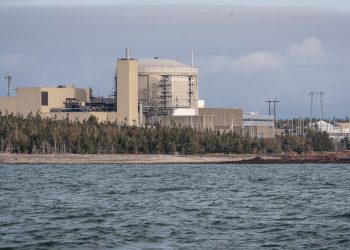
Plutonium is not found in nature but is created inside every nuclear power reactor, including the one at Point Lepreau on the Bay of Fundy. Plutonium is a human-made derivative of uranium. A metallic element heavier than uranium, it is created inside the nuclear fuel along with hundreds of lighter, fiercely radioactive by-products – the fragments of uranium atoms that have been split.
The countries that have nuclear weapons – the five permanent members of the UN Security Council (US, UK, France, Russia and China) as well as India, Pakistan, Israel, and North Korea – have all learned how to separate plutonium from used nuclear fuel for use in weapons. This is done by dissolving the solid fuel assemblies in a hot, highly radioactive chemical bath from which the plutonium is extracted using basic scientific procedures. Any technology for extracting plutonium from used fuel is called reprocessing.
Nuclear advocates have long dreamed of using plutonium as a reactor fuel, thereby increasing the options for new reactor designs and magnifying the longevity of the nuclear age. The problem is, once plutonium has been extracted, it can be used either for weapons or for fuel at the discretion of the country possessing it. Policing methods can be circumvented. As Edward Teller has observed: “There is no such thing as a foolproof system because the fool is always greater than the proof.”
That’s how India exploded its first atomic bomb in 1974, by using plutonium created in a Canadian research reactor given as a gift to India and a reprocessing plant provided by the US. Both the reactor and the reprocessing plant had been designated as “peaceful” facilities intended for non-military use. India declared that the bomb it had detonated was a “Peaceful Nuclear Explosive.”
After the Indian blast, it was quickly determined that several other clients of Canadian technology – South Korea, Argentina, Taiwan, and Pakistan – were also in a position to develop a plutonium-based bomb program. Swift and decisive international action forestalled those threats. In particular, South Korea and Taiwan were discouraged by their US ally from pursuing reprocessing.
Shaken by these shocking developments, in 1977 US President Jimmy Carter – the only head of state ever trained as a nuclear engineer – banned the civilian extraction of plutonium in America and tried to have reprocessing banned worldwide, because of the danger that this nuclear bomb material could fall into the hands of criminals, terrorists, or militaristic regimes bent on building their own nuclear explosive devices. As one White House adviser remarked, “We might wake up and find Washington DC gone, and not even know who did it.”
Japan is the only country without nuclear weapons that extracts plutonium from used nuclear fuel, much to the dismay of its neighbours. South Korea is not allowed to do so, despite repeated efforts by South Korea to obtain permission from the US to use a type of reprocessing technology called “pyroprocessing.” Pyroprocessing is currently undergoing experimental tests at a US nuclear laboratory in Idaho.
Now, New Brunswick has been enticed to take the plutonium plunge. The company Moltex Energy, recently established in Saint John from the UK, wants to use plutonium as a nuclear fuel in a type of reactor that is not yet fully conceptualized. The plutonium would be extracted from the thousands of solid irradiated nuclear fuel bundles currently stored at NB Power’s Point Lepreau reactor using a version of the pyroprocessing technology that South Korea has so far been denied.
On a site right beside the Bay of Fundy, the highly radioactive metallic fuel bundles would be dissolved in molten salt at a temperature of several hundred degrees. A strong electrical current would be used to strip the plutonium metal and a few other elements (less than one percent of the mass) out of the dissolved fuel.
After the government of Canada gave $50.5 million to support the Moltex project in March this year, nine retired US government advisors – all of them experts in preventing the proliferation of nuclear weapons – wrote to Prime Minister Justin Trudeau in May, urging him to authorize an independent review of the international implications of the proposed New Brunswick plutonium scheme.
These nine experts, who have worked under six different US presidents, both Republican and Democrat, are deeply concerned that Canada’s support for reprocessing and the civilian use of plutonium could seriously undermine delicate and precarious global non-proliferation efforts that have been underway for many decades.
No reply from the Canadian government has so far been received, although Trudeau’s office acknowledged receipt of the letter and said that the matter has been entrusted to Foreign Affairs Minister Marc Garneau and Natural Resources Minister Seamus O’Regan.
Without any word from these two ministers, Moltex posted a response to the US experts’ letter on their corporate web site, disputing some of the claims made in the letter to Trudeau. In particular, Moltex claims that their proposed technology is not usable for nuclear weapons purposes because the plutonium is not pure, but mixed with other contaminants that cannot easily be removed.
The Moltex response has prompted another letter to Trudeau from the US non-proliferation experts, correcting this and several other misleading comments from Moltex and reiterating their call for a fully independent expert review of the non-proliferation aspects of the Moltex proposal.
Our political leaders seem oblivious to the dangers to the entire planet that could result from widespread access to plutonium. If Canada can access plutonium, so can any other country. If many countries have access to plutonium, the possession of nuclear weapons must be regarded as a real possibility. In a nuclear-armed world, any conflict anywhere can turn into a nuclear war. The stakes could not be greater.
Citizens of New Brunswick and all Canadians who realize the importance of this issue can write to our Prime Minister in support of a non-proliferation review of the Moltex proposal, and raise this matter with candidates and at the door during the next federal election campaign. We can all raise awareness of the legacy of Nagasaki and do our best to ensure that New Brunswick is not implicated by going ahead with the Moltex plutonium extraction scheme.
Dr. Gordon Edwards, President of the Canadian Coalition for Nuclear Responsibility, is based in Montreal.

![Proposal for gas-fired power plant in Tantramar lacks transparency, says veteran journalist [video]](https://nbmediacoop.org/wp-content/uploads/2025/09/Screenshot-2025-09-04-at-17.47.39-350x250.jpg)