

What is the best way for utilities to delay the transition from fossil fuels? Propose to build nuclear reactors.
Electricity utilities wanting to “decarbonize” have several options for replacing the fossil fuel (coal, oil and gas) plants on their grids: aim to increase energy efficiency and productivity; add new renewable energy and storage resources; consider adding carbon capture and storage (CCS); or propose to build new nuclear reactors.
By objective measures, building new nuclear power plants will cost more, take longer to deploy, and introduce catastrophic accident risks—relative to improving energy productivity, expanding renewables with energy storage, and developing distributed energy resources. CCS suffers from limits of appropriate geology, reduced plant efficiency, and high costs.
However, if the goal is to keep fossil fuel-fired plants operating as long as possible, promising to build more nuclear energy has definite appeal.
Reactor design, planning, and build times are notoriously long—usually measured in decades—with well-established patterns of significant “unexpected” delays. Delaying while waiting for the promised new nuclear builds or reactor refurbishments maintains the status quo, effectively kicking actual climate action well down the road.
The two Canadian provinces with operating nuclear power reactors, Ontario and New Brunswick, provide case studies in this strategy. Both provinces are investing in significant new fossil gas generating infrastructure while waiting for new reactor designs to be developed and then built.
In Ontario, greenhouse gas emissions from the electricity sector have already risen dramatically as fossil gas plants are run to replace out-of-service nuclear reactors, and the province proposes to add more gas-fired generating capacity to its system. After a nearly decade-long hiatus, it only recently proposed a feeble reengagement with renewable energy. New nuclear reactor builds at Darlington, Bruce, and now Wesleyville, with timelines stretching well into the 2030s and 40s, remain the centrepiece of its energy (and supposed) climate strategy.
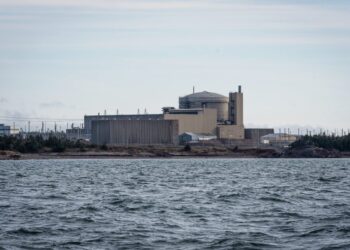
New Brunswick’s NB Power plans to add 600 MW of new nuclear power at its Point Lepreau nuclear site on the Bay of Fundy. Calls to build renewables instead have been rebuffed. In 2018, the province invited two nuclear start-up companies to set up in Saint John and apply for federal funding. Despite generous support from federal and provincial taxpayers, the companies have been unable to attract matching private funds. The NB Power CEO recently said she is “unsure” if the ARC-100, the reactor design promoted in 2018 as the closest to commercialization, will be ready by “the late 2030s.”
Meanwhile, the government recently announced support for building a large fossil gas plant, the biggest power project in the province in more than a decade.
The reality is that the new nuclear reactors being pushed by proponents are largely “PowerPoint reactors”—unproven and unbuilt designs. The BWRX-300 reactor that Ontario Power Generation (OPG) is proposing for its Darlington site, for example, lacks a fully-developed design, including key elements like safety systems. The Canadian Nuclear Safety Commission (CNSC) still gave OPG a licence to build it, while the U.S. Nuclear Regulatory Commission is still reviewing the design and asking for more information.
Recent analyses from the U.S. Tennessee Valley Authority also suggest the cost of the reactors will be far higher than OPG has claimed, and the timeline to construction and completion by 2030 seems less and less likely.
The new Monark design for a CANDU reactor that AtkinsRéalis (formerly SNC Lavalin) is proposing for the Bruce Power nuclear site is even further behind the BWRX-300 in development. According to the CNSC, the Monark is at a “familiarization and planning” stage, with no date set for even the first, preliminary stage of the design review.
The Monark’s main competitor is the AP-1000 reactor by Westinghouse. In 2002, the company submitted the AP-1000 design for formal review by the U.S. Nuclear Regulatory Commission. Two reactors came online in 2023 and 2024 at the Vogtle plant in Georgia, more than two decades later and twice the original timeline. Prior to the Vogtle project, the last reactor to come online in the U.S. took more than five decades from the start of construction to supplying power to the grid.
The final cost of the recent Vogtle project, at US$36.8 billion, was more than twice the original budget. If the same cost profile is applied to Ontario’s nuclear expansion projects, the total bill to Ontario electricity ratepayers and taxpayers could exceed $350 billion.
Promising to build more nuclear power is a political path to climate action delay and a distraction from a sustainable and decarbonized energy system transition. There is a reason why the International Energy Agency predicts that despite new nuclear reactor builds, nuclear energy will provide only eight percent of electricity supplies globally by 2050. In the meantime, while renewables development continues to accelerate globally, Canadian utilities, detoured by nuclear and CCS ambitions, double down on fossil gas and drift further and further behind in the global energy revolution.
Dr. Susan O’Donnell is on the board of the NB Media Co-op and adjunct research professor and lead investigator of the CEDAR project at St. Thomas University in Fredericton. Dr. Mark Winfield is a professor at the Faculty of Environmental and Urban Change at York University in Toronto, and co-chair of the faculty’s Sustainable Energy Initiative.
An earlier version of this story was published by The Energy Mix.

![Massive increase in military spending imposed by U.S. with little media pushback [video]](https://nbmediacoop.org/wp-content/uploads/2026/10/AlexCoshSept232026-120x86.jpg)


![University security closely monitored pro-Palestine activists, documents show [video]](https://nbmediacoop.org/wp-content/uploads/2024/11/20231129_131826-120x86.jpg)
