Depending on your point of view, New Brunswick was blessed or cursed when Prime Minister Mark Carney announced the Sisson mine project as a “nation building project” on November 13, 2025.
The proposed Sisson open-pit tungsten and molybdenum mine in the Upper Nashwaak Watershed had already held provincial and national focus for 18 years and counting.
As a prerequisite of this newest designation, the mine has undergone an updated feasibility study prepared by AUSENCO Engineering, funded primarily by the U.S. Department of War, and released to the public on October 1, 2026.
The mine is named after the small salmon bearing Sisson Brook. As documented in the report, the Sisson mine would bury the brook under hundreds of millions of tonnes of toxic pulverized waste rock. The area would be submerged in a 750-hectare toxic tailings lake, impounded behind a 90-metre-high dam.
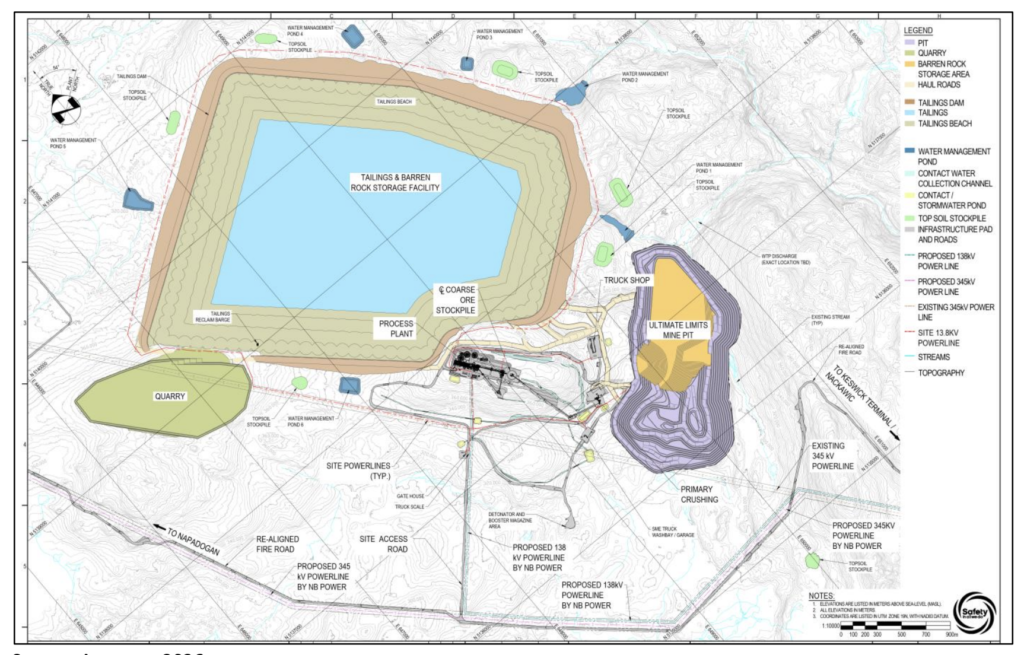
The tungsten ore lies within an ancient scheelite rock formation that formed nearly 400 million years ago when the rocks of the earth were still very much in transition.
According to the feasibility study, the ore deposit at the Sisson site is one of the largest localized deposits of tungsten ore containing the valuable tungsten trioxide mineral outside of China. Unfortunately the ore deposit contains the poorest grade of tungsten trioxide (0.00073, AUSENCO) yet to be proposed as the target of a serious mining venture.
It is this poor grade of tungsten ore that lies at the heart of the debate over the wisdom of proceeding with a mine to exploit the resource.
To get an idea of the earthly destruction required to exploit this resource, imagine repeatedly clearcutting 2,700 trees from the New Brunswick forest. You must chip up all those 2,700 trees to find the chips from the one special tree you are looking for. The rest is waste. So it is with the rock at Sisson. The ratio of waste rock and ore to saleable tungsten trioxide is 2,700 to 1.
To get at the tungsten trioxide, mountains of money must be spent digging, trucking, crushing and disposing of 2,700 units of ore and waste rock to get at one unit of saleable product. Then there is the challenge of selling tungsten at a price that repays efforts spent and offsets the destruction of a pristine watershed and all its intrinsic natural capital. Other tungsten mines are not faced with the same cost of extracting the tungsten. Can we expect the Sisson mine owners to cry not fair and argue that mining tungsten is in Canada’s national interest and therefore deserves government financial help to extract it?
However, herein lies another challenge. Processing the tungsten trioxide to a final state, usable by the steel industry in Canada, requires a facility not currently found within Canada, and as AUSENCO has found, is too expensive to build and operate at the Sisson site. Therefore, the Sisson mine will have to pack up all those tons of pulverized dusty tungsten, and truck them to facilities in the U.S., most likely in Pennsylvania, where they can be transformed into the usable final product, Ammonium Paratungstate (APT). To import that critical APT back into Canada for use in Canada’s “national interest” will likely require negotiations with the self-interested U.S. Government and its Department of War. Good luck with that!
Another arm of the crazed Sisson monster has its hand in the pocket and wallet of the New Brunswick public when it comes to feeding the mine’s voracious appetite for a good chunk of the province’s hard-pressed power grid. As per AUSENCO data, the proposed mine and processing plant will require about three per cent of the current NB Power grid that is already stressed to the breaking point. The mine has been guaranteed to receive power at the cost of production at $0.075/kwh, less than half the $0.1574/kwh that homeowners are charged. To add injury to insult, at a time when there is a possibility that ratepayers will be facing rationing of power, especially in winter, this project proposes to use three per cent of the power grid at cost.
Finally, the mixed hardwood/softwood forest found within the Sisson mine project’s immediate and expanded 20-kilometre pollution footprint (see fig. 1) is unceded Wolastoqey territory and encompasses nearly half the Crown Land within Crown Timber Licence 9. The rights to Licence 9 are held by the AV Group from India. For 20 years, AV Group has run a rayon fibre processing mill in the town of Nackawic, about 35 kilometres from the Sisson site, using wood from this licence. The mill and its predecessor, the St. Anne-Nackawic pulp mill, date back to 1970.
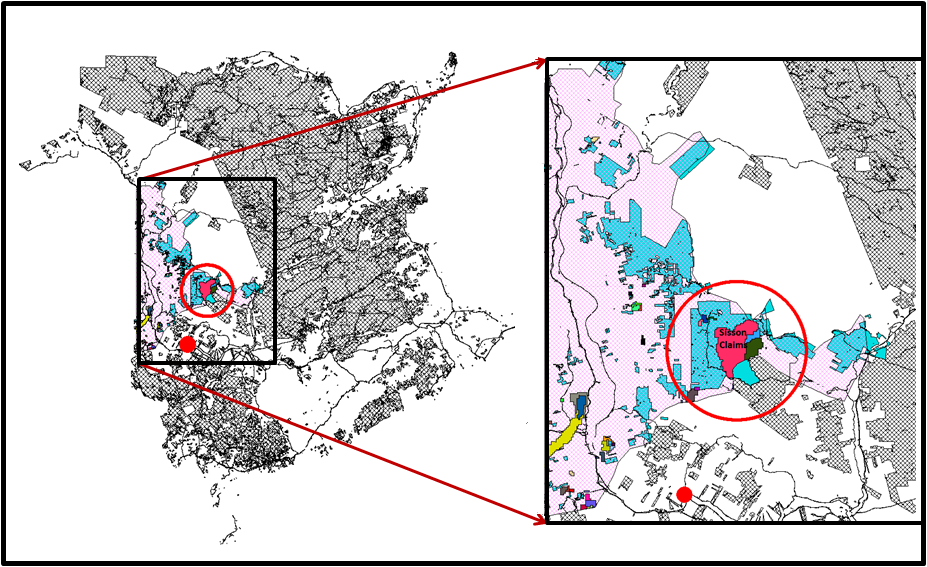
Destruction and pollution of this forest will impact the Nackawic mill’s primary resource for its product, whether it is run by the AV Group or a successor. If this land is industrialized to create an estimated 239 mining jobs for 27 years, as noted in the feasibility study, it will undoubtedly compromise the sustainability of an industry that has employed 350-400 people in Nackawic all those 56 years. What is wrong with this picture?
Considering historical and current prices of tungsten, a cash flow table in the report shows that Sisson cannot proceed without an approximately $1 billion subsidy from the federal and provincial governments in the form of a development loan or a top-up to the price the proponent receives for its product in the first five years of operation.
Given the current and projected price of tungsten, it is likely that in either case, the government’s effective investment over time will run to $2 billion. Such a subsidy will likely not be repaid until late in the life of the mine, if the mine survives as planned; a very big “if.” The government’s financial exposure would be extraordinary; all this for an estimated 239 mining jobs for 27 years, and at the expense of the Nashwaak Watershed that will be destroyed forever by this mine.
Beyond these guaranteed considerations, there is also the risk of a catastrophic failure of the 90-metre-high tailing dam and a flood of toxic tailings down the Nashwaak. As the feasibility study of the mine has exposed, the risk of failure at Sisson may be small, but the consequences will be extreme as my sample model of a failing at Sisson shows here.
The proponent has been required to present an expert model of a tailings failure at Sisson for the last 10 years. Where is that model? Why is the proponent dragging its feet? The Watershed, the Province, and Canada deserve to be informed.
Lawrence Wuest is an ecologist and recipient of the 2012 Milton F. Gregg Conservation Award. He is a frequent commentator on forestry and mining issues. He also works internationally on conservation projects in Papua New Guinea. He lives on unceded Wolastoqey territory in the Upper Nashwaak Watershed.
Correction: An earlier version of this story incorrectly estimated future employment at the mine as 128 full time equivalent jobs. However, in the updated feasibility study of the mine, those positions are projected for the processing facility alone. The updated feasibility study actually predicts mine operations personnel, including hourly maintenance personnel, will peak at 170, with an additional 69 salaried personnel for Mine Operations, Mine Maintenance, and Technical Services departments.
This story was last updated on October 24, 2026 at 10:35 AM.