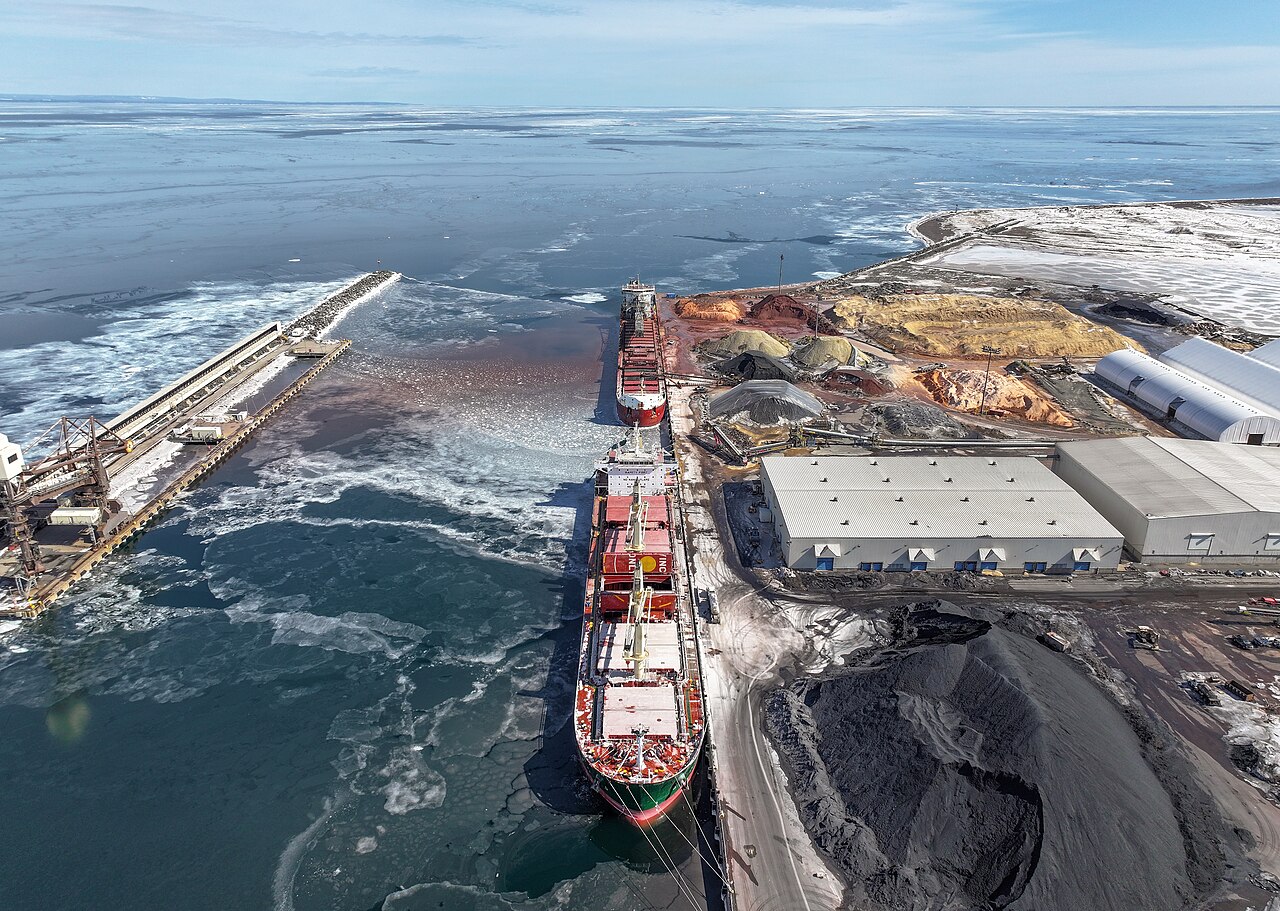
A Montreal firm that wants to build a military industrial complex in northern New Brunswick — and kickstart two mines to supply it — is suing the Port of Belledune and its CEO.
Blackpoint Industries Inc. and one of its Montreal executives, Mario di Palma, filed a lawsuit against the port and CEO Denis Caron on Oct. 5 in Bathurst’s Court of Kings Bench.
The plaintiffs accuse the port and its top executive of scuttling a deal worth more than $3 billion that would have created up to 3,500 jobs in underpopulated areas of the province where there’s little economic activity.
None of the allegations have been proven in court. Brunswick News contacted Caron on Wednesday, but the Port CEO said he would not comment. His side is expected to file a statement of defence in the coming days.
The lawsuit alleges Caron made a lot of empty promises.
“The plaintiffs assert that the statements made by the defendant, Denis Caron — both on his own behalf and on behalf of the co-defendant, the Belledune Port Authority — were clearly false, inaccurate, and misleading, and that he either knew this to be the case or put them forward with such recklessness and casual disregard that he acted in a negligent manner,” states the lawsuit, filed in French.
“In light of the foregoing, the plaintiffs contend that the defendant, Denis Caron, has committed the civil wrong of making false, untruthful, and misleading representations.”
Back in May, when the two sides first met, there was no such acrimony.
In the court filing, Blackpoint says it was participating in a defence trade show in Ottawa, CANSEC 2026, in late May when port administration officials pitched the idea of setting up business at their deep-water facility in northern New Brunswick because it might be of interest to Canada’s Department of National Defence and NATO countries.
Things then moved along quickly.
The lawsuit states the company’s representatives, accompanied by its business partner from Turkey, MKE, a big defence contractor, met at the port only a few days later on May 29.
By July 3, the port and Blackpoint had signed a letter of intent to set up the business.
Blackpoint alleges this was bolstered by a second letter of support, signed by Caron on July 17, giving the firm’s holding company an exclusive option period for due diligence, planning, and development of the project. However, the port reserved the right to conduct reviews and grant approvals, as well as to finalize agreements.
The proposal included leasing a building and about 230 nearby acres at the port to the company for 99 years for $1 annually, the lawsuit states.
The plans included a munitions factory to build explosives and six parcels of land that would be used for a “military campus.”
The complex would include a refinery for processing the heavy metal tungsten, which would be acquired from two proposed mines in another part of New Brunswick – the Sisson mine, about an hour’s drive north of Fredericton, and the Mount Pleasant mine, about 90 minutes’ drive south of the capital.
Sisson is a project of Northcliff Resources, based in Vancouver, and is still in pre-development. Last year, the U.S. Department of Defence gave the company more than $20 million to do preliminary work. The Canadian government kicked in another $8 million, conditionally. Tungsten, one of the heaviest metals, is essential for military armament but the world market for the critical mineral is controlled by authoritarian China.
Mount Pleasant has been dormant since the mid-1980s.
The port, in turn, would get a 10 per cent equity interest in Blackpoint Canadian Strategic Holdings, the firm’s holding company. The lawsuit alleges the two sides hammered out the basics of the deal at the firm’s Montreal headquarters in late July.
Until this lawsuit had been filed, neither party had publicly talked about such a big project.
Nothing is mentioned in the lawsuit about another, seemingly similar proposal that could see the creation of a munitions factory – or explosives plant – nearby.
In late August, the Canadian firm Nalagx told Brunswick News it had partnered with France’s Eurenco, Europe’s top producer of propellants and explosives, to build a plant about 20 kilometres west of the port on 1,500 acres of Crown land.
It’s a project with a first phase valued at $600 million, taking 500 workers to build and needing 250 employees once in operation.
It wants to eventually expand and become Canada’s largest explosives factory since the Second World War with a $2-billion footprint and 1,000 workers.
Premier Susan Holt has said that the project is not a done deal and that talks are ongoing.
In the lawsuit, the plaintiffs allege that thanks to the two letters, di Palma entered into commitments with the Turkish firm for the purchase, starting in autumn, of armament production systems and assembly lines, with the idea of installing the systems in a facility to be constructed on land at the port.
He also worked on securing $60 million in financing from the Business Development Bank of Canada and institutional investors.
The lawsuit says the first phase of the plan, an industrial complex, entailed an investment of up to $500 million and would have created up to 2,000 direct jobs, creating business revenues of up to $300 million annually.
Phase two, it stated, was to re-start the Mount Pleasant mine, a potential investment of up to $150 million with yearly business revenues of $400 million.
Phase three was to get Sisson started, with a $500-million investment, with revenues “to be determined.”
But something went seriously wrong. The firm alleges that Caron on Sept. 3 suggested the deal remained tentative, even though steps had already been taken to secure funding. A holdup was the signing of the lease, which would make or break the entire project.
On Sept. 7, the company says, it sent an email to the port and Caron warning that it was under the gun for hitting certain timelines with its investors.
Four days later, the port told the firm the deal was dead.
“This incomprehensible outcome was never explained, came as a complete surprise, and is in no way justified,” states the lawsuit.
As a remedy, Blackpoint has asked the judge to force the port to honour the 99-year agreement and turn over the building it wanted to lease, in exchange for the 10 per cent equity stake.
It says if the deal isn’t honoured, the judge should impose a permanent injunction preventing the port from using the site in question “in a manner inconsistent with the rights recognized as belonging to the corporate plaintiffs.”
Failing that, the company has asked for unspecified damages and court costs.
– with files from Adam Huras
John Chilibeck is a Local Journalism Initiative Reporter for the Daily Gleaner. This article originally appeared in the Telegraph-Journal on October 22, 2026.