Two farmers, both neighbours, don’t see eye to eye on shale gas fracking.
One, Stephen Moffett, once ran the biggest pig farm in the country east of Quebec. The other, Beth Nixon, is proud to say her family has owned its rolling hayfields in Penobsquis, a short drive from Sussex, for more than a century.
Both have had production gas wells on their land for about 25 years, and both wanted to give their opinion at the provincial government’s inaugural public meeting on Tuesday night about possibly lifting the 12-year moratorium on further natural gas development.
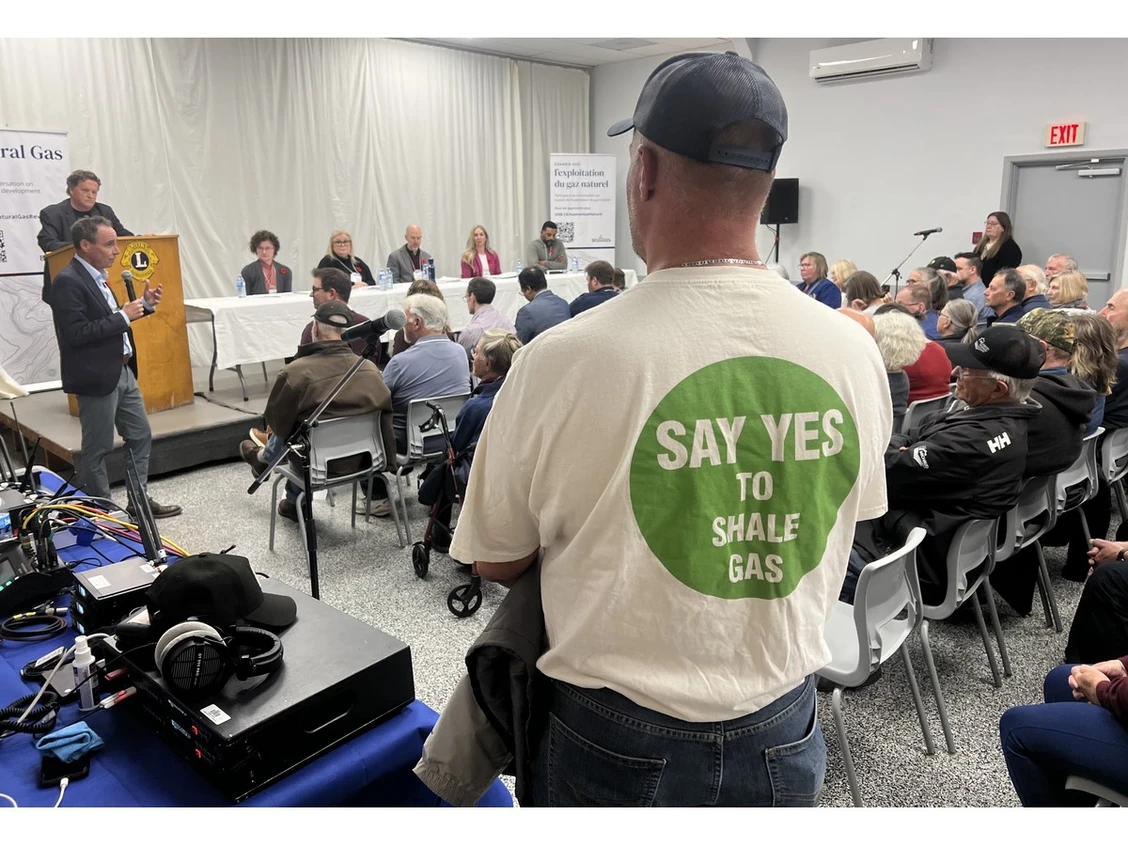
Nixon was one of more than a dozen people who lined up at the microphone during the question-and-answer portion of the two-hour meeting at the Sussex Lions Club, attended by more than 100 people.
She warned the audience that the five wells on her land had caused “lots of problems,” including damaging the air quality.
Nixon cited the admonition of Dr. Chris Arsenault, a Fredericton family physician and committee co-chair of the Canadian Association of Physicians for the Environment in New Brunswick, who cautions about high rates of cancer in communities where businesses make money from hydraulic fracturing – or fracking – for natural gas.
In an opinion piece published by Brunswick News this week, the doctor said, “No cheque is worth giving a kid cancer.”
“I’m saddened and disappointed that there are people in my community that would take a cheque and let kids get cancer,” Nixon said, adding it was hardly worth making money from a well for 20 years if it leaves behind a toxic legacy.
Listening to her speech, Moffett, her neighbour, disagreed. He has about a dozen of the wells on his own land.
“Where does she get this stuff about cancer?” the farmer said to a reporter in his soft-spoken voice. “I raised seven children beside those wells. Beth raised four kids beside her wells. None of our children got cancer.”
Moffett, who is retired, but once had 120,000 pigs on his farm, said the people running the wells, Headwater Exploration, were nice people and easy to get along with. He had asked the manager, a fellow named John, the other day if any of the wells were leaking methane gas.
“He said no. But I shouldn’t have to rely on his word. It’s those people up there who should be telling me whether it’s dangerous or not,” the tall farmer said, pointing at five provincial government officials seated at a table, taking questions from the audience.
“As a farmer, I was regulated because I was providing food, and it was important that it was safe.
“It should be no different with developing natural gas. We need the government to ensure it’s safe.”
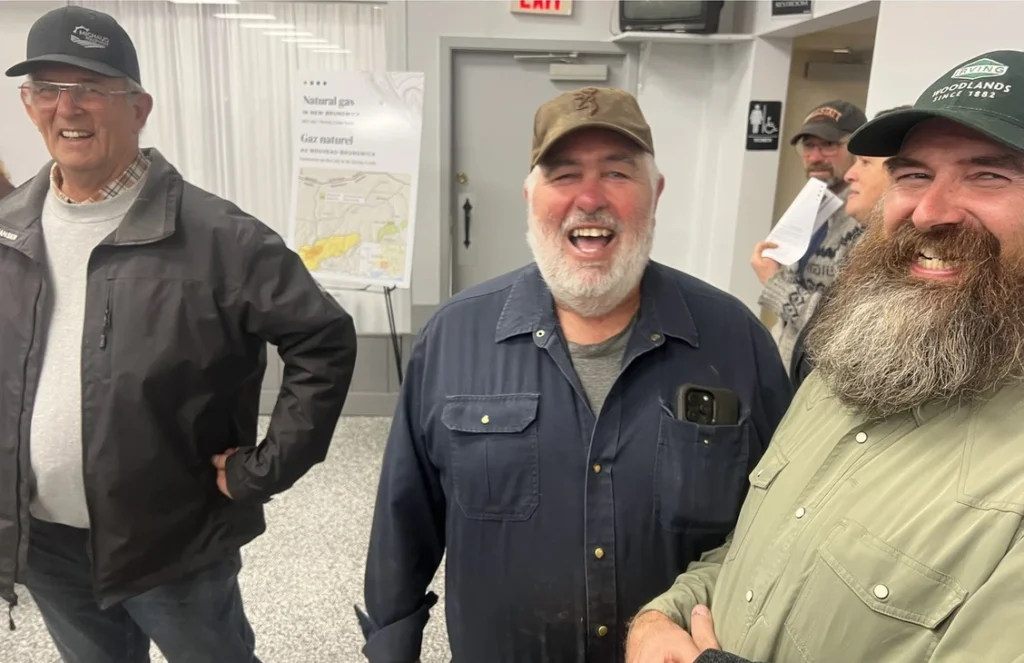
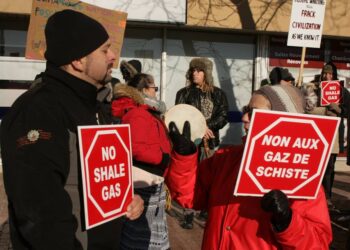
Most of the people who took to the mic were opposed to shale gas development. It was difficult to tell what the majority in the hall thought. More than one speaker said the provincial government should hold a referendum or plebiscite on the issue. One woman at the microphone asked anyone in the audience who was opposed to shale gas to stand up. About half of the people seated in chairs stood, but the other half of the crowd already standing at the back of the hall didn’t have an option on the informal vote.
John Herron, the minister of natural resources, had encouraged the audience to engage in dialogue, not debate. But that’s not what happened at the microphone. The speakers were largely entrenched in their positions.
Facing criticism over deficit spending, the Liberal government announced in August it would set up several working groups from different departments and include outside experts to review the latest evidence about fracking and shale gas development, and any possible economic benefits or harms to human health and the environment.
Separately, it has set up a roundtable between Premier Susan Holt and the 15 First Nations chiefs and another technical working committee that includes Indigenous representation.
Holt has set a January deadline to come up with a decision on this hot-button issue.
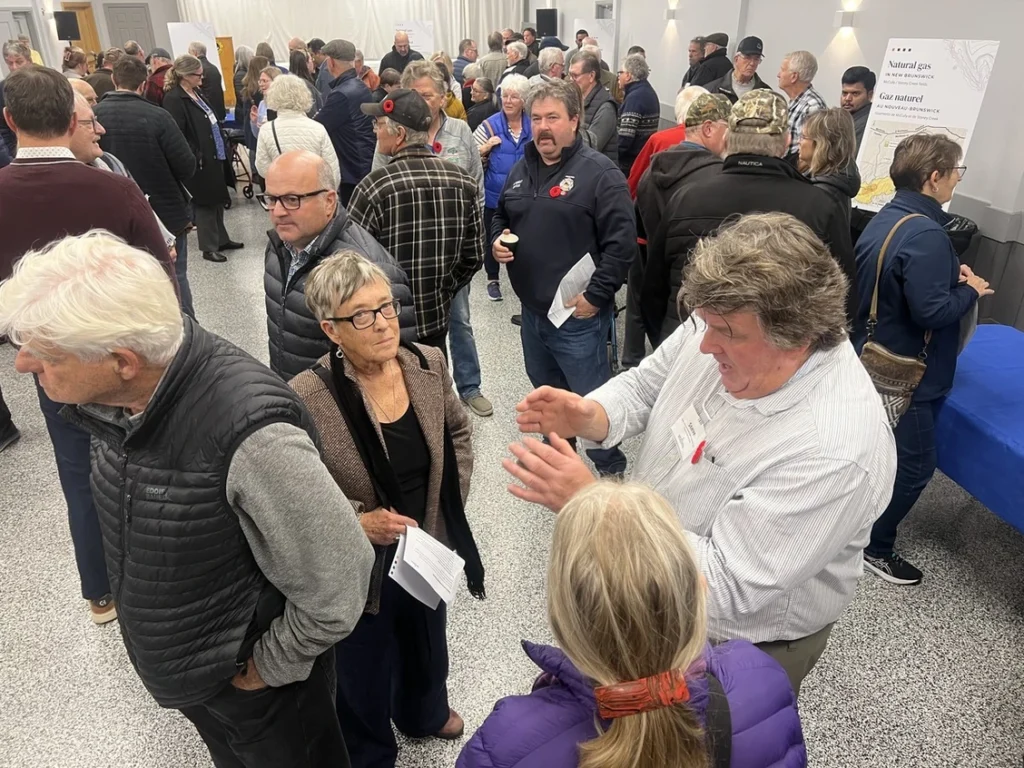
Five of the working groups had tables set up in the hall for the first hour of Tuesday’s meeting, allowing people to ask officials questions one on one. The officials included people like Cade Libby, the deputy minister of natural resources, and Yves Léger, the chief medical health officer.
Afterward, the audience, which had to pre-register to attend the meeting, was encouraged to fill out a questionnaire or send in emailed questions or opinions on the issue. The findings are supposed to be compiled for government before it announces a decision in January whether to lift the moratorium.
Stephanie Coburn, whose family runs beef cattle at Head of Millstream, not far from town, told Brunswick News she was disappointed the Holt government has embarked on what she considers environmentally damaging projects. Besides looking into lifting the moratorium, it approved a gas-fired power plant in Tantramar, the proposed Sisson Mine, and has done nothing to stop new data centres, she said.
Burning more natural gas, she warned, would only contribute to climate change, such as the drought that’s drying up the well her family counts on for drinking water.
“I feel like the people who are pushing this again have given up on the planet,” said Coburn, 79, who used a walker to make her way around the room. “They just want to make sure that the gross domestic product goes up on their watch. And they have projects that they can open that make them look like they’re effective when they’re not.”
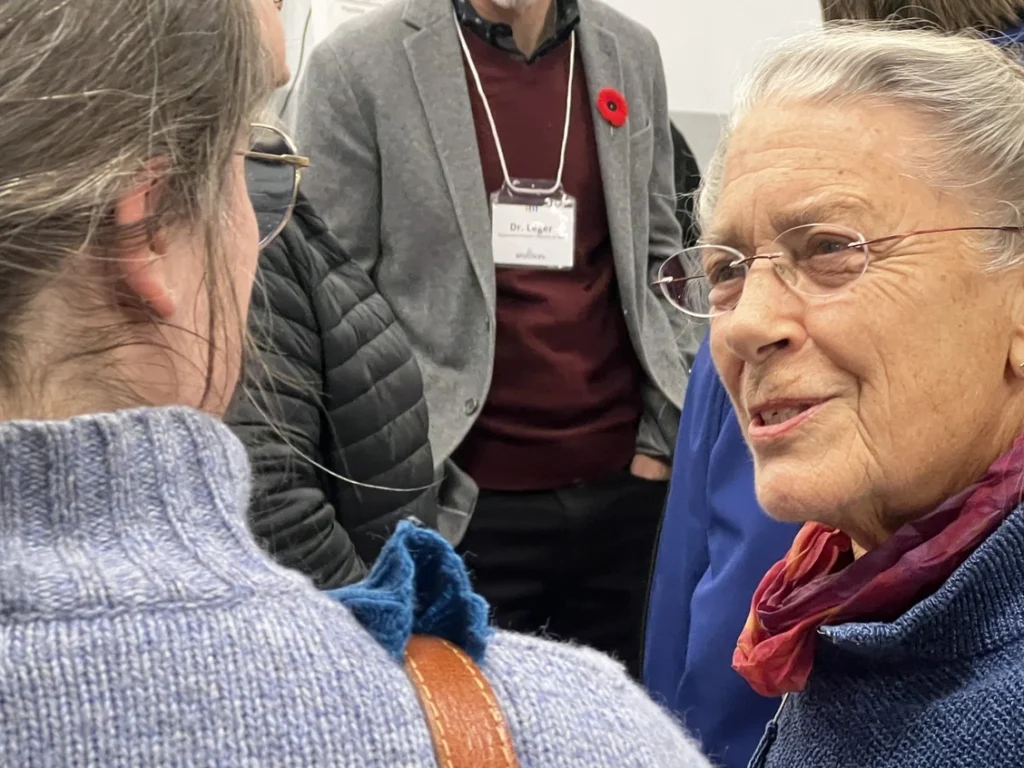
Bill Crowe, who used to run a business transporting frack wastewater from Penobsquis to a sewage lagoon in Nova Scotia, expressed dismay that people would turn down jobs and economic opportunity, considering that funding for New Brunswick’s public services, such as health care and education, depends heavily on the money transferred from provinces like Alberta, British Columbia and Saskatchewan that have a big natural gas industry.
He also took to the mic, telling people there was enough natural gas underground to make the area the next Fort McMurray, the wealthy, growing city in Alberta famous for fossil fuel production.
“Why can’t our kids make a living here?” he pleaded. “I’m tired of being a welfare state.”
But others admonished the provincial government for opening a can of worms, arguing that fossil fuels were endangering the planet and people’s health.
“I’d rather be in a poor province than a rich, unhealthy province,” said Terry Jones who lives in Centre Village where NB Power is proposing to build a 500 MW gas/diesel generating plant.
The bureaucrats at the main table tried to assure the audience with motherhood statements that no final decisions had been made, and they were carefully sifting through the evidence.
Another spectator said Herron could not be trusted because during debate over the moratorium more than a dozen years ago, he was president of the Atlantica Centre for Energy, an organization that favoured shale gas development.
But the minister insisted that his Liberal government hadn’t made up its mind, and he was just one voice in cabinet.
The minister added that if he had his way – and here, he stressed this wasn’t official government policy – New Brunswick would eventually create a sovereign wealth fund from natural gas that was on par with what “Norway or the government of Peter Lougheed” had set up, a reference to the late premier of Alberta.
Norway’s fund, the largest single sovereign wealth fund in the world, is worth $3.4 trillion Canadian, or more than $500,000 for each of the European country’s citizens. It was created from surplus oil revenues in 1990.
The Alberta Heritage Savings Trust Fund, created by Lougheed’s Tory government in 1976 from oil and gas revenues, is now valued at $32 billion and is still used for public spending in areas like health care, education, and roads.
No further meetings have been announced.
John Chilibeck is a Local Journalism Initiative Reporter for the Daily Gleaner. This article originally appeared in the Telegraph-Journal on November 4, 2026 and a version of it was published by The New Wark Times later that day.