
Unhealthy and unsafe migrant labour and housing are well documented in Canada, yet migrant workers face numerous barriers to accessing health care, including fearing that reporting an illness or injury could jeopardize their stay in the country.
A new report by the Madhu Verma Migrant Justice Centre and the Canadian Health Coalition reveals that depending on where a migrant worker lives in Canada, they may have better or worse health care coverage.
Saskatchewan is the only province that does not set a minimum work permit length or residency requirement for migrant workers. However, the province has a waiting period of up to three months that most other provinces do not have.
Farm workers employed in the Seasonal Agricultural Worker Program (SAWP) in Québec, Ontario and Manitoba receive public health care on arrival.
Other temporary foreign workers across Canada must hold a work permit of a certain duration, somewhere between six and 12 months, and/or prove they will reside in the province or territory, usually for 12 months.
On Nov. 18, the Canadian Health Coalition’s Anne Lagacé Dowson hosted a webinar launch of the report, “Excluded from care: Health care barriers for migrant workers in Canada,” with myself and Lutfunnessa Tania, the report authors, as well as migrant workers and researchers who are part of a new research collaborative, the Madhu Centre Fellows for Migrant Justice.
The report launch is now available for viewing here:
‘Suffering in silence’
Stacy Neish, a single mother from Jamaica in New Brunswick, has been struggling to ensure that her Canadian-born daughter gets the health care and dental care she deserves.
“Every parent wants to see their child healthy, happy and protected. I want the same for my daughter,” shared Neish at the launch.
“Accessing basic health care has been an emotional and exhausting struggle. We, migrant workers, contribute to the economy, we sustain small towns, we create wealth, yet when it comes to essential services, we are invisible,” added Neish who is a member of Migrant Workers Alliance for Change.
Neish said that she carries the weight of knowing that a simple medical emergency could become a crisis and she knows she is not alone.
“This is not just my reality. Thousands of migrant mothers are living the same fear, suffering in silence,” said Neish who said her daughter is deserving of care. “She is the future of Canada.”
New mother describes dealing with lingering trauma of medical bills
Juvy has been in Canada since 2021 and is currently based in New Brunswick. She joined the webinar with her 4-month-old baby.
She shared her experiences of being pregnant and being asked for a $10,000 deposit at her first OBGYN appointment. She explained she was initially denied Medicare due to her extension to stay in Canada being in process. She was able to get support from the Madhu Verma Migrant Justice Centre to stay in the country and finally get Medicare.
“People may think why did you decide to get pregnant when you are not covered by Medicare. It’s almost like there is a hidden message that you have to stop your life when you have a certain status in Canada,” said Juvy who explained her fear of speaking out.
“I also want to let people know that this could happen to anybody,” said Juvy while fighting back tears. “Four-months postpartum and I’m still having that trauma.”
Juvy explained that she applied for E.I. maternity leave, but was denied because she didn’t have enough hours of work to qualify. She was not able to accumulate the required number of hours because she was not allowed the opportunity to work.
“I don’t want people to think we feel entitled. I work so hard. I was counting on the benefits to support me during this time. I do not want to beg for anything. I work hard but there is this requirement of a number of hours worked to qualify for E.I., which is out of my control. Do they want me to work illegally to get the hours? I don’t understand. Nothing is logical for me,” said Juvy.
‘We are not garbage’
Alicia Carty is a former migrant farm worker who was injured at work due to inadequate training. She is currently living with daily pain and mental health struggles, including depression and anxiety, from not getting the care she needs.
“When we come here to work and we get injured, we don’t have access to health care,” said Carty who is now an advocate for other injured migrant workers and organizes with Justicia (Justice for Migrant Workers). She is the 2026 recipient of the Nell Toussaint Award for Universal Health Care.
Carty said her organization is supporting a migrant worker who has been injured for more than a year and being forced to work with that injury. “He has been told that he has less than a week to go back home and he doesn’t even have the bus fare to go to the airport,” said Carty.
“We are thrown out like broken vessels. We are not garbage. We should be treated fairly. We are paying into a system that is refusing to give us what we are paying into,” said Carty.
A week ago, Carty was admitted into an emergency room and told she would have to pay $1,000 to see a doctor.
For Carty, the best way for migrant workers to access health care is for migrant workers to be granted permanent residency status on arrival.
Ottawa needs to take the lead on who is eligible for Medicare: law professor
Y.Y. Chen is an associate professor in the Common Law Section of the University of Ottawa’s Faculty of Law, where he holds the Dean’s Research Professorship in Migrant Health Equity. He attended to the report’s recommendation for Ottawa to hold the provinces and territories to account for meeting the Canada Health Act’s criteria, notably universality.
Chen explained that provinces and territories determine who is a resident and eligible for Medicare, noting, “the Canada Health Act leaves considerable room for interpretation on who qualifies as a resident. That results in the wide variety, as documented in the report, of who qualifies for provincial and territorial health insurance.”
Chen noted that the federal health minister has the authority to clarify how Ottawa interprets the Act, including the definition of residents, yet in the more than 40 years of the Act’s existence, the question of who qualifies as a resident has been left to the provinces and territories, which result in the struggles migrant workers face today when accessing health care.
“It’s time for Ottawa to take the lead. We need a clear nation-wide standard of who counts as a resident for the purposes of Medicare. One that reflects the principle of equity and solidarity in Medicare, and broad enough to include all temporary foreign workers,” added Chen.
New report inspired by Nell Toussaint
The report is inspired by Nell Toussaint, a Grenada-born woman who championed universal health care access, including for those without immigration status to be in Canada, while she was alive. In 2023, Toussaint died at the age of 54 from complications related to diabetes. The Canadian Health Coalition honours her legacy with an annual award to a Black champion of universal health care. Nominations for the 2027 award are currently open.
Toussaint came to Canada as a migrant worker. She lost her status to be in the country and tried repeatedly to regularize her status. When she became sick, she was denied health care because Canada does not grant public health care to people who do not have status to be in the country.
A champion for health care for irregular migrants in Canada, she took her fight to Canadian courts and to the UN. In response, a UN committee ruled Canada had violated her right to life and nondiscrimination by denying her access to life-saving health care, and asked Canada to provide an effective remedy and ensure future violations are prevented.
In 2025, Chen represented the Canadian Health Coalition and the Madhu Verma Migrant Justice Centre in their joint intervention before the Supreme Court of Canada in Quebec (AG) v Kanyinda. He is currently co-counsel for the Canadian Health Coalition and several other organizations intervening jointly in Toussaint v Canada (AG).
Chen offered an important reflection on how Toussaint and others with irregular immigration status are shut out of Medicare.
“We need more transformative law and policy reform. Respecting the rights of everyone requires us to extend eligibility to Medicare to everyone who lives here, regardless of their immigration status,” said Chen.
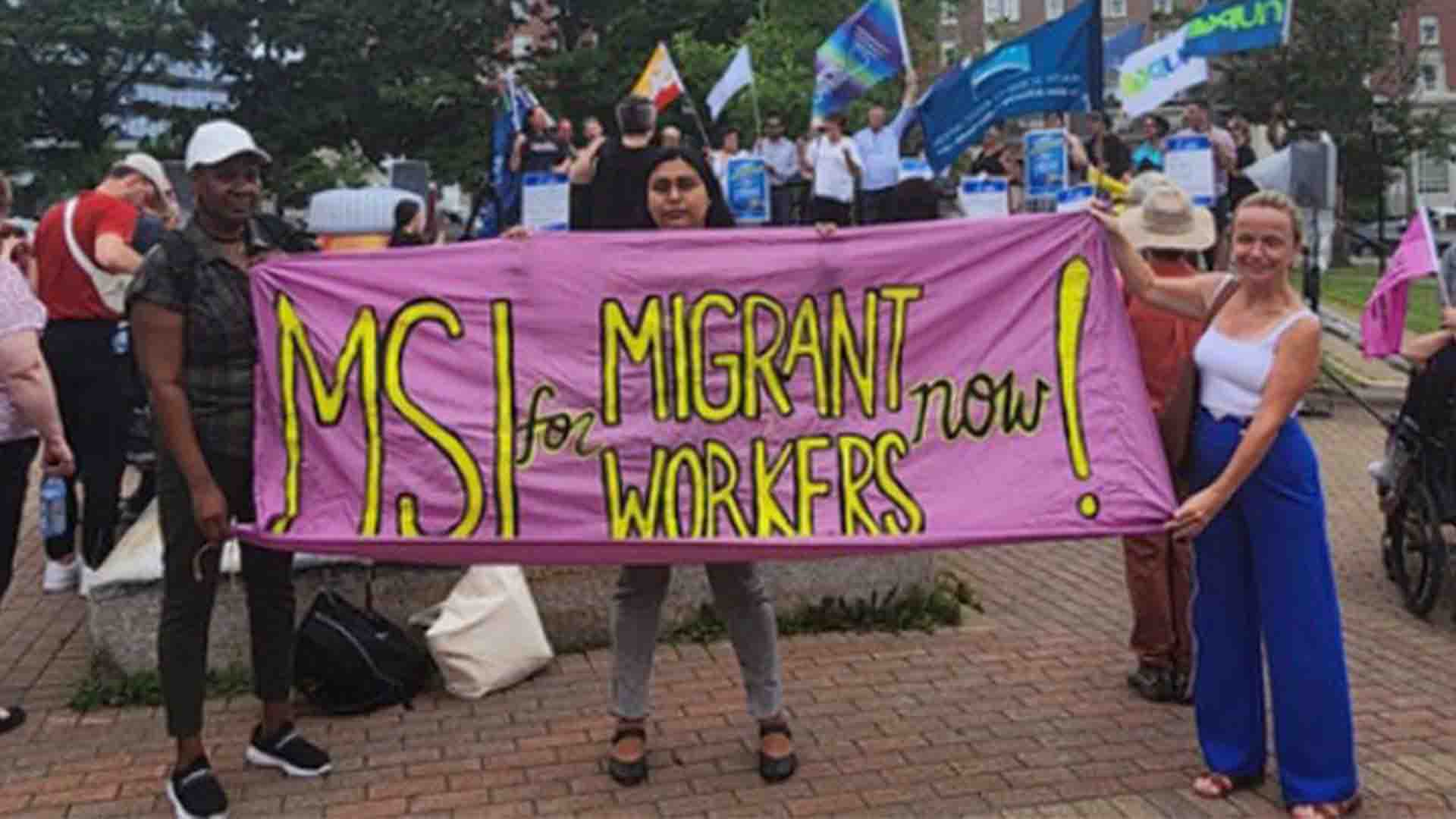
‘Dehumanizing and deplorable’
Susana Caxaj is a professor of nursing at Western University. “The way we treat individuals that come under temporary migration schemes is dehumanizing,” said Caxaj.
“The standard to which we expect individuals to come into these programs with a perfect bill of health and then the minute they are injured or sick, they cease to have the most basic protections. I think that’s incredibly dehumanizing and deplorable,” said Caxaj.
A scholar who focuses on the intersections of migration, housing and health care, Caxaj explained, “we know individuals who are injured or sick must choose between becoming homeless and unemployed or being deported without any health care coverage or risking all of that to get basic health care coverage and other entitlements that they have paid into,” said Caxaj.
Caxaj explained that the temporary foreign worker programs are making people sick, treating “people’s bodies becoming broken and sick as expendable and normal consequences that Canadian society washes its hands off.”
‘Migrant justice is reproductive justice’
Lindsay Larios is an associate professor of social work at the University of Manitoba who specializes in access to pre-natal care and reproductive health care.
“Often the response when someone is not eligible for public health insurance is that they can purchase private insurance, but private insurance often does not cover costs associated with many conditions and is often not an option for many people, specifically when it comes to pregnancy. People in this situation end up paying costs directly including for pre-natal care, labs, ultra-sounds and exorbitant costs for labour and delivery,” said Larios.
“Many of these fees are charged at an inflated rate, at 200 per cent, 300 per cent, and many hospitals across the country will ask for deposits ranging from $10,000 to over $30,000 as we’ve seen in Winnipeg when registering as a patient. People simply cannot afford this and go without care at important points of their pregnancy when care and monitoring is really necessary for the mother and the health of the pregnancy,” said Larios.
Larios noted that unpaid bills get forwarded to collections agencies and in at least one hospital in Manitoba, information on people with unpaid bills are being forwarded to the Canada Border Services Agency.
“All workers in Canada deserve to create and care for their families, to have the health care and resources needed to do so, and the employment and residency protections that any other Canadian worker has the right to,” said Larios.
“This is a migrant justice issue, but it is also a reproductive justice issue. It’s a woman’s rights issue. It is an issue that spans movements, spans human rights advocacy,” said Larios who called on reproductive justice organizers to include migrant work health care struggles.
Challenging the Alberta UCP government’s calls to further deny health care to migrant workers
The report is a timely response to Alberta’s two-tier health care reforms and Premier Danielle Smith floating the idea of making temporary residents, including migrant workers and international students, pay for health care.
Responding to misconceptions of who is responsible for wait lists and who is deserving of health care, the authors argue for a more inclusive public health care system.
Dispelling the notion that migrant workers do not pay taxes and are thus undeserving of health care, they clarify migrant workers do pay taxes that fund Canada’s public health care system but are often denied access to health care due to the length of their work permit or waiting periods.
The report also comes three weeks after two more migrant workers were fatally struck by a vehicle on Ontario’s roads.
On the night of Oct. 29, 2026, Esvin Denilson Marroquin Ajpop (25) and Carlos Roberto Cos Socoy (27) from Guatemala were killed when a vehicle hit them while they were walking on County Road 34 West in Kingsville. A key barrier to health care access is safe transportation.
The report lists 21 recommendations for the federal and provincial and territorial governments to improve access to health care of migrant workers.
Importantly, the authors argue that provinces and territories should grant Medicare to all, regardless of immigration status.
Tracy Glynn is the National Director of Projects and Operations of the Canadian Health Coalition, where a version of this story first appeared on Nov. 19, 2026.
Editor’s note: Tracy Glynn is also the coordinating editor of the NB Media Co-op.