

Temporary foreign workers are being dismissed from jobs in New Brunswick’s seafood industry after working for just a few weeks, with their employer blaming the layoffs on tariffs, but then hiring new workers almost immediately afterwards.
That’s according to an advocate who provides migrant workers with legal support as they navigate the Canadian immigration system and deal with problems in the workplace.
“They come in May and they only work for three weeks and they are dismissed,” said Cristian Sanabria, a community legal worker at the New Brunswick-based Madhu Verma Migrant Justice Centre. “Then the next batch of workers, they come in June and they work until July, and then they are dismissed.”
Sanabria said he’s aware of roughly 50 workers whose cases match that description so far this year. He wouldn’t disclose the name of the employer or employers in question due to concerns about possible retaliation against migrants who remain employed there.
Migrant workers normally have a contract lasting about nine months, but it’s not binding if the season is slow, or if there isn’t enough raw material to keep the workers employed, Sanabria said.
“The main issue is, if there is not enough raw material or the season is slow, why does the company keep hiring new workers?” Industry representatives couldn’t be reached for comment by publication time.
The pattern of turnover is notable in part because hiring temporary foreign workers involves significant costs: employers have to apply for a Labour Market Impact Assessment (LMIA), which involves a $1,000 fee for each position, and they are required to cover the cost of transportation to Canada.
“This is something I have been questioning myself about over the past few months, because, in fact, it does not make much business sense for an employer to pay all the costs associated with the LMIA and airfare, only to let the worker go so easily after having them work for just a couple of weeks,” Sanabria said.
One company has had more than 250 LMIAs approved so far this year, he said.
As for the American trade war, it has resulted in market uncertainty, but so far tariffs affecting the seafood sector haven’t materialized. And yet, temporary foreign workers have reported that their layoffs were attributed to tariffs.
“What they say is, ‘Well, now with the tariffs, we don’t have enough jobs for you guys, so we have to dismiss you,'” Sanabria said.
In August, the federal government included American seafood on a list of counter-tariffed products, but quickly withdrew those items over concerns about knock-on effects in the Canadian seafood sector.

Rallies planned nationwide
The news comes ahead of rallies planned in Fredericton and 10 other cities across the country over the weekend, coordinated by the Migrant Rights Network, to mark Parliament’s return for the fall sitting.
Organizers are focussing on migrant workers’ essential contributions to the provincial economy and the day-to-day struggles they face.
“Every day, migrant workers keep the province’s economy alive, yet the same workers are pushed into precarity through exploitation, deportation threats, and endless delays for work permit renewals,” the Migrant Workers Alliance for Change and Madhu Centre said in a joint statement.
READ MORE: ‘We are treated as disposable,’ says former migrant fishery worker
Migrant workers in New Brunswick have reported issues including overcrowded and mold-infested housing, verbal abuse and discrimination, prolonged periods without work, wage theft and other issues.
In general, temporary foreign workers have closed work permits, meaning that their immigration status is tied to a specific employer. That system leaves workers vulnerable to abuse and exploitation, according to advocates who have called for open work permits and permanent residence on arrival.
Immigration, Refugees and Citizenship Canada has stated that the federal government “takes the safety and dignity of temporary foreign workers very seriously and has implemented measures to address and prevent abuse,” citing efforts such as an anonymous tip line and online reporting tool.

Employment and Social Development Canada has stated that it has implemented stricter administrative monetary penalties as part of efforts to “combat program misuse and increase worker protections.”
Organizers are also drawing attention to events in Calgary, where Canada Border Services Agency officers attended an international student protest to check the immigrations status of attendees.
Ten of those attendees have now received exclusion orders and face deportation, according to an open letter signed by advocacy groups including the Madhu Centre and Independent Jewish Voices–New Brunswick.
Critics have condemned CBSA’s actions, saying that migrants should be allowed to engage in political dissent without putting their immigration status at risk. Some have compared the agency’s tactics to Trump’s anti-immigrant crackdown south of the border. CBSA has confirmed details of its enforcement actions but said it won’t comment further due to privacy legislation.
By the numbers
Eighty workers in New Brunswick have been classified as “vulnerable” so far this year, meaning they have been granted open work permits after facing abusive conditions in the workplace, according to federal figures. Last year, 205 migrant workers in New Brunswick were deemed vulnerable — a record-breaking number.
READ MORE: Record number of migrant workers deemed ‘vulnerable’ in New Brunswick
The province has grown increasingly dependent on migrant labour over the past decade, particularly since the COVID-19 pandemic.
In 2015, the federal government issued 1,020 work permits for migrant workers in New Brunswick, a number that increased to 1,690 by 2019. By 2021, it had reached 2,420. In 2023, there were 4,405 temporary foreign workers in New Brunswick, a figure that so far remains unsurpassed.
By the end of July, the number of temporary foreign workers in New Brunswick had reached 3,325, according to preliminary data from Immigration, Refugees and Citizenship Canada.
New limits on temporary foreign workers were announced in 2024 by then-Prime Minister Justin Trudeau, but with exceptions for sectors including food and fish processing.
Seafood processing employs most of the migrant workers in New Brunswick.
So far this year, 2,360 migrant workers in New Brunswick were classified as either “fish and seafood plant workers” or “labourers in fish and seafood processing.” That’s roughly 68 per cent of all migrant workers in the province. It’s the fifth consecutive year that the seafood processing industry has brought in upwards of 2,000 workers.
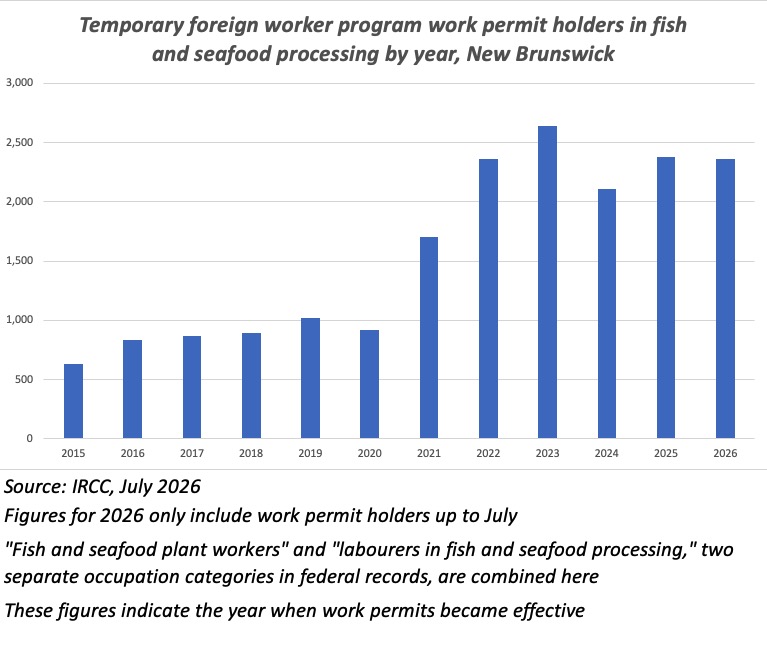 The rest are employed in a wide variety of occupations. Federal data indicates that, in 2026, they have included: 270 harvesting labourers, 120 construction helpers and labourers, 80 transport truck drivers, 60 nursery and greenhouse workers, 50 cooks, 40 food service supervisors, and 30 workers in the wood products sector.
Some of the job categories with 25 workers or fewer include carpenters, chefs, landscaping and grounds maintenance labourers, heavy equipment operators, and registered nurses or registered psychiatric nurses.
David Gordon Koch is a staff reporter with the NB Media Co-op. This reporting has been made possible in part by the Government of Canada, via the Local Journalism Initiative.
Editor’s note: Tracy Glynn, co-founder of the Madhu Verma Migrant Justice Centre, is coordinating editor of the NB Media Co-op. Sarah Kardash, a member of the NB Media Co-op’s board of directors, is project manager for the Madhu Centre.
![Massive increase in military spending imposed by U.S. with little media pushback [video]](https://nbmediacoop.org/wp-content/uploads/2026/10/AlexCoshSept232026-350x250.jpg)
![Amid push for ‘nation-building projects,’ critics warn of ecological devastation [video]](https://nbmediacoop.org/wp-content/uploads/2026/10/MineBabyMineSept242026-2-350x250.jpg)


![University security closely monitored pro-Palestine activists, documents show [video]](https://nbmediacoop.org/wp-content/uploads/2024/11/20231129_131826-120x86.jpg)


![Massive increase in military spending imposed by U.S. with little media pushback [video]](https://nbmediacoop.org/wp-content/uploads/2026/10/AlexCoshSept232026-120x86.jpg)
