
As of August 14, Grifols has paused operations of its plasma collection clinics in Canada, including its New Brunswick locations in Moncton, Fredericton and Saint John.
Plasma, the liquid in blood that transports red and white blood cells, platelets, albumin, clotting factor, and proteins including antibodies, is used to make medicinal products for the treatment of immune deficiencies and bleeding disorders.
The pause on operations comes after investigative journalists reported three deaths at the Grifols’ Winnipeg location since 2018 and numerous compliance violations at its other sites across Canada. The violations involve rules meant to keep plasma donors safe.
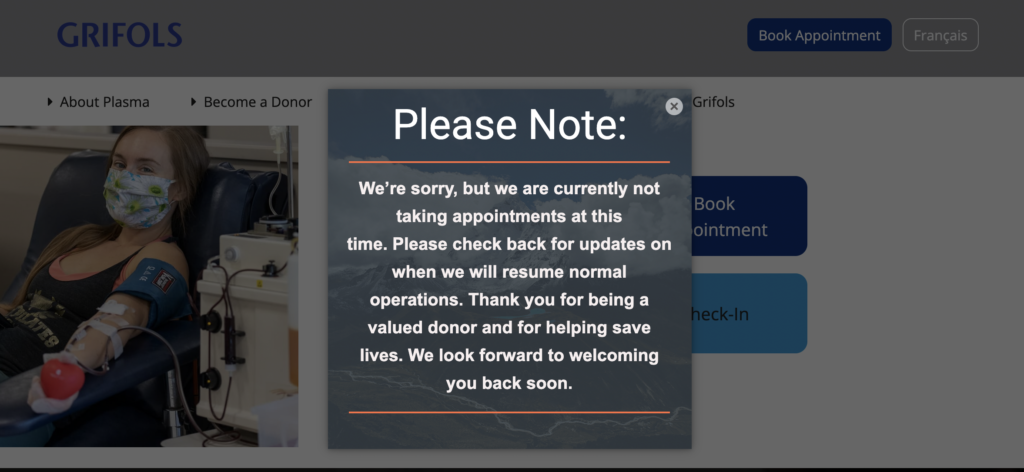
The New Brunswick Federation of Labour, Canadian Health Coalition and labour unions across the country, including those representing Canadian Blood Services (CBS) employees, welcomed the news but want CBS to immediately end its agreement with Grifols. The contract allows the for-profit multinational firm from Spain to act as a CBS agent and buy plasma.
Before the pause, Grifols ads found on Facebook said donors could make thousands of dollars in a year by selling their plasma.

“Paid blood donations exploit vulnerable populations and weaken the blood and plasma supply. Blood products is a public resource, and voluntary donations are the safest way to collect this resource,” said Chris Watson, president of the New Brunswick Federation of Labour.
Despite public outcry, Grifols’ predecessor Canadian Plasma Resources (CPR) was allowed to start buying plasma in Canada, first in Saskatoon in 2016. In 2023, Grifols took over CPR’s operations and is currently the only company with an arrangement with CBS that allows it to buy plasma.
Some provinces have banned payment for plasma. New Brunswick is not one of them.
Ontario, British Columbia, and Québec have paid plasma bans. However, Grifols has been allowed to bypass Ontario’s ban by operating as an ‘agent’ under a 15-year contract with CBS, which includes a legal exemption to pay donors for plasma.
In response to Grifols’ temporary closure, Ontario Public Service Employees Union President JP Hornick said: “There is now a mountain of evidence that confirms our worst fears about the privatization of plasma collection. This dangerous outsourcing should never have been permitted in the first place. The Ford government must take immediate action to safeguard the health of Ontarians.”
CUPE Saskatchewan declared, good riddance, and called for a criminal investigation regarding deaths at Grifols locations in Winnipeg.
“Vulnerable people, who are preyed upon by these gross cash-for-blood schemes, will be safer following this company’s decision to no longer run its private clinics in Canada. However, this should not have been happening in the first place,” said Kent Peterson, president of CUPE Saskatchewan.
“If this disgusting cash-for-blood corporation has nothing to hide, why is it closing up shop and skipping town?” asked Peterson. “Something stinks, and it’s time for the police to investigate and hold these horrible corporations accountable for what they’ve done.”

Almost one year ago, on October 25, 2025, 22-year-old international student Rodiyat Alabede died while selling her plasma at the Grifols facility in Winnipeg.
According to information requests to federal and provincial authorities shared with The Globe and Mail, over the 46 minutes that Alabede was giving plasma, the plasma machine displayed five alerts related to her blood pressure and blood flow. According to the plasma machine’s operating manual, the alerts should have resulted in the donation being terminated. Alabede convulsed for two minutes before Grifols staff ended the donation. She died about one hour later.
Grifols facilities in New Brunswick, Ontario, Saskatchewan and Alberta have in the past received non-compliant ratings from Health Canada. Issues have included improper screening of donors for suitability, cleaning and maintenance of equipment, and investigation of errors and accidents.
On August 19, The Globe and Mail reported that Health Canada had accepted Grifols’ revised reports, allowing the company to now argue there were only six – not 25 – such incidents at the company’s facilities. Removed from the list are violations previously noted in Saint John.
“It appears Health Canada is revising its reports based on the influence of Grifols and its self-reporting. We expect Health Canada and other responsible parties to conduct a full investigation into the deaths of people at Grifols locations and into its compliance system,” said Jason MacLean, chair of the Canadian Health Coalition.
Andrew Longhurst, a senior researcher with the Canadian Centre for Policy Alternatives, told CBC, “Show us why these changes are being made now, at a time when these kinds of changes raise serious concerns about the integrity of this regulatory approach.”
Grifols said it decided to pause its operations due to “unfounded attention,” according to The Globe and Mail.
The Globe also reported federal regulator Health Canada welcoming Grifols’ temporary closure of its plasma collection sites. “Health Canada will continue to work collaboratively with Grifols to ensure these concerns are addressed before any plasma collection sites can be reopened,” read a statement from Emilie Gauduchon-Campbell, spokesperson for Health Minister Marjorie Michel.
For CBS’s part, it has maintained that paid plasma is safe and part of meeting Canada’s plasma needs.
“Paid plasma donation has been a growing reality in Canada for more than a decade. Through our agreement with Grifols, we have brought this pre-existing dynamic into the national blood system – ensuring it is managed in a way that prioritizes the needs of Canadian patients who rely on these life-saving therapies,” wrote Dr. Brian Postl, chair of the CBS board on June 29.
Canada joins only a handful of countries that allow payment for plasma, including the U.S., Germany, Austria, Czech Republic and Hungary.
“We should never have allowed private plasma corporations to buy plasma. It’s not allowed in most countries so why is Canada allowing it?” said Jason MacLean.
The New Brunswick Federation of Labour is also renewing its demand of the provincial and federal governments to ban paid blood and plasma donations.
Tracy Glynn is the national director of projects and operations of the Canadian Health Coalition. She is also the coordinating editor of the NB Media Co-op.





![Amid push for ‘nation-building projects,’ critics warn of ecological devastation [video]](https://nbmediacoop.org/wp-content/uploads/2026/10/MineBabyMineSept242026-2-120x86.jpg)