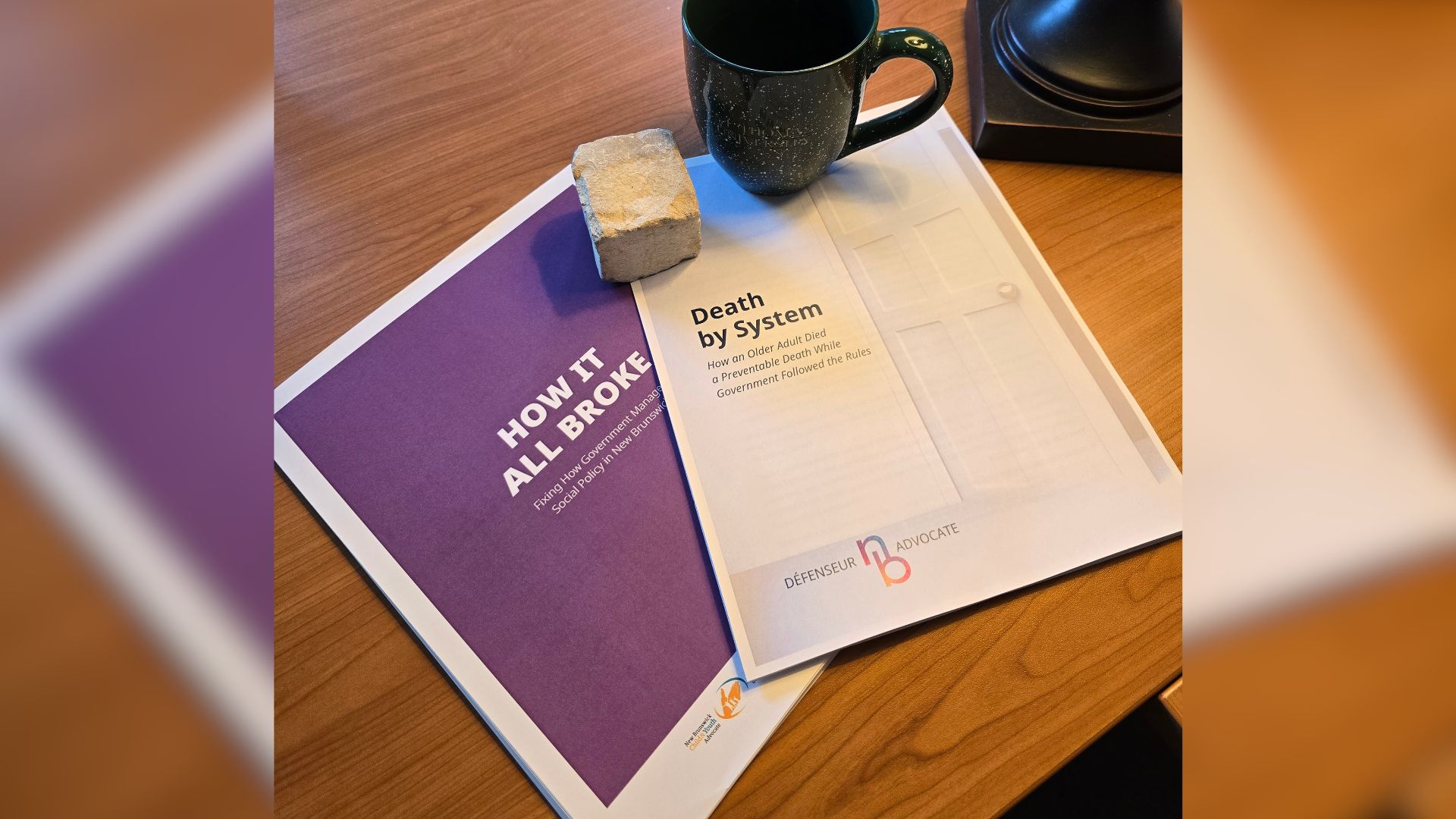
Returning from vacation, I found a report on my desk titled Death by System. Despite the tragic events it describes, this is one of the few reports on long-term care that have left me hopeful.
The report, released by the Office of the New Brunswick Advocate, details the death of Alice, a woman living with dementia in a special care home that could not meet her needs. Over the course of a year or so, she repeatedly wandered away from the home. Eventually she was found too late and died after being hospitalized. The Advocate’s investigation concludes that Alice died even though people were following the rules, and even though many recognized she was at risk. Most importantly, the Advocate concludes that unless the system itself changes, this will happen again.
During more than a decade working on an international research project examining promising practices in long-term care, I learned that many of the most serious problems inside care homes originate outside them—in governance, funding, regulation, accountability, and approaches to care. Too often, inquiries into failures in long-term care miss this broader context. They focus instead on proposing additional regulations that will either make no difference or make matters worse by adding to compliance burdens. Moreover, these cultures of compliance are often punitive. Staff end up afraid, keeping their heads down and mouths shut. There is no room for creativity, responsiveness, flexibility, or adaptation—neither in the care homes nor in the systems that govern them.
What has been so impressive about the Advocate’s Office recent work is that they are not only identifying these systemic failures but imagining inspiring alternatives. Indeed, they have been reimagining governance as responsive to both immediate and long-term needs. This is a vision of government as a solver of problems. Here, governance draws on expertise to understand problems, budgets accordingly, and tracks accomplishments. Inquiries are not about blame or absolution but about producing knowledge to improve processes and outcomes, learning in other words. Our research has been calling for precisely this sort of creative innovation.
One point of contention I have with the Advocate’s report is the suggestion that the staff at the Ministry of Social Development gave up. The Advocate writes, for instance that “it is of no use to assume that the system is not equipped to address the problem with the urgency needed and therefore do nothing” (8) or later on the same page, “The complete failure to address the problem was, in essence, simply giving up in the face of the inadequacy of the system.” Did they give up?
Ultimately, we’d have to ask them.
My guess is that “giving up” is not the most useful way of understanding what happened. Again, I take a lesson from our research on long-term care. We were often told that care home staff ended their shifts in distress because they could not do what they knew to do. There was insufficient capacity, not enough resources, not enough staff, not enough time to do what they knew they should be doing. This is not the same as giving up. And they certainly paid a steep emotional toll.
I wonder if something similar may be going on? If so, this does not deny the problem, but it is no longer about the character or will of staff: they are not giving up per se. Rather the problem has to do with capacity, and what happens to workers after they labour for extend periods in under-resourced areas.
The Advocate’s report is focused on what economist Mariana Mazzucato terms “dynamic capability.” In an entrepreneurial government one wants civil servants to be competent, agile, open to learning and innovation. This aspect of governance has often been neglected and the Advocate’s office does well in calling for a more dynamic, problem-solving style of governance.
The other piece that Mazzucato points to when thinking about entrepreneurial government is capacity. Capacity is an essential bedrock for capability. And capacity, in her view, is a product of the way governments relates to their resources, (natural, capital, and human). Again, I can’t help but reflect on some of the lessons from our research on long term care, in this case the lesson taught to me by a Norwegian waiter.
We were in Bergen. Our research team was having lunch at a small restaurant and impressed by the exceptional care we had seen, I wondered out loud “how do these people afford such good care.” The passing waiter, upon hearing me, stopped, whipped out his phone, and showed me a page with numbers scrolling. This was the home page of the Norges Bank with a live counter that displays the current value of their sovereign wealth fund.
Looking into this further, I learned that this Sovereign Wealth Fund was initially modeled after Alberta’s Heritage Fund to invest the money raised from Norway’s resources, and their oil and gas specifically. Take a listen to the bankers on their website, if you want to understand a surprisingly promising approach to resources, as belonging to the people of Norway and invested and protected for future generations. This is now the largest sovereign wealth fund in the world, and as a result Norwegians are among the richest people on the planet. Without touching principal, the fund pays for approximately 30 per cent of their care budget. That is a key reason we saw the kind of care we did in Norway.
As a resource-rich province, there may be much for us to learn from Norway, and these lessons may be timely given that Canada is setting up its own sovereign wealth fund.
The Advocate is correct that we need to do something. The lack of capacity should not be accepted. The entrepreneurial thinking around capacity that Norwegians exemplify, or Mazzucato calls for, would serve as a good complement to the Advocate’s focus on capability.
We need skill, creativity and innovation brought into the realm of governance. And we also need to rethink how governments relates to resources. This is a big project. But then this is a great province. And there are many scholars, organizers and others who are reimagining public service and economic relations to be inspired by when implementing an entrepreneurial and caring vision of government.
While there is much that can be done immediately, change of this sort will also be generational. And people like Alice will continue to die unnecessarily until these transformations are made.
Albert Banerjee is the Research NB Research Chair in Community Health and Aging and Associate Professor of Gerontology at St. Thomas University.