

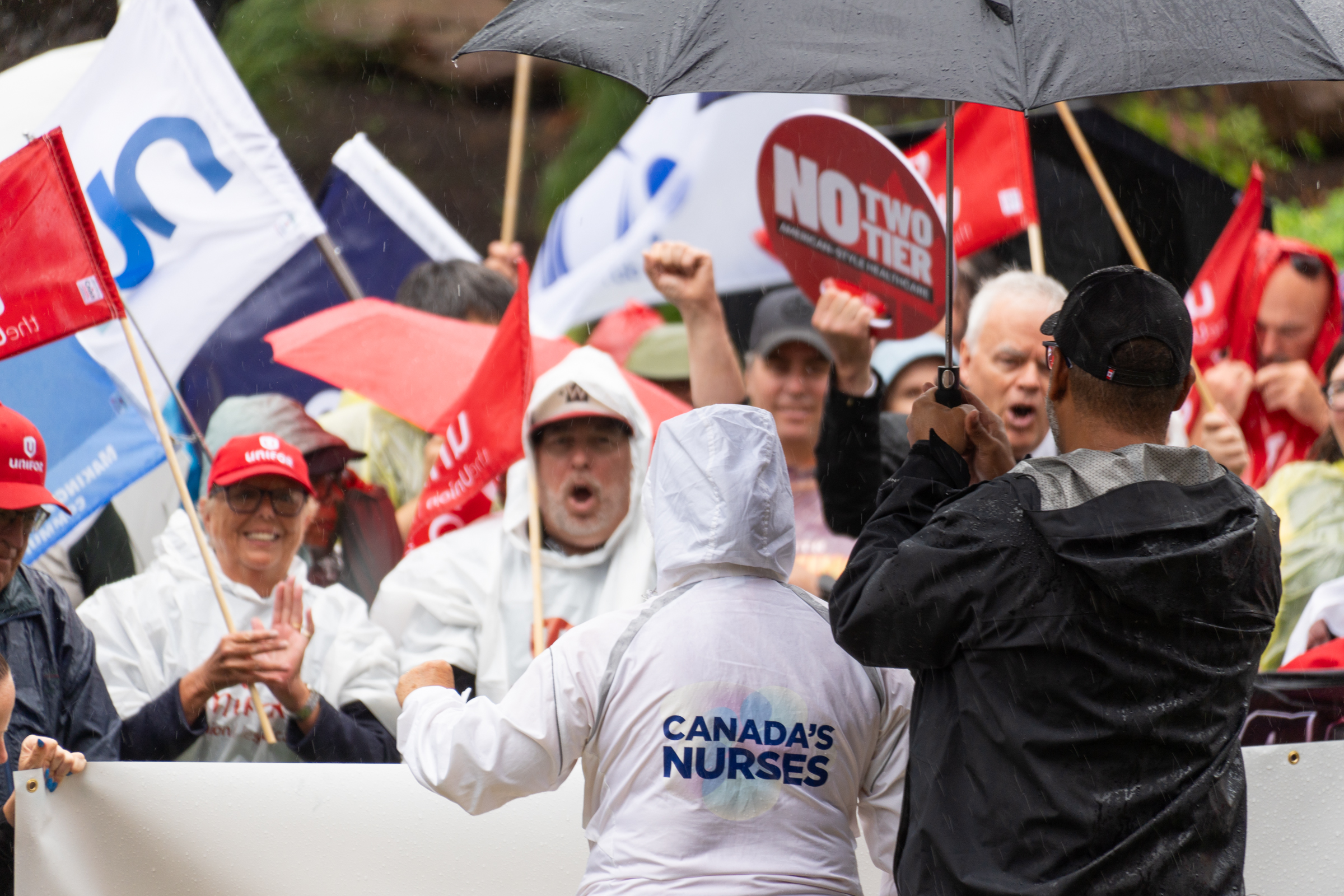
Public health care advocates braved the wind and rain to rally outside the premiers’ Council of the Federation meeting on Wednesday in Charlottetown. They demanded Canada’s premiers stop the spread of American-style, two-tier health care before it takes root nationwide.
Alberta’s Bill 11 is at the centre of their concern. The law lets doctors decide, patient by patient, whether to bill someone directly or bill the public system — opening the door to a parallel private tier where care depends on ability to pay rather than medical need. Health coalitions warn this is a direct violation of the Canada Health Act, and if left unchallenged in Alberta, it will spread province by province.
“Danielle Smith’s Bill 11 is a direct attack on public health care in Alberta and the rest of Canada and must be stopped. Premiers need to join us in telling Prime Minister Mark Carney to uphold the Canada Health Act that requires health care be provided based on medical need, not on the ability to pay. Bill 11 breaks this federal law. If allowed, it will lead to longer wait times and force people to pay twice for health care. Our health care system can be fixed with investments and accountability, not with cuts, privatization and profit-making,” said Jason MacLean, Chair of the Canadian Health Coalition.
The harms of a chronically underfunded health care system left to further deteriorate in the hands of the private sector are already visible across the country: hallway medicine and stalled long-term care projects in British Columbia; illegal private clinic fees in Nova Scotia; seniors in Ontario charged thousands of dollars out of pocket for cataract and joint replacement surgeries; and mounting pressure on public systems in New Brunswick, Manitoba, Newfoundland and Labrador, and Quebec.
Chris Gallaway, Executive Director of Friends of Medicare, came from Alberta to deliver his message to the premiers. “By pushing forward with implementing Bill 11 our provincial government in Alberta is rapidly bringing two-tier American-style health care into Canada, including creating a private insurance market for medically necessary health care services. By September, Albertans will face a system of legislated queue-jumping for surgeries, in direct contravention of the Canada Health Act.”
“The urgency of addressing this threat to our universal Medicare cannot be overstated. There is no more time to waste. We need leadership from our federal government including a clear commitment that they will protect the right of Albertans – and all Canadians – to equitable access to universal, comprehensive, public health care,” said Gallaway.

Andrew Longhurst, senior researcher at the Canadian Centre for Policy Alternatives, came from British Columbia to join Gallaway and others at the rally and a public meeting on saving public health care the night before at St. Paul’s Hall. The public meeting was standing room only. Longhurst is clear about who benefits from Bill 11.
“Alberta’s Bill 11 opens the door to a large private health insurance market, including the U.S. insurance industry. If the federal government fails to defend the Canada Health Act from the onslaught of the private insurance industry, it not only spells the end of public Medicare as we know it, but it puts our Canadian sovereignty at risk. The private health insurance industry is one of the most powerful lobbying forces in the U.S., and it is responsible for that country having the highest health care spending with the worst health-related outcomes among high-income countries,” said Longhurst.

The New Brunswick Health Coalition was part of a joint statement from health coalitions and labour unions to premiers issued yesterday. In the statement, Renée Boudreau, RN, and Co-Chair of the New Brunswick Health Coalition, said, “The New Brunswick Health Coalition believes that health care is a public good — not a business opportunity. We urge Premier Susan Holt and the Government of New Brunswick to invest in strengthening our public health care system and reject the expansion of two-tier health care.”
“No one should profit from another person’s illness or desperation. When people are sick, they are at their most vulnerable. They need timely, high-quality care based on need, not on their ability to pay. Every dollar diverted to private, for-profit care weakens the public system that serves us all. The solution to long wait times and staffing shortages is not privatization — it is sustained investment in our public health care system, better support for health care workers, and a renewed commitment to universal access,” said Boudreau who is also a nurse at the Chaleur Regional Hospital in Bathurst.
Included at the top of the premiers’ statement on July 22 was health care. While they did not specifically address two-tier health care, they called on the federal government to renew health care funding agreements and to maintain the Canada Health Transfer. “Premiers are calling on the federal government to renew these funding agreements and commit to maintaining at minimum a 5 per cent CHT growth rate annually after March 31st, 2028.”
The Canadian Health Coalition welcomes premiers fighting for more health care dollars but they also want guarantees that each health care dollar transferred from the federal government be invested in the public health care system.
Tracy Glynn is the National Director of Projects and Operations of the Canadian Health Coalition, and the coordinating editor of the NB Media Co-op. Steve Staples is the National Director of Policy and Advocacy of the Canadian Health Coalition.






![NB Update: What comes after the crisis in local journalism? [video]](https://nbmediacoop.org/wp-content/uploads/2025/06/LabourUpdateApr132025-120x86.jpg)
![Massive increase in military spending imposed by U.S. with little media pushback [video]](https://nbmediacoop.org/wp-content/uploads/2026/10/AlexCoshSept232026-120x86.jpg)
