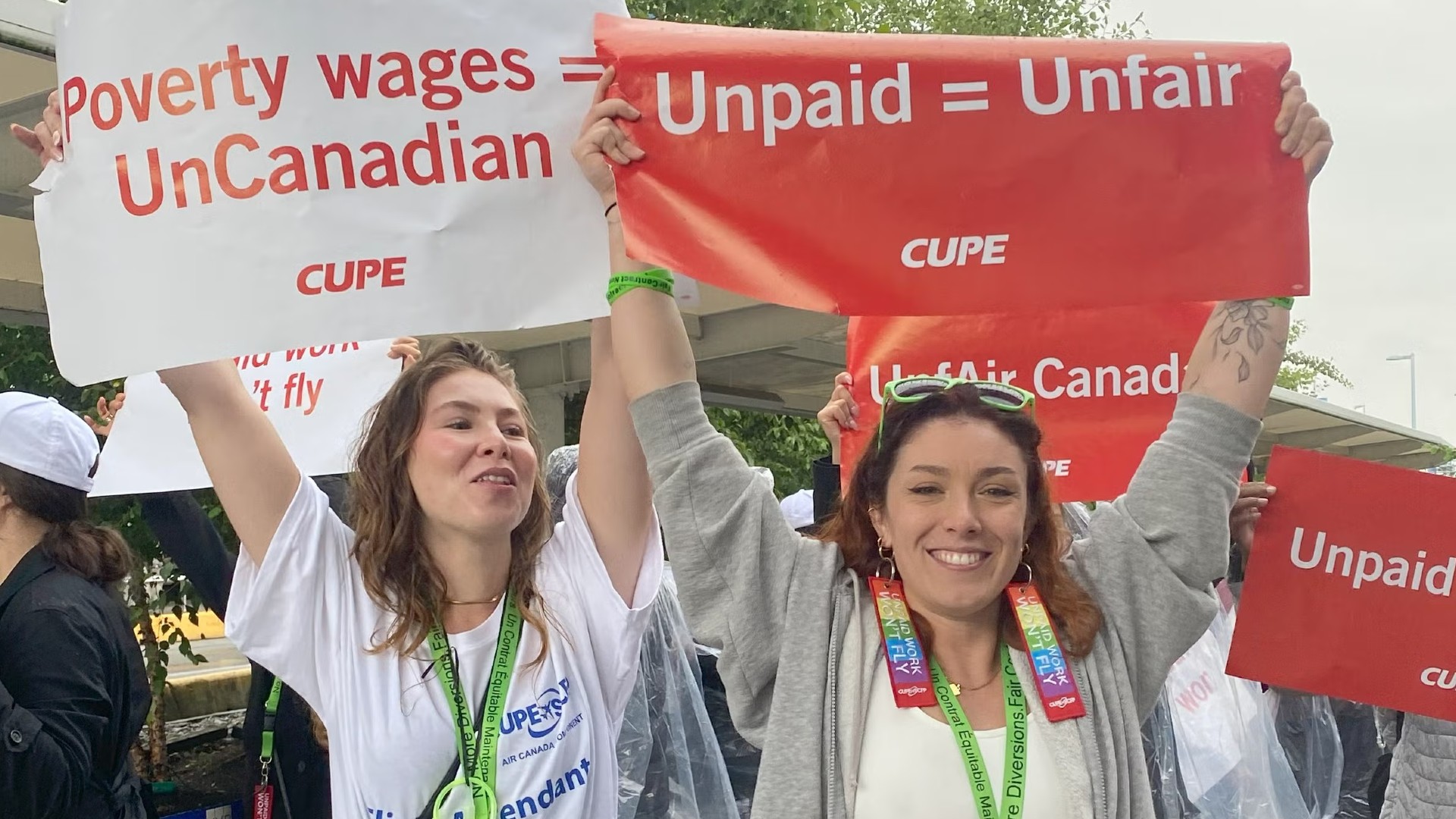
The union representing Air Canada flight attendants appeared to declare victory Tuesday after defying two back-to-work orders.
Details of the deal haven’t been released but the Canadian Union of Public Employees (CUPE) said the agreement represents “transformational change for our industry after a historic fight to affirm our Charter rights.”
The union said in the statement that “unpaid work is over,” a reference to a common industry practice that has provoked indignation in the labour movement: flight attendants typically receive no compensation for their work before and after flights, such as performing safety checks and boarding passengers.
Air Canada has stated that its offer involved an overall 38 per cent increase in total compensation over four years, including “a new provision for ground pay that is industry-leading in Canada.” But the union has said the airline’s offer doesn’t keep up with inflation, leaving junior flight attendants struggling with poverty in a sector largely staffed by women.
When roughly 10,000 flight attendants walked off the job on Saturday, Minister of Jobs and Families Patty Hajdu responded by invoking Section 107 of the federal labour code. That provision gives the Minister broad discretionary power to “secure industrial peace” by directing the Canada Industrial Relations Board (CIRB) to “do such things as the Minister deems necessary.”
Following instructions from the Minister, the board ordered flight attendants to “resume their duties” by Sunday afternoon. CUPE refused to comply, calling the order a violation of the constitutional right to strike. The CIRB, in turn, declared the strike unlawful on Monday, ordering cabin crews back to work again. But the union stated that it wouldn’t back down, with CUPE national president Mark Hancock saying that he was willing to face jail time.
Air Canada announced on Tuesday that operations will gradually resume beginning on Tuesday evening following the agreement mediated by prominent Toronto labour lawyer William Kaplan.
In 2015, the Supreme Court recognized the right to strike as an “indispensable component” of collective bargaining that is protected by the Charter of Rights and Freedoms. But the feds have repeatedly turned to Section 107, drawing condemnation from labour leaders who say this practice allows companies to avoid fair negotiations.
Air Canada CEO Michael Rousseau appeared to confirm that he was relying on federal intervention on Monday in an interview with BNN Bloomberg. Asked about the absence of any contingency plans for stranded travellers, Rousseau said: “We thought, obviously, the Section 107 would be enforced, and that [CUPE] wouldn’t illegally avoid section 107.”
During that interview, Rousseau also defended the practice of unpaid ground work, saying “the rates that we pay… do compensate for the extra work.” Rousseau said he doesn’t plan to resign.
Meanwhile, with the question of unpaid work under scrutiny, the feds appeared to be in damage control, with Minister Hajdu announcing “consultations” on the matter.
Air Canada was formerly owned by the federal government, but it was fully privatized under Prime Minister Brian Mulroney in 1989.
David Gordon Koch is a journalist with the NB Media Co-op. This reporting has been made possible in part by the Government of Canada, administered by the Canadian Association of Community Television Users and Stations (CACTUS).

![Amid push for ‘nation-building projects,’ critics warn of ecological devastation [video]](https://nbmediacoop.org/wp-content/uploads/2026/10/MineBabyMineSept242026-2-350x250.jpg)



![‘We’re still here, and we will always be here’: Mi’kmaq language program fosters pride [video]](https://nbmediacoop.org/wp-content/uploads/2026/09/MikmaqCampAug142026-120x86.jpg)