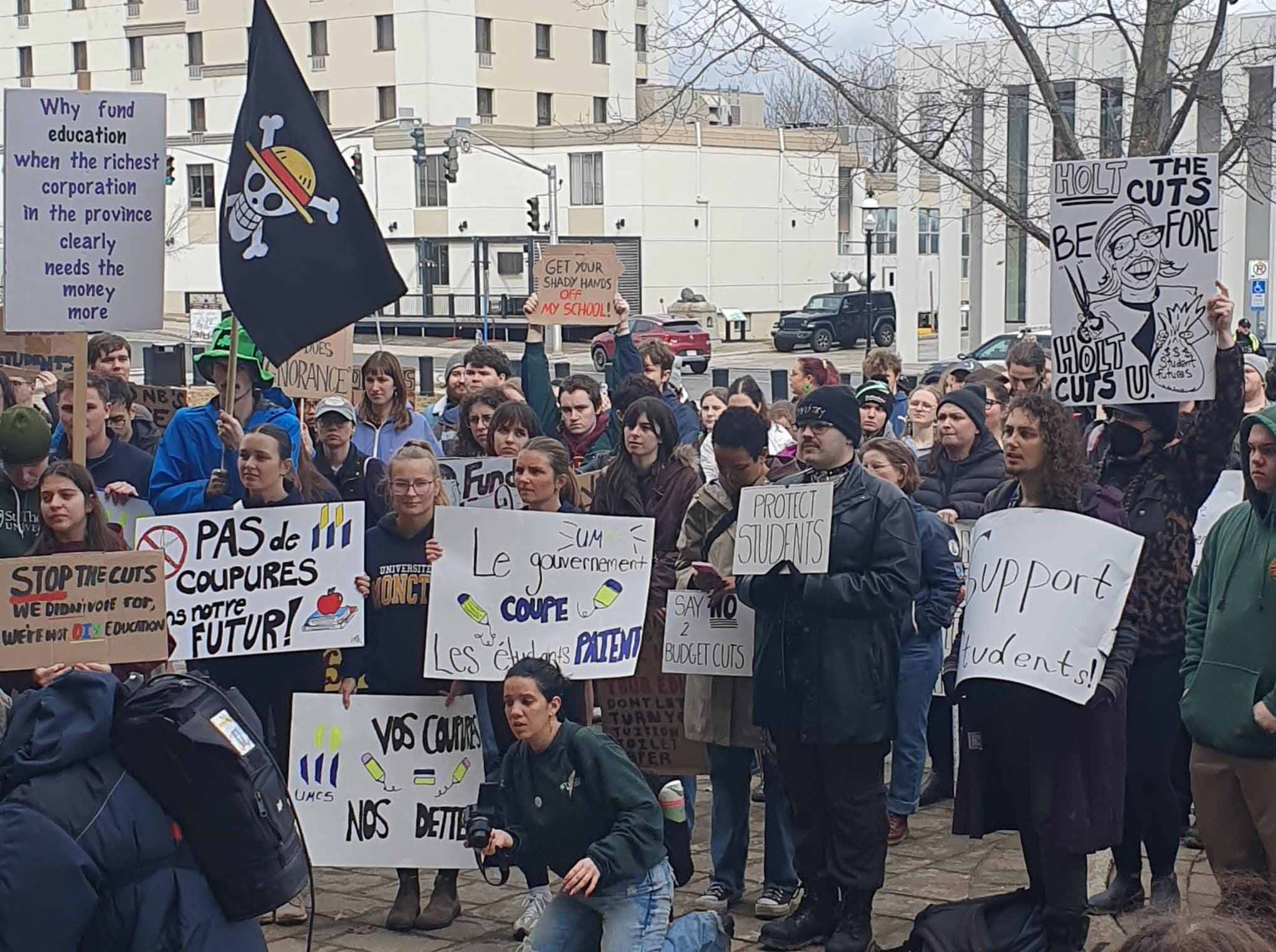
New Brunswick’s Minister of Post-Secondary Education says the government may hire a private collections agency or even garnish wages to recover unpaid student loans currently in default.
Those proposals have attracted a backlash from some critics who say that ratcheting up the collection of unpaid student loans will strain debtors already struggling amid a larger affordability crisis.

Minister Jean-Claude D’Amours told a legislative committee last week that the government intends to collect upwards of $5 million this year from a portfolio of delinquent student loans worth roughly $110 million. About $42 million in debt was written off in August 2024 under the previous government, he said.
“The message that is important to understand is that now, it’s the end of play time,” he told a legislative committee recently, in English translation. “People will need to assume their responsibilities.”
One New Brunswick resident who asked to remain anonymous said that despite years of post-secondary education, he went bankrupt last year and now works a low-wage job.
“I’m 42 with two undergrad degrees, a year of a masters, a credential, and a certificate,” he said. “I currently drive for a ride-share…. My entire life I heard education, education, education. Well guess what. I’ve got it and now I’m being accused of play time.”
The minister’s comments show that the government doesn’t understand the cost-of-living crunch that students are experiencing, said Camila Baquerizo Bayona, VP Education for the St. Thomas University Students’ Union.
She noted that in addition to tuition, students are paying for expenses such as groceries and rent, and that mature student might also be raising a family. “We’re definitely concerned about the affordability crisis,” she said.
Not all student leaders oppose the policy.
“People who get student loans have to repay them eventually,” said Emma Raphaelle, president of FÉCUM, which represents students at the main campus of l’Université de Moncton.
“We’re not surprised that they’re looking for other ways of getting financing for the government,” the third-year education student said, pointing to deficit figures from the provincial budget.
The budget released last month projected a record-breaking $1.3 billion deficit, and the government is projecting about $6 billion in deficit spending over three years. Student loans in New Brunswick are currently interest-free, a policy introduced under the Conservative government of former premier Blaine Higgs.
Raphaelle said she hopes the Premier Susan Holt’s government won’t begin applying interest or cutting programs such as bursaries or repayment plans.
Researchers who spoke to the NB Media Co-op criticized the plan, calling it punitive social policy that’s unlikely to generate much in terms of revenue for the province.
When people default on their loans, it’s typically not a choice, said Julia Woodhall-Melnik, an associate professor in the Department of Social Science at UNB and Canada Research Chair in Resilient Communities.
“Usually, it’s something that falls by the wayside because the expenses of everyday life, they take precedence.”
If people are “compelled” to repay their student loans, it may involve cutting corners on items like clothing for their children, she said.
She called for fiscal measures like a wealth tax, adding that it’s unclear whether the provincial government will be able to recover more than it spends on measures such as a private collections service.
The gradual erosion of public financing for universities has resulted in steadily rising tuition.
In New Brunswick, public support peaked in 1979-80, when the government shouldered about 82 per cent of total operating costs, a figure that had declined to 56 per cent by 2019-20, according to the Federation of New Brunswick Faculty Associations.
Those cost have been “downloaded onto individuals,” said Ryan Romard, a researcher with the Canadian Centre for Policy Alternatives.
About half of students across the country take on student debt, he said, most of them “working-class people whose families don’t have enough wealth to pay their way through.”
Those who take on student debt are likely to come from a “negative net worth household.” The student debt, in turn, becomes “a financial anchor around your neck” causing people to delay major life decisions.
He called the Liberal government’s debt recovery effort a “petty and spiteful policy that is just going to have a really negative impact on people’s lives.”
Romard echoed calls for policies such as a wealth tax instead of “nickel and dimeing student loan debtors.”
In 2020, students at the bachelor level ended their studies with an average of $36,400 in debt in New Brunswick, compared to a Canada-wide average of $30,600, according to Statistics Canada. A higher-than-average number of university students in New Brunswick also graduated with debt.
In an interview, Minister D’Amours said the province is still deciding on its next steps. “Are we using internal staff or are we going to hire a collection agency? We’re not there yet.”
He wouldn’t rule out the prospect of garnishing wages.
D’Amours stressed that anyone with a loan in default should contact Service New Brunswick to make repayment arrangements.
“I can appreciate that maybe some people are struggling, and this is probably the reality,” he said. “But they have also a responsibility to call us. We will do the evaluation.”
He said those arrangements are made on a case-by-case basis. Debtors have a six-month grace period after their studies, and the amortization period is typically 10 years.
“If we don’t have that money, it’s harder to be able to continue to help more students and also to help our post-secondary institutions,” he stated.
He couldn’t say how much the government might pay for a contract with a private collections service but said “the objective is to have the cheapest cost for the taxpayer.”
Asked if there’s any evidence that high-earners are avoiding repayment, D’Amours said there are people whose wages are “pretty good in the province that are in default,” though he didn’t elaborate.
Woodhall-Melnick, the UNB researcher, said she would be “shocked to see more than a couple cases” in which high earners were defaulting on their loans.
“Of course, we have bad actors in every system,” she said. “Just because we have bad actors in every system doesn’t mean that we should punish the multiple good actors that really genuinely just can’t pay back their loans.”
The government previously signalled its plans in the budget speech in March, saying the province would “improve collection of money already owed to the province, including the student loan portfolio.”
A government discussion paper published in February also floated the idea of recovering “fees related to government services such as hospital stays for medically discharged patients.”
David Gordon Koch is a journalist with the NB Media Co-op based in Moncton. This reporting has been made possible in part by the Government of Canada, via the Local Journalism Initiative.
![Is a Moncton company helping to build jet fighters bombing Gaza? [video]](https://nbmediacoop.org/wp-content/uploads/2024/06/ApexMay192024-350x250.jpg)
![Massive increase in military spending imposed by U.S. with little media pushback [video]](https://nbmediacoop.org/wp-content/uploads/2026/10/AlexCoshSept232026-350x250.jpg)
![Amid push for ‘nation-building projects,’ critics warn of ecological devastation [video]](https://nbmediacoop.org/wp-content/uploads/2026/10/MineBabyMineSept242026-2-350x250.jpg)


![Is a Moncton company helping to build jet fighters bombing Gaza? [video]](https://nbmediacoop.org/wp-content/uploads/2024/06/ApexMay192024-120x86.jpg)