
![Delayed restrictions on herbicide prompt failing grade from environmental group [video]](https://nbmediacoop.org/wp-content/uploads/2025/09/StopSprayingSept92025.jpg)
After last year’s provincial election, Premier Susan Holt instructed several of her newly-minted Cabinet ministers to restrict aerial herbicide spraying, as recommended about three years earlier by an all-party legislative committee.
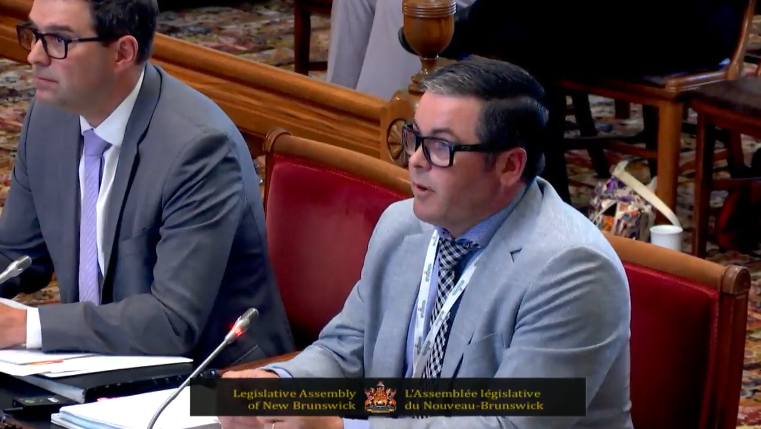
But senior officials from the Department of Natural Resources told lawmakers on Tuesday that the province hasn’t yet introduced a number of recommendations including buffers or “setbacks” meant to separate herbicide spraying from homes, bodies of water, and natural protected areas.
The delays raise questions about the degree of influence that industry is exerting over the provincial government. Chris Norfolk, acting assistant deputy minister of Natural Resources, told MLAs that the setbacks could hurt New Brunswick’s softwood lumber industry.
“We have reviewed the implications of fully implementing these required setbacks and I can say, based on our preliminary estimates, we do have some concern that this would create a significant impact to the province’s timber supply,” Norfolk said during a presentation to the Standing Committee on Climate Change and Environmental Stewardship.
Setbacks on aerial spraying
The 2021 report emphasized public concern about the use of herbicides in New Brunswick and followed extensive hearings at the Standing Committee on Climate Change and Environmental Stewardship.
The senior official said there was “some movement” on the recommendations, notably that Natural Resources increased “setbacks related to habitations” from 155 metres to 500 metres earlier this year.
However, MLAs from the all-party committee apparently believed that this 500-metre restriction was already in place back in 2021 when they penned the report — and that it wasn’t enough.
At the time, their report recommended that those buffers be increased “from 500 metres to one kilometre from dwellings.”
When questioned about this by Green Party MLA Megan Mitton, Deputy Minister Cade Libby said that people within one kilometre also now receive a “notification that spray program is happening in that area.”
For bodies of water and wetlands, the report called for “a minimum 100-metre aerial spraying setback from water and wetlands” or “spray plans that may vary depending on the landscape and the hydrological characteristics of the land,” and it recommended that “the government ban the spraying of pesticides in protected watersheds under the Clean Water Act.”
Norfolk appeared to indicate that those recommendations hadn’t been implemented, though he said that over the past five years, no spraying has occurred in “designated watersheds on Crown land in New Brunswick.”
A map produced by Stop Spraying New Brunswick — based on publicly-available data from the provincial government — appears to support this assertion. However, some spraying occurred in 2021 just outside of Turtle Creek, which is one of New Brunswick’s designated protected watershed areas and supplies Greater Moncton with its drinking water supply.
Holt promised investigation
During last year’s election campaign, the Liberal Party platform pledged to “investigate alternatives to pesticide and herbicide use and re-evaluate the safety of glyphosate with new and comprehensive data specific to New Brunswick.”
In November 2024, the Premier instructed Minister of Environment Gilles LePage in his mandate letter to lead that investigation, with support from several other ministers, notably John Herron, Minister of Natural Resources.
Mandate letters also instructed LePage to lead the implementation of recommendations in the 2021 report, with support from Herron and several other ministers. They include Minister of Health John Dornan; Minister of Agriculture, Aquaculture and Fisheries Pat Finnegan; Minister of Finance René Legacy; and Luke Randall, Minister responsible for Economic Development.
Notably, that report called for an economic study that would evaluate the impact of a potential ban. But that kind of study won’t be ready until 2027, according to officials from Natural Resources.

“The pesticide advisory board under the Department of Environment and Local Government is going to take the lead on this recommendation, engaging a consultant — if budget is present — to study the use of herbicides across various sectors including forestry,” Norfolk told MLAs, adding that the work is expected to begin next year.
The senior bureaucrats from Natural Resources defended the province’s use of chemical herbicides on Tuesday, while also downplaying how much they’re used in New Brunswick. Herbicide application is “not done very often at all,” Deputy Minister Cade Libby told the committee.
Green Party MLA Megan Mitton, who was part of the committee that produced the 2021 report, expressed frustration about the long delays. “We’re still pretty far out from from getting the information we need to even evaluate next steps,” she said.
Failing grades
The committee hearing took place just as the volunteer-led group Stop Spraying NB announced the results of its latest annual “report card” evaluating the performance of New Brunswick’s major political parties.
That group gave failing marks to both the governing Liberal Party and the official opposition Conservatives.
The governing Liberals, have “basically failed to follow through with their election promises in the amount of time that would have been reasonable,” said Caroline Lubbe-D’Arcy, the chair of SSNB.
The group faulted the Greens for failing to table a motion to ban spraying during the latest legislative session, giving them a B-minus. However, SSNB acknowledged that Green MLAs “continue to ask questions in legislature and during committee meetings and table petitions.”
Minister responds
The NB Media Co-op requested interviews with the Minister of Environment and the Minister of Natural Resources. In response, the Department of Environment provided a statement attributed to Minister LePage.
It said, in part, that pesticide use in New Brunswick is “tightly regulated” with a “strong, layered system” that he said is “guided by science.”
LePage said that since the November 2021 report, the government has “added further oversight and restrictions.”
Those include reactivating the Pesticide Advisory Board, and what he called “stricter conditions with additional setbacks from dwellings, water and additional notifications to the public,” without providing details.
15,000 hectares sprayed annually
J.D. Irving and other forestry companies in New Brunswick spray chemicals including glyphosate over softwood plantations to inhibit the growth of other plants.
Libby said the annual spraying of about 15,000 hectares amounts to about 0.5 per cent of Crown land, and costs “just over $3 million.”
Glyphosate is also used to control weeds in agriculture in New Brunswick, but aerial spraying doesn’t occur on farms, according to the provincial government.
NB Power uses herbicides to control the growth of vegetation beneath its 28,000 kilometres of transmission lines, but it doesn’t conduct aerial spraying, according to its website.
The utility stopped using glyphosate-based substances in 2023 but still uses products including Garlon, Navius, and Clearview, according to an NB Power spokesperson.
The 2021 legislative committee report called for NB Power to “immediately begin phasing out spraying pesticides under transmission lines.”
Clarification: A previous version of this report omitted one of the recommended restrictions related to water, namely that “the government ban the spraying of pesticides in protected watersheds under the Clean Water Act.” It was updated to include this information at 10:25 a.m. on Sept. 12, 2025. It was updated again at 5:25 p.m. to clarify that spraying took place in 2021 just outside of the Turtle Creek watershed, not within the watershed itself, according to a map based on government data.
It was previously updated at 8:12 p.m. on Thursday, Sept. 11, 2025, to include a response from the Minister of Environment, along with video and more details from this week’s hearing.
David Gordon Koch is a journalist with the NB Media Co-op based in Moncton. This reporting has been made possible in part by the Government of Canada, administered by the Canadian Association of Community Television Users and Stations (CACTUS).

![Massive increase in military spending imposed by U.S. with little media pushback [video]](https://nbmediacoop.org/wp-content/uploads/2026/10/AlexCoshSept232026-350x250.jpg)
![Amid push for ‘nation-building projects,’ critics warn of ecological devastation [video]](https://nbmediacoop.org/wp-content/uploads/2026/10/MineBabyMineSept242026-2-350x250.jpg)


![University security closely monitored pro-Palestine activists, documents show [video]](https://nbmediacoop.org/wp-content/uploads/2024/11/20231129_131826-120x86.jpg)


![Massive increase in military spending imposed by U.S. with little media pushback [video]](https://nbmediacoop.org/wp-content/uploads/2026/10/AlexCoshSept232026-120x86.jpg)
