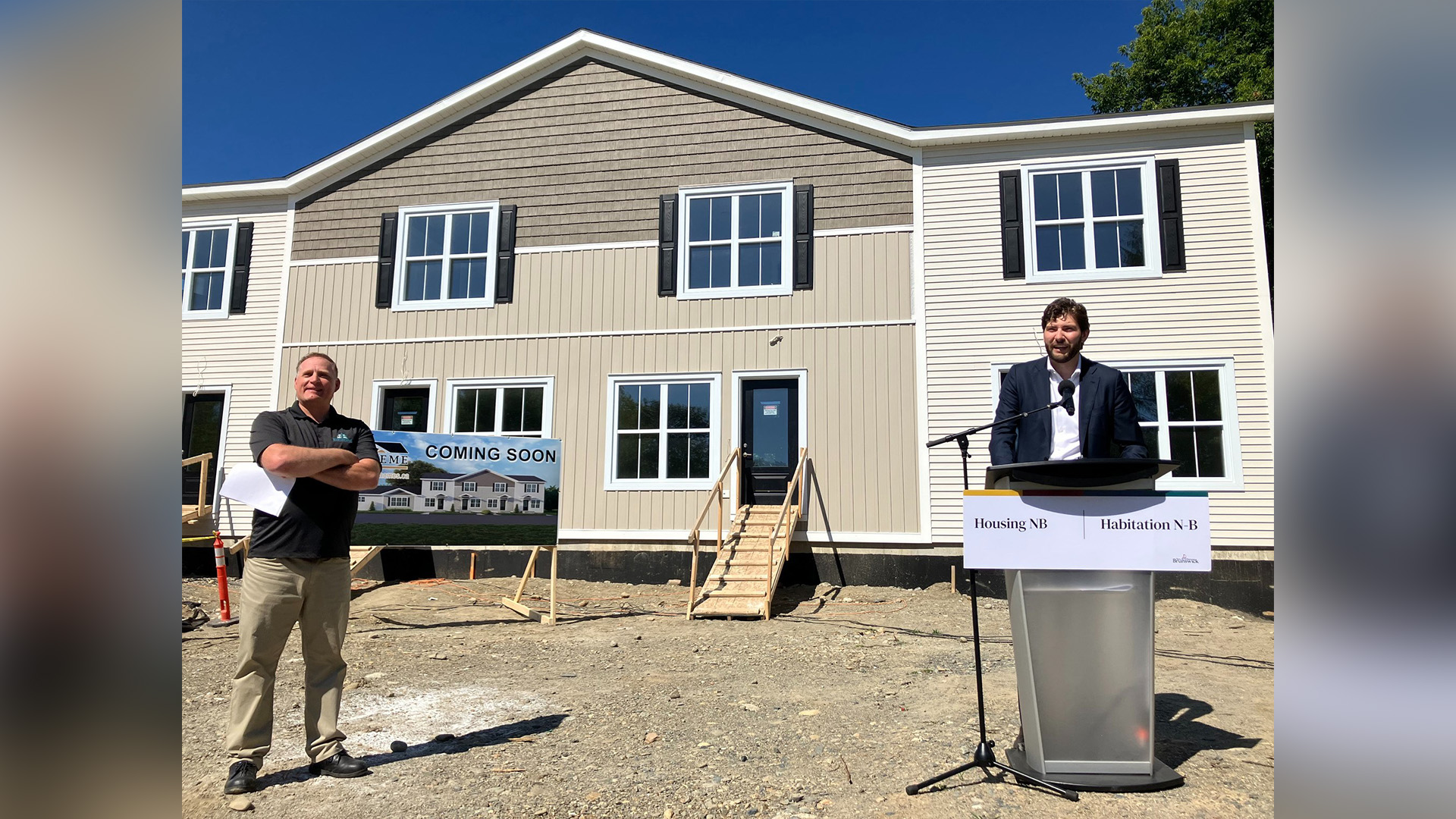
Plans for affordable housing construction announced in this week’s Speech from the Throne won’t be enough to make a serious dent in New Brunswick’s subsidized housing waitlist, according to a researcher at the University of New Brunswick.
The province plans to add “a total of 1,760 affordable housing units” by 2029, according to the speech delivered at the Legislature on Tuesday by Lt.-Gov. Louise Imbeault.
It’s an apparent reference to subsidized housing units, where tenants generally pay rent amounting to 30 per cent of household income.
The government started 320 units this year and another 430 are planned for 2026, according to the throne speech.
“It’s not enough,” said Julia Woodhall-Melnik, an associate professor in the Department of Social Science at UNB and Canada Research Chair in Resilient Communities.
She’s a housing policy expert and founder of the Housing, Mobilization and Engagement Research Lab at UNB Saint John.

Until recently, no new public housing whatsoever had been built since the early 1980s, so any government investment is a “massive improvement,” she said. “But will it meet the demand and need of the waitlist? No.”
It’s unclear how the government arrived at the 1,760 figure. It might indicate the number of units that officials believe can be built with available construction resources, or with a certain designated budget, for example.
In any case, “there will not be enough movement to significantly shorten the NB Housing waitlist this decade,” Woodhall-Melnik said.
A spokesperson for NB Housing said that number will include units owned and operated by the provincial Crown corporation and others that become available through the Affordable Rental Housing Program.
That program provides financial assistance — in the form of a forgivable loan — to private businesses, non-profits and co-operatives for “construction, repair and conversion of rental housing projects,” according to a government website.
It’s a rent-geared-to-income program, meaning that tenants will pay 30 per cent of their household income for rent, like with NB Housing units.
13,000 households on waitlist
François Boutot, CEO of the New Brunswick Housing Corporation, recently told a legislative committee that the waitlist for public housing now stands at more than 13,000 households.
That list increased more than twofold in recent years, from more than 5,700 households in 2021. NB Housing reportedly manages about 4,500 housing units.
Even if Premier Susan Holt’s government follows through with the construction of 1,760 units — and repairs older ones that are currently vacant — about 11,000 households will remain on the waitlist. That is, if it doesn’t keep growing.
“We would have to see considerable turnover and movement from public housing into market housing in order for the entire wait list to be stably housed,” Woodhall-Melnik said.
New Brunswick has witnessed dramatic rent increases over the past five years, combined with low vacancy rates, reduced stocks of low-priced rental units, and growing populations of homeless people.
Roughly eight-and-a-half minutes of the throne speech, which lasted about an hour, were dedicated to affordability, housing, homelessness issues.
Vacancy control
After coming to power in last year’s provincial elections, the Holt government soon fulfilled a major campaign promise by implementing a three per cent rent cap. That policy is slated to remain in place next year and will be reviewed annually, according to the throne speech.
Woodhall-Melnik noted that the provincial government has other policy options at its disposal to curtail the loss of affordable housing. Examples include vacancy control, which would limit landlords’ ability to increase rent when units are vacant.
Developers in the private market could also be mandated to include a certain number of “deeply affordable” units in new builds, she said, either through rental subsidies from the government — or simply by making below-market rent a requirement for a certain number of units.
Besides those options, she called for more ambitious public housing construction, saying the units could be built either by NB Housing or by the community housing sector, which is made up of non-profits and co-operatives.
In either case, she said, the province is “going to have to build deeply affordable units faster if we’re going to make our way through the wait list.”
‘Trickle-down’ theory
The throne speech also noted the Holt government’s efforts to spur housing construction more generally, including the elimination of provincial HST for new multi-unit residential construction.
But Woodhall-Melnik cautioned against what she called “trickle-down housing affordability,” also called “filtering theory.”
The idea is that an increased supply of new housing on the private market will make older units more affordable, as higher-income people vacate older homes.
In practice, the theory doesn’t hold in New Brusnwick because “for the most part, we don’t have high-income renters,” she said.
The median household income for renters is about $45,000 per year, she said, adding that most people who move into higher income brackets choose to purchase their homes.
This story was updated at 11:30 a.m. on Oct. 23, 2025.
David Gordon Koch is a journalist with the NB Media Co-op. This reporting has been made possible in part by the Government of Canada via the Local Journalism Initiative.
![Is a Moncton company helping to build jet fighters bombing Gaza? [video]](https://nbmediacoop.org/wp-content/uploads/2024/06/ApexMay192024-350x250.jpg)
![Massive increase in military spending imposed by U.S. with little media pushback [video]](https://nbmediacoop.org/wp-content/uploads/2026/10/AlexCoshSept232026-350x250.jpg)
![Amid push for ‘nation-building projects,’ critics warn of ecological devastation [video]](https://nbmediacoop.org/wp-content/uploads/2026/10/MineBabyMineSept242026-2-350x250.jpg)

![Is a Moncton company helping to build jet fighters bombing Gaza? [video]](https://nbmediacoop.org/wp-content/uploads/2024/06/ApexMay192024-120x86.jpg)