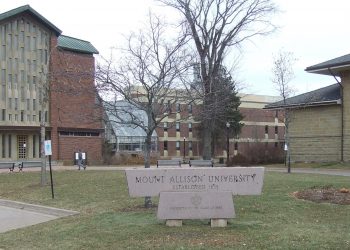
As Susan Holt’s Liberal Government announces devastating cuts to the province’s post-secondary education sector, universities and colleges across the region are left to pick up the pieces.
Holt’s proposed cuts, estimated to be $50 million dollars, will gut the province’s education system and strip wealth and knowledge from our territory.
In an internal document, Holt’s government proposed dramatic, ill-considered and inane actions. These included doing away with the region’s post-secondary regulating body, MPHEC, privatizing Mount Allison University, closing satellite campuses in largely rural Francophone regions of the province and merging, which is to say subsuming, St. Thomas University into the University of New Brunswick.
Holt has since claimed to reverse course on the STU-UNB merger plans and Mount Allison privatization scheme, but that may be little more than sleight of hand to distract from the real target: a classic neoliberal transfer of wealth from the public sector to the private.
In a decidedly anti-Robin Hood-esque move, Holt proposed to plunder an already dramatically under-resourced post-secondary education system, taking largely from New Brunswick’s youth, and moving that money to private capitalist interests. The biggest beneficiary, at $45 million (or 90 per cent of the proposed cuts) is Irving Paper. Only one year ago, Irving Paper laid off almost half its workforce, complaining about the industrial rate of electricity.
To those paying attention, this may not shock you. Holt’s own platform almost completely ignores the sector, focusing exclusively on student loans and housing. Despite painting themselves as a socially just alternative to the Higgs Conservatives that preceded them, Holt has shown no interest in nurturing the spaces where New Brunswick youth could learn about issues like social inequality and social justice. Spaces where we learn how to bridge those social divides so essential to healing the province.
However, NB’s post-secondary institutions are doing laudable work – and more often than not with the province’s own young people. Today, just shy of 60 per cent of students in New Brunswick’s universities come from the province itself. Simply stated, New Brunswick universities train New Brunswickers. And we do so remarkably well.
In the most recent Maclean’s national university rankings, Mount Allison is listed as the country’s top-ranked primarily undergraduate institution. Similarly, in TIME’s inaugural university rankings, UNB placed #1 in Atlantic Canada and 14th in the nation, ahead of Ontario powerhouses like Western, Queen’s, and Ottawa. St. Thomas University boasts the second highest percentage of Indigenous student enrolment in the country. And regardless of where they come from, STU’s students stay in the province at a higher rate than any other English university.
It is becoming increasingly clear that the adoption of AI will have a radical impact on labour. Experts predict that many rote jobs will be taken over by AI-assisted machines. What this means is that higher education will become even more important as it trains people for more complex tasks, particularly small liberal arts universities like Mount Allison and St. Thomas which are best positioned to train the next generation of thinkers. Our nimble structures, hands on approach to learning, and small class sizes mean that we already have the tools to meet these challenges. Starving these institutions or turning them over to the private sector means undermining the public good.
So what do cuts to public post-secondary education mean for New Brunswickers? In short, they will make us poorer and ensure that our local concerns are less well understood than ever.
New Brunswick is a province that statisticians routinely deem one of the poorest in the nation. It has the lowest numbers of university graduates. Yet, data consistently demonstrates ties between health and post-secondary education. Put simply, those with university educations are healthier than their peers. It seems unfathomable that the Holt government–which ostensibly prioritizes health care–would ignore this and make it even harder to obtain university degrees.
Further, New Brunswickers already suffer from neglect to their universities. Canada’s Social Science and Humanities Research Council invests less in New Brunswick than in other provinces: a third of the amount it gave to researchers in Nova Scotia on a per capita basis, and half on a per student basis.
This underfunding has serious consequences for the economy and social cohesion of the province. Local governments and the province itself are dependent on outside consultants for policy advice, often relying on big wigs from land owning families. In one recent case, the provincial government relied on environment and energy policy advice from a pro-business consultant who misrepresented his credentials.
Turning our backs on our universities at this time means that we will be poorer and less healthy. It means we will know less about ourselves given that it is New Brunswick’s universities alone that attend to local challenges.
Slashing the budget of New Brunswick universities means increasing our province’s subordination to the rest of Canada. That’s not what the proud New Brunswickers we know want. It’s not too late to listen and reverse course.
The internal government document on proposed post-secondary budget changes, uploaded by The New Wark Times, is available here.
Kristi Allain is a Professor of Sociology and Canada Research Chair in Physical Culture and Social Life at St. Thomas University.
Nathan Kalman-Lamb is Associate Professor of Sociology at the University of New Brunswick.