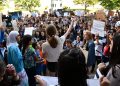
On February 3, gunmen raided the home of Saif al-Islam Qadhafi, the most influential of former Libyan leader Muammar Qadhafi’s living children, and shot him dead. A candidate in the April 2026 presidential election, opinion polls showed Saif receiving a high degree of electoral support. Thousands gathered for his funeral in the city of Bani Walid. As The Economist reported following Saif’s death: “Libya’s threadbare opinion polls suggest that Saif was the country’s most popular public figure.”
Needless to say, Saif’s assassination is an event of major significance. It decapitated a movement, commonly called the “Green Resistance,” that many Libyans viewed as an alternative to the violence, deadlock, and corruption that has characterized Libyan politics since the destructive NATO war of 2011 – a war in which Canada was heavily implicated, as I detail in my book Targeting Libya.
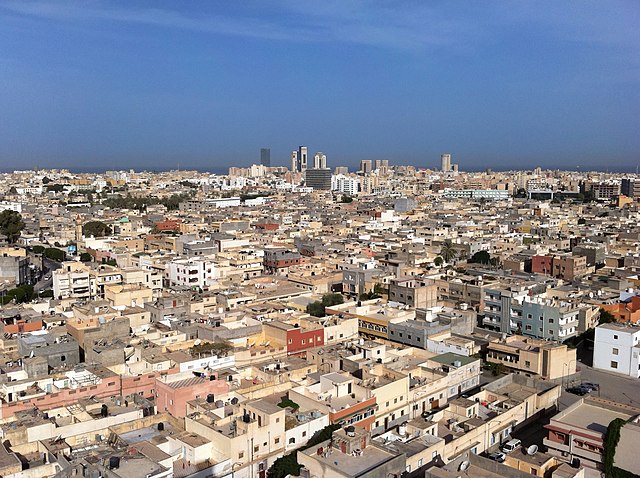
Libya has been effectively partitioned since 2014: in the west, the Tripoli-based Government of National, led by Abdulhamid Dabaiba (who has long been accused of corruption), enjoys UN recognition, while the eastern House of Representatives functions as a military government under the command of Field Marshal Khalifa Haftar. The killing of Saif al-Islam bolsters Libya’s current rulers in both governments going into the national election in April.
During the latter years of his father’s rule, Saif al-Islam was a key mediator between Libya and the West. A supporter of economic liberalization and occasional critic of his father’s government, Saif nonetheless defended the existing power structures of the Jamahiriya (or “State of the Masses”) founded by Muammar Qadhafi in 1977, eight years after the coup that brought the Libyan colonel to power. Following the NATO-backed uprising of 2011, Saif was jailed by a militia in the city of Zintan, but he was released in 2017 following the passage of a general amnesty law. The Qadhafi scion ran for president during the December 2021 election; however, the election was ultimately cancelled and postponed several times. Some in the Libyan government asserted that the election was cancelled at the behest of Washington to prevent the popular Saif from winning power; the US government dismissed these suspicions as “conspiracy theories.”
After his release from captivity, Saif was isolated by both Libyan governments. As Anas El Gomati writes, “[Saif] remained outside the system, tolerated, contained, and watched, a reminder of an alternative line of inheritance that could never be fully neutralised. He had lived under the persistent threat of assassination since 2017.” Nevertheless, he cast a long shadow over Libya’s political scene.
Saif’s killing was not the only Libya-related news to hit Western headlines this February. Documents released by the US Department of Justice revealed that, following NATO’s war on Libya, financier and child sex trafficker Jeffrey Epstein worked with former British and Israeli intelligence officers to exploit “political and economic turmoil” in Libya for their own gain. Specifically, Epstein and his associates hoped to enrich themselves by accessing billions in Libyan state assets frozen in Western countries.
For many Libyans, the revelations about Epstein’s attempt to profit from NATO’s war will reaffirm their nostalgia for the Qadhafi era, which was far more stable, sovereign, and prosperous than present-day Libya. As the son of Muammar Qadhafi, Saif embodied a possible return to that lost time. But instead of restoring a longed-for past, Saif has been removed from the political scene, most likely to protect the status quo.
The years leading up to Saif’s killing were characterized by renewed US economic and military interest in Libya. In March 2024, the US announced plans to reopen its embassy in Libya, which had been closed since 2014. In October 2025, AFRICOM’s deputy commander visited cities held by both of Libya’s governments. Two months later, Abdulhamid Dabaiba met with the commander of AFRICOM and announced his intention to deepen military cooperation with the US. These developments occurred as Trump sought to increase US influence in Africa, and to secure control over major oil producers around the world, including Venezuela and Nigeria.
Indeed, major US oil companies have increased their investments in Libya over the past year. In March 2025, Libya launched its first licensing round for oil exploration since 2008. As Atlantic Council contributors Rose Keravuori and Maureen Farrell note: “Shell, BP, TotalEnergies, and Eni have reopened channels with the National Oil Corporation (NOC) – and ExxonMobil signed a memorandum of understanding in August for offshore exploration in the Sirte Basin.” Canada’s interest has not faded either. On January 20, 2026, Canada’s ambassador to Libya met with the chairman of Libya’s National Oil Corporation. The two discussed “the status of Canadian companies operating in Libya’s oil and gas sector” and “future Canadian participation in development and investment projects.”
At the same time, the Trump administration has pushed for negotiations between Libya’s two governments. In November 2025, a joint statement from the US, major European countries, and other interested actors called for “deeper east-west military and economic coordination.” One week before Saif’s assassination, US officials and high-level representatives from Libya’s two governments gathered in Paris for discussions aimed at national unity. Trump envoy Massad Boulos described the meetings as “fruitful.”
While the US has increased military ties with the Government of National Unity in Tripoli, Haftar’s forces in the east – already backed by the UAE and Egypt – have announced a $4 billion military deal with Pakistan as part of Haftar’s “Vision 2030” plan to modernize his forces and secure Libya’s borders from instability in the Sahel and Sudan. In these ways, both of Libya’s governments have sought external support to bolster their positions over the past year. The killing of Saif will have the same effect domestically, removing a potential challenger to national power.
Though the exact circumstances of the assassination remain muddled, Saif’s role as a prominent enemy of both Libyan governments, and a critic of foreign interference, have raised suspicions. During a February 13 interview on Nigerian radio, Libyan academic Mustafa Fetouri asked: “Who stands to benefit from having [Saif] pushed out of the political scene? The simple answer: almost everybody.” The governments in Tripoli and Tobruk have removed a potential rival to their power, while external powerbrokers no longer need worry about a restoration of Qadhafi-era nationalism. “I would not be surprised if the investigation tells us that there was some kind of foreign secret service behind his assassination,” said Dr. Fetouri.
Saif’s supporters wanted to bury his body in Sirte, the hometown and tribal seat of Muammar Qadhafi, but they were forbidden from doing so. Public remembrance of Saif has been strictly controlled by existing authorities, as Anas El Gomati describes:
Condolence receptions were blocked. Public mourning was prevented. Saif spent a decade being told where he could live, who he could see, and when he could speak. His killers decided where he could die. His rivals decided where he could be buried. No one has been arrested. No one will be. In Libya, silence after a killing is never the absence of an answer. It is the answer.
Whether or not Saif would have governed differently from Dabaiba or Haftar is a mystery. However, the fact that he was hated by Libya’s powers that be and their foreign backers, and that his murder follows a US push for influence and oil access in the North African country, are bound to cause speculation for years to come.
In this sense, Saif’s murder means more of the same for Libyans: more corruption, cynicism, and foreign intervention. In another sense, it means the end of a possible alternative which, though untested in power, might have broken from the past 15 years of violence and instability imposed on Libya by NATO powers. Now Libyans will never know what a President Saif Qadhafi might have meant for their country.



![Is a Moncton company helping to build jet fighters bombing Gaza? [video]](https://nbmediacoop.org/wp-content/uploads/2024/06/ApexMay192024-120x86.jpg)