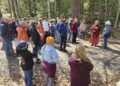
![Mi’kmaw leader Rita Smith ‘saw something that needed to get done and she did it’ [video]](https://nbmediacoop.org/wp-content/uploads/2026/04/image-1-scaled.png)
Innovative historical research on Mi’kmaw communities, done with Indigenous protocols in mind, sheds light on women’s roles in founding Mi’kmaw communities.
Mi’kmaw historian Mercedes Peters visited Fredericton on April 10, 2026, to give a talk about treaties and the founding of her First Nation.
Born in Mehnakwesk (Saint John), Mercedes Peters is a Mi’kmaw woman and a band member of Glooscap First Nation. She is a PhD Candidate in History at the University of British Columbia where she studies the importance of Mi’kmaw women’s community care work to the assertion of Mi’kmaw nationhood. Peters also works as the Sharing Our Stories Director at the Mi’kmawey Debert Cultural Centre.
Peters is functioning in an academic field —History— that has strict rules of objectivity, and she is changing the field through her approach to her work. As a Mi’kmaw woman, Peters said: “I have to be visible in my research” because Indigenous “knowledge cannot be shared without relationship.”
Furthermore, Peters is shaping her original research around “a series of doings” since Mi’kmaq is a language is structured around verbs. Instead of centering on one moment the founding of the First Nation, her research will elude chronological history and “make sense to Mi’kmaw people,” whose conception of history is not a straight line.
Peters’ talk was about the tremendous impact of Rita Smith, “a founding figure” of Glooscap First Nation, but also a renowned basket maker and community builder. Peters focused on Smith’s basket-making and leadership.
A traditional skill of the Mi’kmaq for centuries, basket making was a specialty of the Smith family. They made apple baskets for Scotian Gold, the leading apple production company in Nova Scotia, and also exported them internationally.
“They were so good at it that Sesame Street (…) featured them on the show,” said Peters. This is a skill that is passed on through generations: “the talent in this family is unimaginable,” noted Peters.
Smith was the first woman to have been Chief of two First Nations, Annapolis Valley and Glooscap (formerly known as Horton). The Mi’kmaq have dwelt in the area for many centuries and Peters added: “the only reason we’re celebrating 42 years this year is colonialism but more specifically Indian Affairs policies in Nova Scotia.”
Peters outlined the formation of the current First Nations associated with Rita Smith. This stems from a 423-acre parcel of land bought by Silas Rand, a missionary and so-called “ethnologist” who collected oral legends from the Mi’kmaq and developed early dictionaries. Peters explained that, despite reservations about non-Indigenous people preserving Indigenous oral narratives, “we have to thank Rand for preserving a lot of these stories.”
Smith was able to make change in her community because, according to Peters, “she had help because she had built relationships.” Smith’s relationships with her neighbours but also with people like Daniel Paul, author of We Were Not the Savages (1993), who worked in government at the time, were crucial to her activism.
For Peters, the founding of the community was “an act of traditional Mi’kmaw governance.” Smith was a community-builder: “she drove and she visited (…) she was achieving consensus,” even from people who were not allowed by the Indian Act to vote.
For Peters, Rita Smith is “not gone (…) but I was going to have to hear from her, through generations that followed her.” However, Peters found an interview from 1982 that confirmed things that she had heard from Smith’s descendants.
Smith’s life lesson to her community and family is: “if something is worth doing, it is worth doing right.” Peters mentioned the use of “mothering” as a way of defining the work that Rita Smith did: advocating, basketmaking, founding a community, fighting for a home that would become a band office later on. Peters concluded: “Mi’kmaw women [are] the backbone of Mi’kmaw nationhood.”
Mercedes Peters’ conference was sponsored by the Atlantic Canada Studies Centre and the UNB Faculty of Arts.
Peters gave the talk in the Alden R. Clark Theatre of Fredericton’s Sports Hall of Fame, where her father, basket coach Jason Peters (deceased in 2022), was inducted in 2024. Jason Peters was a pioneer for Indigenous involvement in sport in the province.
Sophie M. Lavoie is a member of the NB Media Co-op’s editorial board. Videography by Livia Steeves.



![Massive increase in military spending imposed by U.S. with little media pushback [video]](https://nbmediacoop.org/wp-content/uploads/2026/10/AlexCoshSept232026-120x86.jpg)