New Brunswick’s economy has long centered on resource extraction. Timber, mining, and oil and gas, significant contributors to the province’s GDP and exports, are all industries heavily supported by the public through provincial and federal tax breaks and direct subsidies.
While social movements and creative thinkers around the province are strategizing alternative means of economic life, generations of Liberal and Progressive Conservative governments and industry leaders have tied the New Brunswick economy to an extractivist model of development, especially in rural areas. To support this model, governments prioritize mining, drilling, quarrying, clearcutting and transporting natural resources over other forms of economic activity such as community-based local development initiatives.
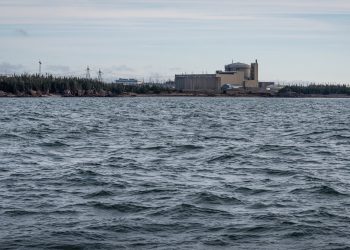
The community of Belledune in rural northern New Brunswick, which boasts a lead and zinc smelter, a phosphoric acid factory, a coal-fired power plant and a large port for exporting resource products is exemplary of this model. The NB Power Belledune Generating Facility is the last coal-burning power plant in New Brunswick. According to information received by Colombian solidarity activists from NB Power in 2016, it sources its coal from two mines in Colombia owned by Glencore PLC, a multinational company that also owns the smelter in Belledune through its subsidiary Glencore Canada. When workers at the Belledune smelter went on strike on April 24, Glencore locked them out.
Tracy Glynn, a NB Media Co-op board member and doctoral researcher with the RAVEN project at the University of New Brunswick, has worked with mining-affected communities and solidarity networks for two decades. Glynn is part of efforts to end NB Power’s reliance on “blood coal” from Colombia.
Blood coal is mined in a way that is extremely harmful to the workers and communities near the mine. Social movement groups in both New Brunswick and Colombia have asked NB Power to join communities and workers to put pressure on its coal supplier to comply with environmental, labour and safety standards. NB Power has twice written letters to the President and CEO of Cerrejón, asking the company to comply with such standards.
“NB Power sources coal from two Glencore-owned mines in Colombia that are implicated in numerous human rights and labour violations and environmental degradation,” says Glynn. Glencore is a primary shareholder (along with BHP and Anglo-American) and operator of the Cerrejón mine, an open-pit coal mine in La Guajira and La Jagua mine which together supply most of NB Power’s coal.
“Indigenous Wayuu children living in the vicinity of those mines are dying in the thousands because of lack of access to clean drinking water, food, health care and housing,” according to Glynn. “Numerous human rights organizations blame the water and food crisis on the Cerrejon coal mine.”
Glencore employs Colombian paramilitary groups, local death squads, as security for the mine and supports paramilitary groups across Colombia with finances, equipment, and intel, according to the NGO Pax for Peace. A representative of the Wayuu accused Colombian paramilitaries, including those charged with Cerrejón mining security, of forcibly driving the Wayuu off their land in a “massacre.”
“Glencore, one of the largest mining multinationals in the world, has a track record of harming workers and communities around the world,” says Glynn. Glencore has a history of bribery and tax evasion in the United States and Australia, and has been accused of practicing slavery in the Democratic Republic of Congo, and is considered by American intelligence services to have been a significant player in kickback schemes to acquire oil assets in Saddam Hussein’s Iraq during the UN oil-for-food programme in the 1990s.
Alain Deneault, a New Brunswick-based public intellectual and the 2015 NB Media Co-op AGM keynote speaker, has analyzed Canadian mining companies and corporate tax avoidance. His book Imperial Canada, Inc. notes that Canada is a “legal haven of choice” for transnational mining corporations and that Canadian law and public policy gives mining transnationals an incentive to register in Canada by providing protection from prosecution and taxation in the countries where their mines operate.
The NB Media Co-op has reported extensively on the situation around Cerrejón, including the strikes organized by the SINTRACARBON, the union representing the coal mine workers, as well as the Maritime visits of Colombian union activists such as Francisco Ramirez and Jesus Brochero. Safety concerns have been important motivators for the worker strikes.
Similar to the communities near Belledune, the communities affected by corporate resource extraction in Colombia are rural communities, which often bear the brunt of the effects of climate change and environmental degradation. SINTRACARBON has worked to bring forward community concerns and interests in their bargaining with Glencore in Colombia.
Colombia is one of the most dangerous countries in the world to be a labour or environmental organizer. Ramirez has personally survived at least eight assassination attempts since he helped unionize Cerrejón, and recent negotiations between the government and the communist FARC guerrillas have made the situation for social activists worse, rather than better. Despite these deadly conditions, many social movements have mobilized for a fairer Colombia. Last month, more than one million workers from the Central Union of Workers, SINTRACARBON’s national affiliate, went on strike for an alternative development strategy which would protect workers, communities, and the environment.
In addition to mounting ethical and labour concerns, the Conservation Council of New Brunswick stated recently that New Brunswick needs a viable plan to phase out coal and other carbon-intensive energy sources. NB Power has stated that it plans to phase out coal by 2030.
In the Belledune region, local communities are developing green alternatives for sustainable economic development, such as La Barque in Pointe-Verte, a community co-operative with more than 600 members. The UNB RAVEN project is currently working with a local video production company based in La Barque to explore how these kinds of local projects can be supported through research and the production of alternative news and digital media.
Abram Lutes is an environmental action reporter with the RAVEN project Summer Institute and a member of the NB Media Co-op board of directors.
![NB Update: What comes after the crisis in local journalism? [video]](https://nbmediacoop.org/wp-content/uploads/2025/06/LabourUpdateApr132025-350x250.jpg)