

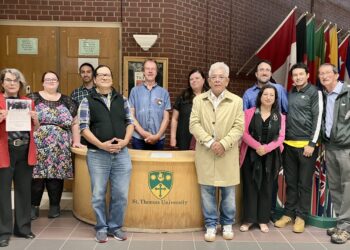
Pamela George’s presence haunted the room through a beautiful red dress hanging to the left of the panelists during the event commemorating the life of this mother and poet senselessly murdered. The almost 100 participants had heeded the organizers’ call to wear red to at the event to remember her.
Hosted on Saint Thomas University (STU) campus, the commemoration held January 22, was emceed by STU student Justice Gruben. Wolastoqewi Grand Chief Ron Tremblay welcomed everyone to the event.
Keyaira Gruben, mother and STU social work student, is an elected band councillor in her community of Kingslear, the youngest woman to ever have this role in her community. Gruben shared a bit of the history of colonization and Pamela George’s story: “a 28-year-old mother doing what she had to do to provide for her kids” while perceptions of her in court completely “dehumanized” her.
STU Criminology professor Josephine Savarese, one of the organizers, had received Pamela George’s family’s blessings to hold this event and reminded participants that “they will never forget what happened on April 18, 1995.”
George’s killers only served 40 months of what should have been a 12-year sentence. For Gruben, George’s case signifies the “failures of the justice system in protecting our women” and is representative of the “lack of recognition of sex work in country.” Gruben deplored “the normalization of the silencing of her death” since it happened in 1995, especially when “our [Indigenous] women are targeted.”
Ramona Nicolas, Kcihcihtuwihut/Knowledge Keeper based at the Mi’kmaq Wolastoqey Centre at UNB fittingly opened the event by singing the “Strong Women Song.” Nicolas said that “as Indigenous women, all women, we read about this and don’t realize how close to home these issues are.” Many cases remain unresolved in New Brunswick and the recent report into missing and murdered Indigenous women and girls made 231 recommendations for action that have yet to be acted on by the provincial government.
Tremblay acknowledged “the other missing and murdered throughout this continent” and emotionally reminded participants that many of the missing and murdered Indigenous women were subjected to sexual violence before they were killed. Tremblay prayed “for the safety” of women and, as the granddad to many grandsons, he “urges everyone to teach boys about respect.” Justice Gruben echoed Tremblay’s comments and cautioned that “as Indigenous men, we really have to watch ourselves,” and lead by example.
Making a parallel, Miigam’agan, STU Elder-in-residence, warned that “we are killing our first mother,” referring to mother earth. For her, the roots of reconciliation are embedded in dynamic traditions that need to be maintained and cultivated: “our language is not sexist, not racist, it’s multidimensional (…) very much alive and we draw on it to learn how to live with each other.”
At institutions of higher learning, K. Gruben deplored the fact that many students “feel like they don’t belong” and suffer from imposter syndrome outside of their communities, which makes access to things like education very complicated. Many students don’t drop out, they are pushed out of the educations system. For her, “lifting up Indigenous men and women” in educational institutions is crucial.
Nicole O’Byrne from UNB Law was a student in Regina in 1995 when Pamela George was killed. She stated emphatically that Canadian society had to move forward because “we can’t rewrite that history.”
Instead of going through the terrible details of George’s killers’ trial, O’Byrne asked herself “How do we actually live together?” For her, this was something that essentially was written into the Treaty documents: “we need to go back to the original text and spirit of the Treaties” which “shows us a way forward” in a Nation-to-Nation relationship. For O’Byrne, the only thing missing to making a positive change is “our political will.” When members of the public brought out the inherent racism of the existing systems, O’Byrne conceded that the “criminal justice system needs to be completely overhauled” in order to include Treaty rights.
Both Gruben siblings emphasised the significance of the recent movement to stop one of George’s murderers from reading his poetry at an event at the University of Saskatchewan. UNB History professor Erin Morton, one of the first signatories to the petition started by University of Saskatchewan Cree scholars to stop the reading, was present at the commemoration. She said “it’s important to remember that families are grieving their losses for a long time” and cautioned that “it’s not [White academics’] role to tell these stories.”
To close the event, local poet Chevelle Malcolm read a beautiful original poem written in honour of Pamela George, repeating the verse “what do we all have in common, human to human.” The lovely red dress made by Myoung Kim of Kim’s Needles will hopefully serve as a reminder of all the Pamela Georges that we have lost.
Sophie M. Lavoie is a NB Media Co-op editorial board member and writes on arts and culture for the NB Media Co-op.



![University security closely monitored pro-Palestine activists, documents show [video]](https://nbmediacoop.org/wp-content/uploads/2024/11/20231129_131826-120x86.jpg)

![Amid push for ‘nation-building projects,’ critics warn of ecological devastation [video]](https://nbmediacoop.org/wp-content/uploads/2026/10/MineBabyMineSept242026-2-120x86.jpg)
