![Destructive storms like Hurricane Fiona could happen annually by 2100, climate modelling shows [video]](https://nbmediacoop.org/wp-content/uploads/2024/01/CoastalJan252024.jpg)
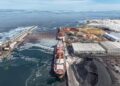
Concerned residents gathered in Shediac recently to learn about how rising sea levels and coastal erosion contribute to the risk of disastrous flooding in southeast New Brunswick.
The risks were vividly illustrated by a computer rendering showing the effects of a potential “100-year storm” by 2030.
Several stretches of road in Pointe-du-Chêne were outlined in red, marking them as unpassable. Several roadways were marked in orange and yellow, marking them as dangerous or difficult, respectively.
In Pointe-du-Chêne alone, 51 buildings could experience “maximum damage,” said Meher Chelbi of the company 2Pixels Geomatics.
In that extreme scenario, water levels would reach 2.6 m. That’s 50 cm higher than levels recorded in the Shediac area during Hurricane Fiona, which damaged hundreds of homes in New Brunswick when it struck in September 2022.
Data from the Pointe-du-Chêne tidal gauge station indicates that the maximum water level reached 2.1 metres at that time.
But as the global climate crisis causes sea levels to rise, storms like Hurricane Fiona will become increasingly common, potentially once every 10 years by 2050 or annually by 2100.
And a storm with water levels reaching 3.1 m could occur once every 20 years by the end of the century, potentially affecting more than 1,700 buildings in the Shediac area alone.
Chelbi presented the information — along with Dominique Bérubé, a coastal geomorphologist with the provincial government — as part of a series of public meetings organized by the New Brunswick Environmental Network.
Data illustrating worst-case scenarios should inform decision-making in fields such as land management and emergency response planning, Chelbi said.
Some area residents said government officials are doing too little to address the effects of climate change on coastal communities.
“They’re still authorizing buildings in areas that are extremely vulnerable,” said Arthur Melanson.
He’s vice-president of the Red Dot Association, a group of that promotes environmental protection of local coastal and wetlands area. “Where’s the common sense from government?” he asked.
Donald Alexander, president of the Southeastern Anglers Association, also expressed concern about new construction, including septic systems, in vulnerable areas, saying it would cause “all kinds of problems.”
His group has taken on restoration projects to help prevent erosion and flooding.
Jolyne Hebert, manager of the Shediac Bay Watershed Association, said updated climate change models can be overwhelming but that local decision-makers must consider the information carefully.
She added that major storms tend to serve as a “wake-up call” but the effect tends to be temporary. Hurricane Fiona, however, seems to have left a stronger impression on people, she said.
“It’s good to see that there’s still so much interest in the topic of how to adapt,” she said.
David Gordon Koch is a journalist with the NB Media Co-op. This reporting has been made possible in part by the Government of Canada, administered by the Canadian Association of Community Television Stations and Users (CACTUS).

![Photo exhibit shows dangers faced by journalists, daily struggle to survive in Gaza Strip [video]](https://nbmediacoop.org/wp-content/uploads/2026/10/RizekExhibitOct222026-5-350x250.jpg)
![Is a Moncton company helping to build jet fighters bombing Gaza? [video]](https://nbmediacoop.org/wp-content/uploads/2024/06/ApexMay192024-350x250.jpg)
![Massive increase in military spending imposed by U.S. with little media pushback [video]](https://nbmediacoop.org/wp-content/uploads/2026/10/AlexCoshSept232026-350x250.jpg)
![Amid push for ‘nation-building projects,’ critics warn of ecological devastation [video]](https://nbmediacoop.org/wp-content/uploads/2026/10/MineBabyMineSept242026-2-350x250.jpg)