![‘Continuum of genocide’: Pentagon funding of Sisson mine provokes renewed opposition from Wolastoq Elders [video]](https://nbmediacoop.org/wp-content/uploads/2025/07/SissonJuly3020252.jpg)
When news broke earlier this year that the U.S. Department of Defence had awarded $20.7 million to Northcliff Resources for its controversial Sisson mine project in the Upper Nashwaak River area, it came at an odd time in the history of Canada–U.S. relations.
President Donald Trump had been openly musing for months about annexing Canada, while also launching a trade war based on bogus claims about a crisis at America’s northern border.
Those events fuelled calls from Canadian politicians and business interests for the rapid development of natural resource projects, with some arguing that it would help Canada secure its economic independence from the U.S.
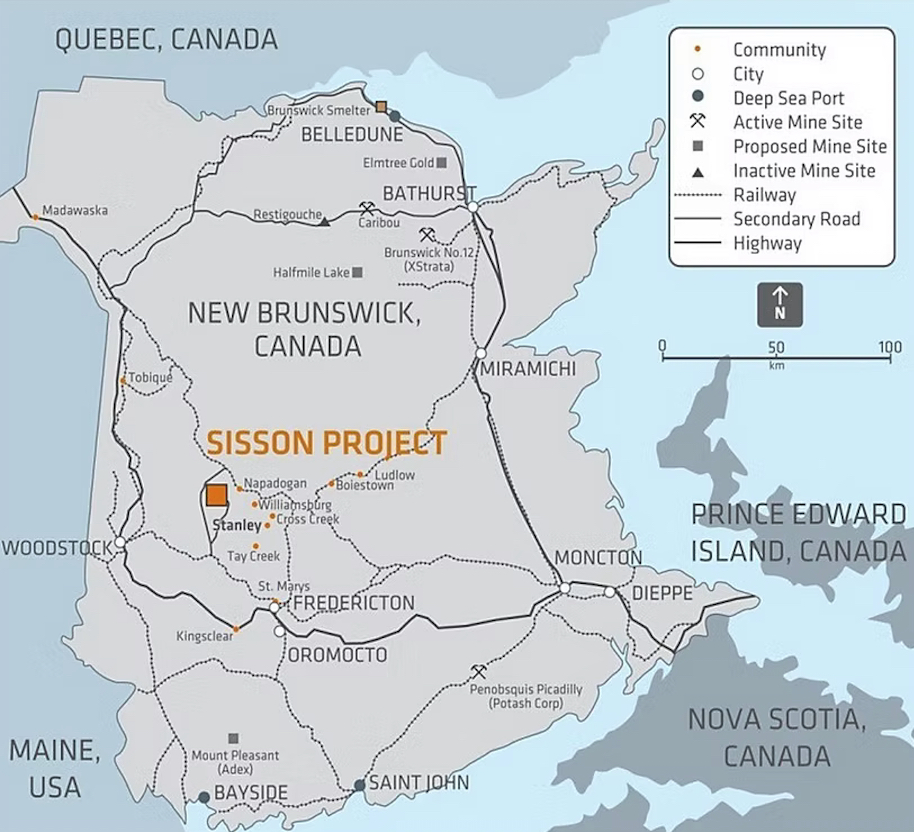
Against this backdrop, the idea of a Canadian mining company partnering with the U.S. military establishment to develop an open-pit mine 60 kilometres northwest of Fredericton might have seemed like a remote possibility.
And yet, Northcliff Resources announced in May that the U.S. Department of Defence had awarded the company $20.7 million “to accelerate development of the Sisson critical minerals project.” The Vancouver-based firm — which is majority-owned by Todd Minerals of New Zealand — said the funds were for activities including an updated feasibility study and “pre-construction work programs,” awarded under the U.S. Defence Production Act. The Government of Canada chipped in another $8.2 million in “conditional funding.”
The proposed mine will “help address the demand for tungsten and molybdenum,” two minerals that “play a key role in many defence and aerospace applications,” the statement explained, adding that China currently produces about 80 per cent of the world’s supply of tungsten.
The news has provoked indignation from Indigenous Elders who oppose the project, including Wolastoq Grand Chief Ron Tremblay. The Wolastoqey Grand Council represents a traditional governance structure with a grassroots constituency.

Tremblay — also known as Spasaqit Possesom or morningstar burning — said it was ironic to see the partnership taking shape amid calls for Canada to divorce itself economically from the United States. “It’s just one of those head-scratching situations,” he said in an interview with the NB Media Co-op. “That’s like getting back together with your abusive spouse.”
Tungsten carbide is known for its hardness, and its military applications include armour-piercing ammunition. Tremblay said the Wolastoq Grand Council rejects activities contributing to war and what he called the “continuum of genocide” in places such as the Gaza Strip and the West Bank. “We oppose war and we oppose supporting the construction of weaponry,” he said.
Alma Brooks, a Wolastoq Elder, said news about the Department of Defence backing the Sisson mine only hardened her resolve to see the project scrapped. “I am absolutely and totally against anything that would support the United States or Canadian military in their war efforts,” she said in an interview.
In particular, she pointed to Israel’s prolonged and devastating U.S.-backed assault on the Gaza Strip, “a genocide that’s happening right under the nose of the world,” she said.
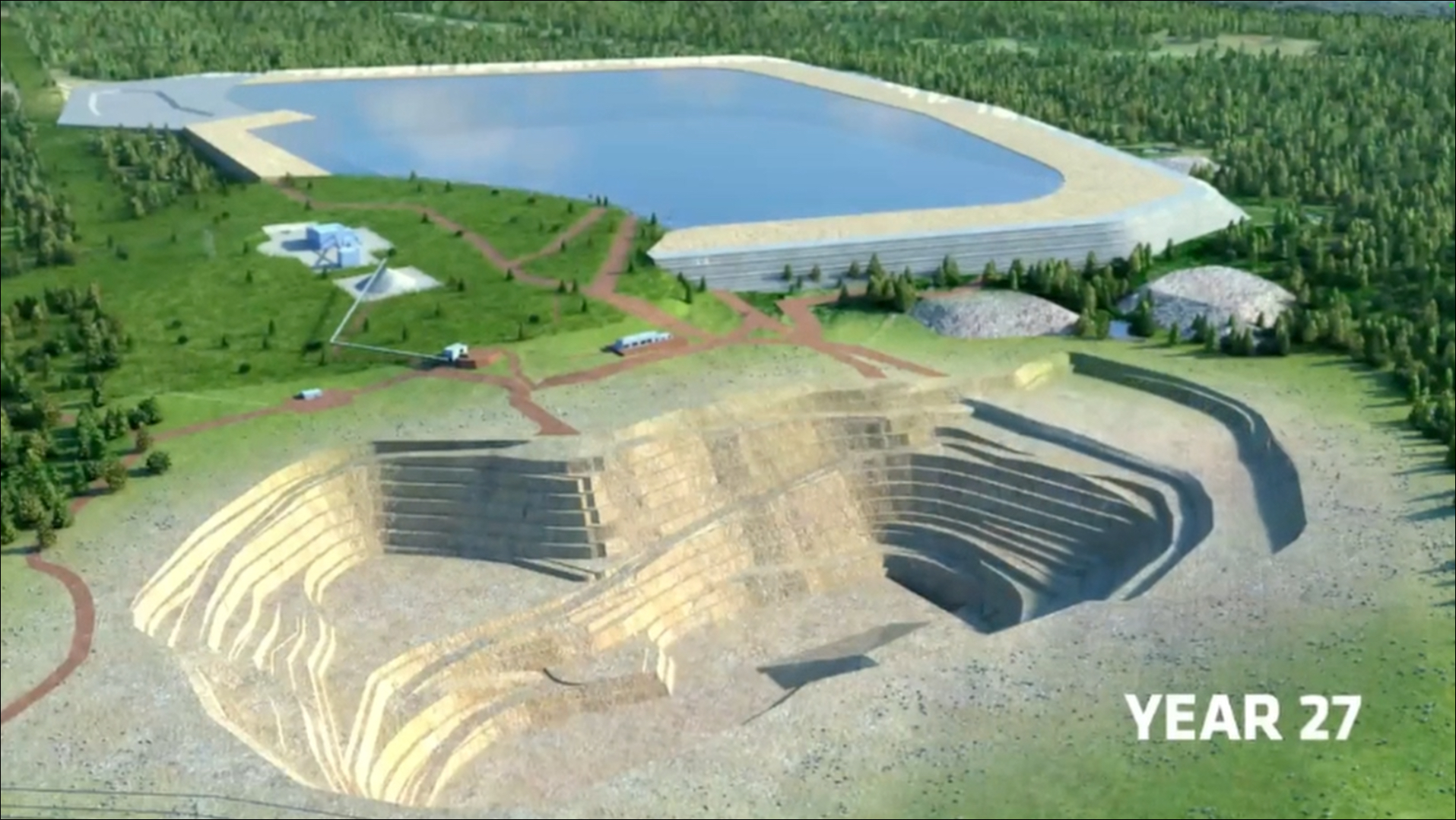
Tremblay and Brooks are among the Wolastoq Elders who have long pushed back against the planned open-pit mine in the name of protecting unceded Indigenous land and water. The greatest concern for many who oppose the Sisson project is the possibility that its massive tailings dam will breach, devastating the watershed, like the 2014 Mount Polley disaster in B.C.
“I am a water protector, a grandmother, and most of my teachings are about the sacredness of water, and so I have a responsibility to speak out and protect the water, the giver of life,” Brooks said.

A spokesperson for the Sisson Partnership didn’t respond to a request for comment by publication time. The company received environmental approvals from the provincial government in 2015 and from the feds in 2017, subject to the company meeting certain environmental conditions. The company has big money riding on the project, having spent $70 million on it so far, according to its own numbers.
The project has reportedly stalled due to a lack of financing and low tungsten prices. But more recently, tungsten prices have climbed as China has restricted the supply in response to U.S. tariffs.
The Sisson project’s website presents a relatively sunny picture of its relations with Indigenous communities, noting, for example, a 2017 cooperation agreement with Woodstock First Nation. That year, all six Wolastoqey First Nations also signed an “accommodation agreement” with the province, providing them with a share of future revenues.
But five of the chiefs have reportedly stated that they oppose the project and felt coerced by the Liberal government of the day into signing the agreement. The website for Wolastoqey Nation in New Brunswick, an advisory body for the six communities, criticizes the Sisson mine, saying it “poses a risk to water cleanliness and fish-bearing brooks in the proposed mine location.” None of the six chiefs could be reached for comment by publication time.
Earlier this year, Tremblay met with Premier Susan Holt, along with the Ministers of Natural Resources and Indigenous Affairs, to discuss “concerns about resource development within our homeland,” he said.
The Grand Chief later received a letter from Premier Holt, dated May 26, telling him that development of the Sisson project “involves a rigorous environmental assessment review and numerous permitting steps before any mining operations begin.”
The letter goes on to indicate that formal consultations won’t involve the Grand Chief.
“As per [the Department of Indigenous Affairs’] contact protocol, which is informed by and consistent with decisions of the New Brunswick courts, we have and will continue to consult and engage in dialogue with the six Wolastoqey Band communities as represented by their Chiefs and Councils, with respect to all mining in the province including Sisson,” Holt stated, in part.
That’s an apparent reference to 2019 ruling in which a New Brunswick judge dismissed complaints from the Wolastoq Grand Council about a snowmobile hub project, saying the council had no legal standing for consultation.
Holt, in her letter, added that the Grand Chief should convey any concerns to the six recognized bands. Tremblay said that contradicts other messages he’s received from the government. “She promised or guaranteed us that we’ll be sitting at the table,” he said.
He stressed that the Wolastoq Grand Council is an independent body that will decide for itself what “true consultation” involves, adding that they receive no government funding. “We’re sovereign so they cannot control us or threaten us to hold any funding back.”
The province didn’t make anyone available for an interview. Following the publication of this article, a government spokesperson provided a brief statement attributed to Keith Chiasson, Minister of Indigenous Affairs. “We value the Grand Council’s feedback and trust that their perspectives are incorporated in the feedback we receive from the six Wolastoqey nations,” Chiasson said, in part. He also said talks continue with the six bands.
“Extensive consultation began in 2012 and there has been an ongoing dialogue with First Nations regarding this project,” he said. “This file remains active, and I’m always open to having discussions with First Nations.” He added that the provincial government “is committed to providing updates concerning this project as new information becomes available.”

Natural Resources Minister John Herron recently met with the Peace and Friendship Alliance — a coalition of Indigenous people and settlers aiming to uphold the treaties signed in the mid-1700s — where the Minister spoke about the Sisson mine project.
Chief Tremblay, who was at the meeting, commended Herron for showing up, but took issue with some of his remarks, particularly on the matter of Indigenous consent. “He clearly stated in one of his responses that we don’t have a veto,” Tremblay said.
Tremblay maintains that free, prior and informed consent is required for the Sisson mine project under the UN Declaration on the Rights of Indigenous Peoples. Canada has endorsed UNDRIP and implemented it into federal law. However, new legislation meant to fast-track projects deemed to be in the national interest — yet another response to the U.S. trade war — appears to threaten those efforts.
Brooks also attended the Peace and Friendship Alliance meeting. Her assessment of the Minister’s remarks was blunt: “He just rattled on about nothing.”
Shortly after news broke about U.S. Department of Defence involvement in the Sisson mine project, the NB Media Co-op asked Premier Susan Holt to respond to the Wolastoq Grand Chief’s concerns. “I think Grand Chief Tremblay’s concerns about the U.S. Department of Defence’s role in the Northcliff project are valid,” she told reporters during the news conference.
But more generally, the Premier has touted the presence of critical mineral deposits in New Brunswick, including those at the Sisson mine site. “Canada has identified 34 critical minerals,” she proclaimed during a speech at the Canadian Club Toronto in April. “Twenty-one of them exist in New Brunswick, and many of those undeveloped, ready to be tapped into.”

During that speech, she appeared to suggest that the Department of Defence’s interest in critical minerals could serve as a bargaining chip in talks with the Trump administration. “It gives us interesting leverage in the situation that we’re in right now,” she said, adding: “I asked myself if I could get through the speech without using the T word.”
She also told the Toronto crowd that her government is “building fundamentally new and respectful relationships with First Nations,” an approach she said “was desperately needed” following the Conservative government of Blaine Higgs, which saw relations with First Nations deteriorate. “We have First Nations at the table ready to partner,” Holt said.
However, Brooks, the Wolastoq Elder, said the Sisson project will likely face resistance if it goes forward. Wolastoq grandmothers and others have maintained a presence at the site of the proposed mine for years, even building off-grid cabins, although a court injunction barred them from interfering with Northcliff’s work. “I think there’s people that are still there,” Brooks said.
Fundraising is currently underway for the camp, according to the Facebook group for the grassroots group called Connecting to the Land. That group confirmed that Nick Polchies remains on the land at the Sisson camp.
Brooks said meetings are taking place with concerned residents in the Nashwaak River area. “That would be the next step,” she said. “To try to build that alliance and make the alliance stronger.”
-With an interview by Anna-Leah Simon
This article was updated at 7 p.m. on July 29, 2025 to include a response from the Department of Indigenous Affairs. It was updated again at 2:50 p.m. on July 30, 2025 with video and additional reporting.
David Gordon Koch is a journalist with the NB Media Co-op. This reporting has been made possible in part by the Government of Canada, administered by the Canadian Association of Community Television Users and Stations (CACTUS).


![Is a Moncton company helping to build jet fighters bombing Gaza? [video]](https://nbmediacoop.org/wp-content/uploads/2024/06/ApexMay192024-350x250.jpg)
![Massive increase in military spending imposed by U.S. with little media pushback [video]](https://nbmediacoop.org/wp-content/uploads/2026/10/AlexCoshSept232026-350x250.jpg)
![Amid push for ‘nation-building projects,’ critics warn of ecological devastation [video]](https://nbmediacoop.org/wp-content/uploads/2026/10/MineBabyMineSept242026-2-350x250.jpg)