

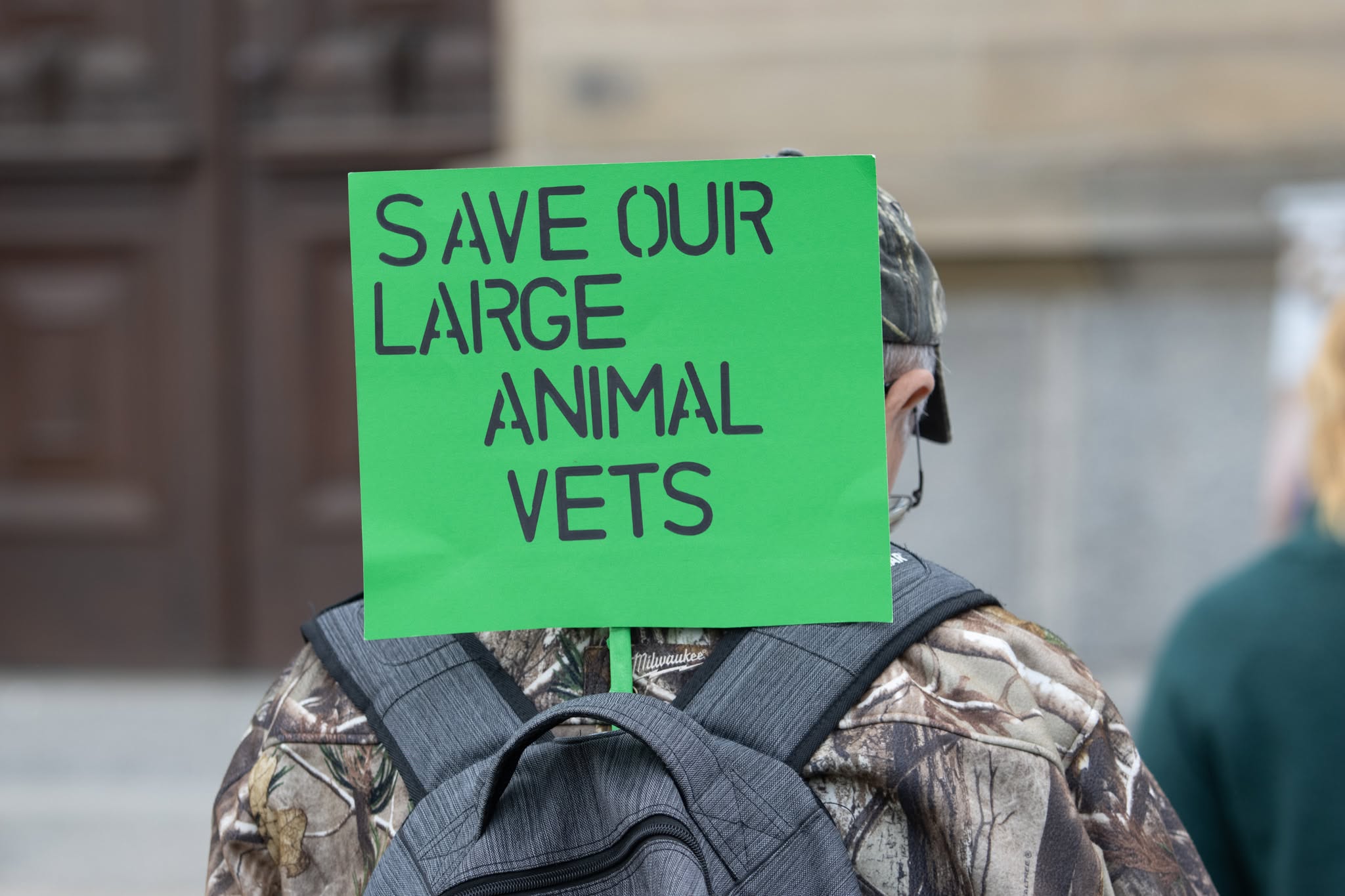
Farmers brought their tractors to Fredericton on June 3 to demand an independent review of a decision that would eliminate provincial veterinary field services and close New Brunswick’s animal disease laboratory.
Farmers, veterinarians, lab workers, the SPCA, a former premier, and more than 31,000 signatures have spent three months saying why the decision must be reversed. The government has yet to put forward a coherent rationale for the cut.
Eleven weeks ago, the Holt government announced through a budget memo that it would close the provincial veterinary and animal disease laboratory and phase out provincial field veterinary services. Since then, an unusually broad coalition of New Brunswickers has told the government, in detail, why the decision is wrong. The government has yet to put forward a detailed public business case that answers the concerns raised by farmers, veterinarians, animal welfare organizations, and laboratory staff.
The Agriculture Minister has offered fragments. A saving of about $4 million a year against a deficit calculated in the billions. Most service calls are for companion or hobby animals. Other provinces use private veterinarians.
None of these has been developed into an explanation of why the system that supports a growing agriculture sector at record exports and record farm cash receipts is the place to find that saving.
The Minister’s written response to a petition tabled in the legislature describes a registry that “will be developed” and a feasibility study that “will be conducted.” A registry to be developed and a study to be conducted are descriptions of process, not a rationale for the decision.
At a May 1 meeting between the Agricultural Alliance of New Brunswick, the Minister, and Premier Holt, the government brought no new information. The Alliance issued a public statement afterwards saying the department “did not seek meaningful input” and that the process “does not reflect genuine consultation.” It has since walked away from the monthly meetings the province offered, and will not return until clear answers and a credible plan are produced.
Outside the government, the response has been loud and unified.
The Agricultural Alliance of New Brunswick, which represents twelve livestock associations, opposes the cut. So do the New Brunswick Cattle Producers, the National Farmers Union, and the Dairy Farmers of New Brunswick. The New Brunswick Veterinary Medical Association has filed public objections, as has the New Brunswick Union, which represents the workers at the provincial veterinary laboratory. The New Brunswick SPCA, which uses the lab for the necropsies that underpin its cruelty prosecutions, has said the cut undermines its ability to enforce the law and has flagged five active court cases. The Professional Institute of the Public Service of Canada has launched an ad campaign challenging the rationale. The Progressive Conservative Official Opposition has called it a devastating blow, and former PC premier David Alward, a cattle farmer himself, joined protesters at the legislature in May. More than 31,000 people have signed a petition to reverse the decision, most of them from within New Brunswick. Farmers have rallied at the legislature three times, including the rally planned for June 3.

Their opposition is grounded in specific reasons. The Veterinary Medical Association has pointed out that disease surveillance depends on accredited diagnostic capacity, which mandatory federal reporting does not replace. A veterinary pathologist familiar with the facilities has explained that the proposed alternative, the Research and Productivity Council, is principally an analytical laboratory and lacks the staff, expertise, and certifications to take on veterinary diagnostic work within the timeline the government has set.
The New Brunswick Union has flagged a conflict of interest at the centre of the process. RPC is being asked to conduct the government’s feasibility study that will recommend whether RPC takes over the work.
NBU President Susie Proulx-Daigle said “a third party must be brought in,” because the group that stands to gain from the outcome cannot be the one conducting the study.
The Agricultural Alliance and the SPCA have detailed how the cut breaks specific working systems, from rural emergency veterinary coverage to necropsies in cruelty prosecutions. Farmers have explained that the rural large-animal vet shortage is already real and that the province’s plan would deepen it. Every other province operates a public or provincially funded animal health laboratory. New Brunswick would be the only one without.
So the question stands. Why is Susan Holt’s Liberal government not listening?
The Liberals ran on engagement and transparency. The veterinary decision arrived through a budget memo, without consultation. The government has since offered monthly meetings about implementation and commissioned a feasibility study from the body that would benefit if the study says yes.
The Alliance has stopped attending the meetings. The lab workers’ union and the farmers are both demanding the study be redone externally.
On engagement and on transparency, this record fails the standards the Holt government set for itself.
Even Holt’s own cabinet ministers are divided on this issue. The Agriculture Minister defends it. The Natural Resources Minister told a public meeting in Petitcodiac the decision might be delayed or shelved. The Premier confirmed both statements were accurate.
If Holt’s cabinet cannot agree on whether the cut is policy, the government has no business pressing on with it.
This is a government that asked New Brunswickers for their trust and won an election on the promise it would listen to the people. In this case, listening would not require an admission of defeat, only a pause to explain the reasoning, commission an independent feasibility study, and build a real plan with the people whose livelihoods depend on the answer.
Agriculture is one of New Brunswick’s few growth sectors. The cost of getting this wrong would be measured in herds, farms, prosecutions, and public trust.
Support New Brunswick’s farmers: write your MLA, and tell Premier Holt that a decision made without a rationale is not one she has to keep defending.
The chance to get this right is still here.
B.E. Rybak writes “A Letter From A Maritimer” where she offers analysis of Canadian politics and public life, rooted in Maritime perspective and shaped by experience in business, leadership, and service. This piece was first published there on June 3, 2026.
![Pay equity legislation covering private sector, care sector coming next year: Holt [video]](https://nbmediacoop.org/wp-content/uploads/2025/10/PayEquityOct172025-6-350x250.jpg)
![Doctors warn of fracking’s ‘unacceptable health risks.’ Where do the political parties stand? [video]](https://nbmediacoop.org/wp-content/uploads/2024/09/Fracking_Site_in_Warren_Center_PA_08-350x250.jpeg)

![University security closely monitored pro-Palestine activists, documents show [video]](https://nbmediacoop.org/wp-content/uploads/2024/11/20231129_131826-120x86.jpg)

![Massive increase in military spending imposed by U.S. with little media pushback [video]](https://nbmediacoop.org/wp-content/uploads/2026/10/AlexCoshSept232026-120x86.jpg)
