![Student accepted into UNB grad program stranded in Gaza awaiting Canadian study permit [video]](https://nbmediacoop.org/wp-content/uploads/2025/11/BiometricsNov72025-1.jpg)
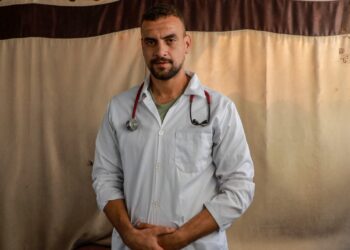
It was a “dream come true” for Baraa, 23, when he learned that he’d been accepted into the Master of Computer Science program at the University of New Brunswick.
He was supposed to begin his studies in September, but instead he remains in a displacement camp in the bombed-out city of Khan Younis, in the southern Gaza Strip.
Baraa faces a dilemma: Canadian authorities won’t issue him a study permit until he submits biometrics — fingerprints and photographs — but to do so he must leave the Gaza Strip, which is virtually impossible without already holding a travel visa.
For now, Baraa’s dreams of higher education are on hold — all universities in the Gaza Strip have been heavily damaged or destroyed, part of a broader pattern that human rights experts call “scholasticide” — and it’s a daily struggle to obtain basic necessities.
“We live with almost no electricity, very weak internet, and constant fear,” he said in an interview through an unstable Wi-Fi signal. The NB Media Co-op has agreed to identify him only by his first name to protect his safety.
“I didn’t go through all this struggle and hard work just to lose my future because of a border,” he said. “I worked on my visa under bombardment.”
He’s not the only one facing delays: more than 130 Palestinian graduate students are awaiting study permits after being accepted into 26 Canadian universities, according to the non-profit Palestinian Students & Scholars at Risk. Some have been waiting since June 2024, according to PSSAR.
Advocates say the delays reflect a lack of political will, and that Canada is discriminating against Palestinian students who have already endured unimaginable hardships, especially during Israel’s two-year assault on the Gaza Strip, a military campaign widely condemned as genocidal.
“We are not asking for sympathy, we are asking for fairness,” Baraa said.
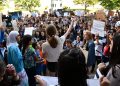
On Tuesday, PSSAR held a news conference in Ottawa with representatives from Oxfam Canada and the Canadian Muslim Public Affairs Council, alongside NDP MP Heather McPherson and Liberal MP Salma Zahid.
They called for the government to “act with transparency, fairness and urgency to process student visas for Palestinian students.”
Watch the full news conference:
Documents reviewed by the NB Media Co-op confirm that Baraa has been accepted by UNB’s School of Graduate Studies, and that Immigration, Refugees and Citizenship Canada received his application for a study permit almost five months ago.
A letter from IRCC dated July 6 instructs him to “go to any Visa Application Centre most convenient to you” to submit biometrics.
A spokesperson for IRCC wouldn’t comment on Baraa’s case, citing privacy legislation, but confirmed in an email that biometrics “can only be completed after people leave Gaza as IRCC has no presence there.”
The statement, attributed to senior communications advisor Matthew Krupovich, said that by the end of October, IRCC was processing study permits applications from 160 Palestinians in Gaza and the West Bank. He said Canadian authorities “do not ultimately decide who leaves” the Gaza Strip.
“Due to factors beyond Canada’s control, leaving Gaza remains extremely difficult, posing a significant obstacle to the continued processing of applications from individuals, including prospective students, currently in Gaza,” he said.
“Each country sets its own entry and exit requirements. We continue working closely with local authorities— at every level —to advocate for the safety of people in Gaza, however we do not ultimately decide who can leave.” (You can read the full statement from IRCC here).
But several countries — including France, Italy, the United Kingdom, and Ireland — have helped students leave the Gaza Strip to pursue their studies, according to Nada El-Falou, director of student services for PSSAR. Earlier this year, CBC reported that several Palestinian graduate students awaiting Canadian visas ultimately went to France.

“We’ve had multiple students who had secured admission in Canada, fully funded,” she said in an interview.
“They were ready to come. They had already waited for months to get their visas. But then they were able to secure scholarships in France as well. And France facilitated their exits within a month.” She said it’s a “huge loss” for Canada when top students ultimately go elsewhere.
It’s also potentially a matter of life and death. Last year, twin sisters Sally and Dalia Ghazi Ibaid were reportedly applying for study permits and preparing to cross the Rafah border when they were killed in an Israeli airstrike. They had been accepted into a PhD program in engineering at the University of Waterloo.
“I don’t want to be the next name on this list,” Baraa said. A ceasefire agreement has been in place since Oct. 10, but there have been almost daily reports of Israeli attacks on the Gaza Strip.
The Israeli military continues to enforce a blockade at the Rafah crossing — the only route into Egypt — and the Gaza Strip is otherwise surrounded by Israel and the Mediterranean Sea. “The borders are all closed to the public,” El-Falou said.
A Canadian study permit alone doesn’t guarantee passage across the heavily militarized perimeter, but advocates say that Canada should be able to intervene like other countries have done.
“The claim that we’ve heard from IRCC or from Canada in general is that they can only evacuate someone who already has a visa,” El-Falou said. “Canada needs to evacuate the students, not only provide them with the visas.”
During Tuesday’s media conference, McPherson — the Edmonton Strathcona MP who is running for the leadership of the New Democrats — called it a case of “political cowardice.”
“The Liberals are not willing to do the political advocacy with Israel to get these students out of Gaza in the same way that other countries around the world have done.”
Zahid, the Liberal MP for Scarborough Centre–Don Valley East, said she had raised the issue with senior officials at IRCC.
“While there is officially a ceasefire, the reality is violence continues and people are still dying in Gaza, she said. “The genocide is happening.”
Aaron Shafer, an associate professor of forensic sciences at Trent University, said that one of his students is a “top scholar” from Gaza City who has waited for more than a year for an update from IRCC.
He said that professors have asked to meet with Minister of Immigration Lena Diab, but instead were granted a 12-minute meeting with IRCC’s director general.
That senior official “delivered one message,” Shafer said: “’No exemptions for Gaza.’ There was no discussion, no rationale, no emotion…. No exceptions for a man-made famine. No exception for genocide.”
But he said students in Gaza don’t want “exceptions or special treatment. All they’ve asked for is fair and due process.”
The problem goes beyond exiting the Gaza Strip.
El-Falou said that even students who have managed to reach Cairo have faced long delays after submitting biometrics. “Some of them have been waiting since May 2024.”
On the other hand, she said that processing time for students in Egypt who aren’t Palestinian is about six to nine weeks. “It’s very clear that this is a discriminatory according to their citizenship,” she said.
Krupovich, the IRCC spokesperson, said the department “is committed to a fair and non-discriminatory application of immigration procedures.” He invoked the need for background checks, a process that he said may involve agencies including the Canadian Security Intelligence Service.
El-Falou called that process a “black box.”
“Whenever we ask what’s happening with the application, they always say, this is not handled by IRCC, it’s handled by third-party organizations.” Otherwise, she said, advocates are met with “radio silence.”
IRCC declined the NB Media Co-op’s request to interview the Immigration Minister.

Palestinian students find themselves stranded at a time when Ottawa has announced drastic cuts to study permits. However, starting in January, graduate students like Baraa will be exempted from the study permit cap.
It’s unclear how much the limits have affected enrolment at UNB.
“UNB is unable to provide comment on student visa applications, as the application process and status are managed directly between the applicant and Immigration, Refugees and Citizenship Canada,” the UNB Media Office said in an email.
Back in Khan Younis, the clock is ticking for Baraa, who still hopes to make it to UNB for the winter semester — and to eventually use his training to help people in Palestine.
“I hope to use what I have learned to help develop the academic and technological fields in Palestine, to rebuild what was lost, and to give a new generation access to better education and opportunities.”
Correction: A previously version of this report stated that many of the 130 Palestinian students awaiting study permits were graduate students; in fact, all of them are or were grad students, according to PSSAR. This report was updated on July 16, 2026 at 1:20 p.m.
David Gordon Koch is a staff reporter for the NB Media Co-op. This report features photos by Rizek Abdel Jawad, a photojournalist from Gaza City. This reporting has been made possible in part by the Government of Canada via the Local Journalism Initiative.
![Is a Moncton company helping to build jet fighters bombing Gaza? [video]](https://nbmediacoop.org/wp-content/uploads/2024/06/ApexMay192024-350x250.jpg)

![Is a Moncton company helping to build jet fighters bombing Gaza? [video]](https://nbmediacoop.org/wp-content/uploads/2024/06/ApexMay192024-120x86.jpg)